22.8% of U.S. employees work remotely at least part of the time, representing over 36 million people (Bureau of Labor Statistics, March 2025).
Hybrid schedules do not hurt productivity. A Stanford study published in Nature found zero negative impact on performance, with a 33% drop in employee turnover.
85% of business leaders struggle to trust that offsite employees are productive, even though 87% of those employees say they are.
Employers save an average of $11,000 per year for each offsite worker.
86% of full-time employees who are fully remote report burnout, signaling that flexibility without boundaries creates new problems.
Nearly 80% of employees who can work remotely now do so at least part of the time. That shift has reshaped hiring, retention, and how companies measure productivity. The remote work statistics behind it reveal far more than most managers realize. We compiled the latest data from leading sources to show where remote work stands today.
The article is prepared by WorkTime, a non-invasive monitoring software that keeps in-office, remote, and hybrid teams productive and engaged.
How many people work remotely in 2026
The work-from-home surge of the pandemic era is over, but the shift it created is permanent. Here is what the latest data shows about the number of people working remotely and where remote work adoption stands today.
1. About 22.8% of U.S. employees work remotely at least partially. That accounts for more than 36 million Americans. This includes 12.3% who telework some hours and 10.7% who telework all hours (Bureau of Labor Statistics, March 2025).
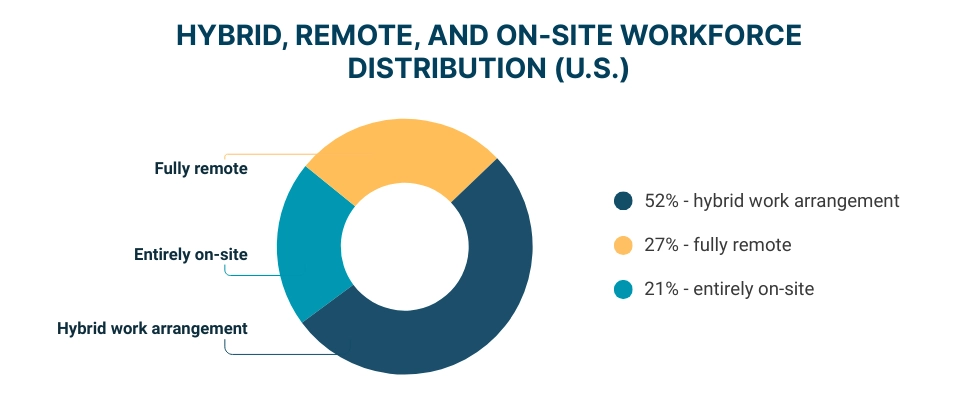
2. Among offsite-capable roles, 52% of U.S. workers split their time between home and office. Another 27% are fully remote. Only 21% of offsite-capable staff are entirely on-site.
3. Around 79% of employees who can work remotely do so at least some of the time. Prior to 2020, fewer than 6% of the workforce had any work-from-home arrangement.
4. Remote work has settled at about 28% of all U.S. workdays. Stanford economist Nick Bloom confirmed this with three separate data sources: surveys, building badge swipes, and cell phone tracking. All three point to the same number.
5. Remote job postings increased 3% in Q4 2025. One study reported this increase, reversing a slight cooling earlier in the year. Research found that 24% of new postings were for hybrid roles and 11% were fully remote across 423,000+ U.S. positions.
6. Nearly 42.8% of employees with advanced degrees work remotely. Education is the strongest predictor of who gets to work from home. Those with a bachelor's degree telework at 37.6%, while those with a high school diploma sit at 9.1% (BLS/Backlinko). ACS data from the American Community Survey confirms that remote workers remain well above pre-pandemic baselines across nearly every metro area.
Monitor remote teams non-invasively!
7. The 35-to-44 age group has the highest percentage of remote workers. Employees in this range are often mid-career, knowledge-based professionals, and many have personal life responsibilities that make flexible work arrangements especially valuable.
8. An estimated 75 million U.S. employees have jobs that could be done remotely. That is 56% of the non-self-employed workforce. Not all of them work remotely today, but the potential for remote work opportunities is enormous.
Remote work productivity statistics
The productivity debate is the most important conversation in remote work. And the data points in different directions depending on which study you read.
9. Hybrid schedules showed zero negative effect on productivity in the gold-standard study. Those working 2 days remotely and 3 in the office matched in-office colleagues on every team performance metric, and turnover dropped by 33%.
10. Remote workers log about one hour less per day than in 2019. Overall, productivity increased slightly during the same period. Removing geographic limits allowed employees to sort into positions better suited to their skills.
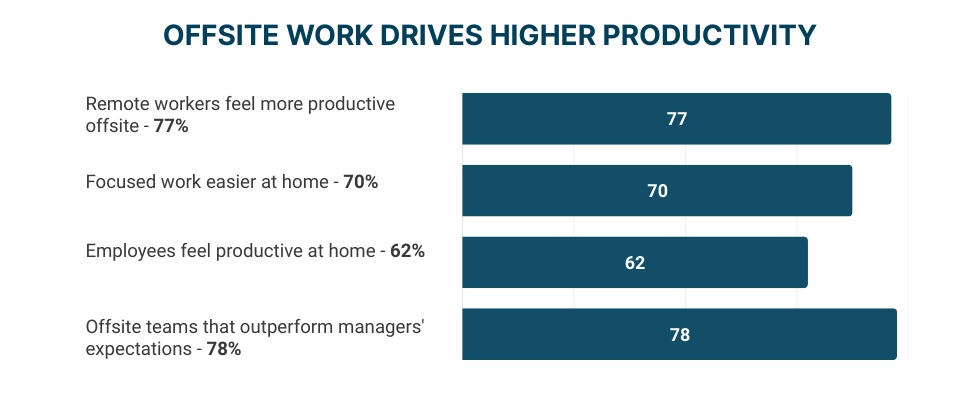
11. Nearly 77% of remote workers say they are more productive offsite. 70% of remote workers say focused work is easier from a home environment, 62% of employees feel more productive when they work from home, and 78% of managers say their offsite teams outperform expectations.
12. Hybrid teams are approximately 5% more productive than both fully remote and fully in-office teams. Research found that well-organized hybrid arrangements can deliver up to a 5% productivity gain, accounting for reduced commute time and focused homework (McKinsey/Stanford). This supports the growing consensus that a hybrid work model is the sweet spot for most companies.
13. An estimated 85% of business leaders struggle to feel confident that offsite employees are productive. Only 12% say they have full confidence. Meanwhile, 87% of those employees report being productive (Microsoft Work Trend Index, 2022). This gap, sometimes called "productivity paranoia," is a measurement problem, not a performance problem. Many employers lack the digital tools to see how things are actually going.
14. Around 88% of remote employees feel they need to prove they are being productive. 64% of employees keep their chat status green even when they are not working. When employees feel watched but not trusted, they engage in productivity theater rather than actual work.
15. A one-percentage-point increase in remote work adoption correlates with 0.08-0.09% higher total factor productivity. Industries with higher adoption saw significant reductions in non-labor costs (BLS, 2024). The solution to this remote work challenge is not more surveillance. It has better visibility. Digital tools like WorkTime's non-invasive productivity monitoring give business leaders the data they need to see real productivity patterns without capturing screenshots, keystrokes, or personal content.
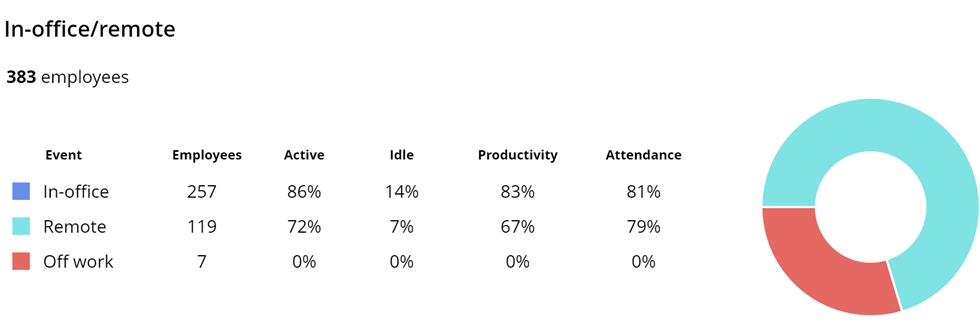
Track and compare employee attendance and productivity across office, home, and remote work settings.
What employees and companies want from flexible work
Understanding what employees and companies want is critical for building a work arrangement that attracts top talent.
16. An overwhelming 98% of workers want to work remotely at least part of the time for the rest of their careers. The desire to work remotely is the strongest signal in all the data.
17. The data shows that 55% of job seekers rank a hybrid schedule as their top choice. Workers split evenly between wanting 1-2 days in the office (28%) and 3-4 days (27%). Only 16% of job seekers say an in-office role is their top choice.
18. Due to the survey, 46% of workers would look for a new job if no longer allowed to work from home. Among fully remote workers, 64% say they would leave if required to return full-time.
19. Remote workers value their work arrangement at the equivalent of an 8% salary increase. Many employees would take a pay cut to keep working remotely. Studies show 37% would accept a 10% pay cut to maintain a work-from-home option.
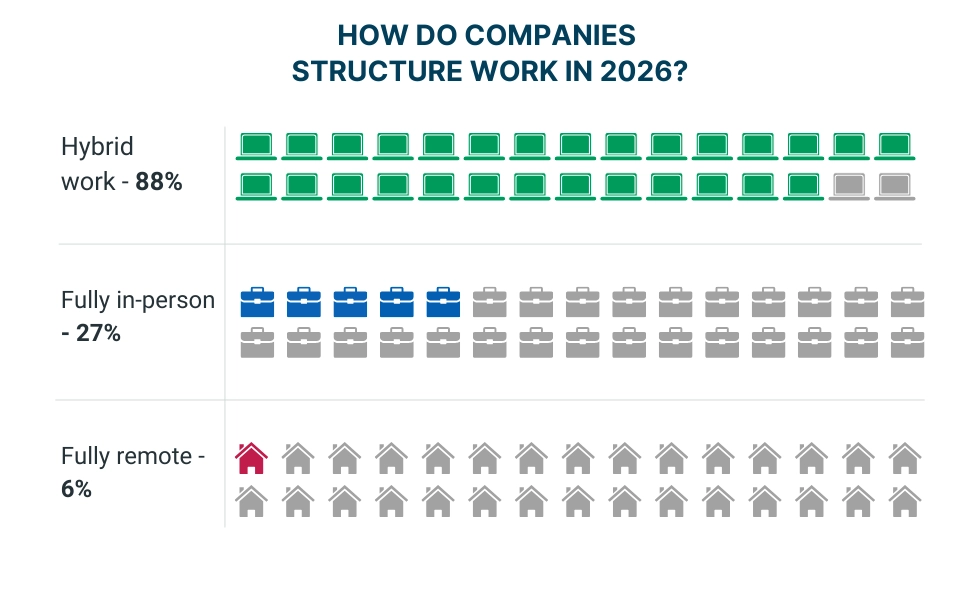
20. Today, 88% of employers offer some form of hybrid work. Most companies have settled into flexible work arrangements. Only 27% have returned to fully in-person requirements, and 6% of businesses are fully remote.
21. Nearly 75% of companies with fewer than 500 employees offer remote or flexible work options. Company size plays a major role. Smaller firms are far more likely to offer flexible positions than large corporations. Only 35% of companies with 500 to 5,000 employees and 17% of large enterprises offer the same flexibility. Many employers who initially resisted flexible work arrangements have come around.
22. About 76% of companies report greater employee retention by allowing remote work. For job seekers in 2026, the message is clear: flexible work arrangements are the expectation. For employers, offering flexible and hybrid roles is no longer optional if they want to compete for top talent.
How remote work affects work-life balance and mental health
One of the strongest benefits of remote work is a better work-life balance. But the data shows both gains and risks.
23. Studies reveal that 79% of remote workers report lower stress levels. Additional data show that 82% of workers report their mental health is better with flexible work, and 76% of those on hybrid schedules cite improved work-life balance.
24. Those who telecommute save an average of 72 minutes per day by not commuting. This time savings has a positive impact on personal life, family responsibilities, and overall well-being.
25. According to recent findings, 86% of full-time employees who work fully remote report burnout. That is higher than the in-office burnout rate. When your home environment is also your office, it is easy to never stop working.
26. Due to the data, 81% of remote workers check email outside of work hours. Additionally, 63% of workers work on weekends, 34% work during vacations, and 47% are concerned about blurred work-life balance boundaries.
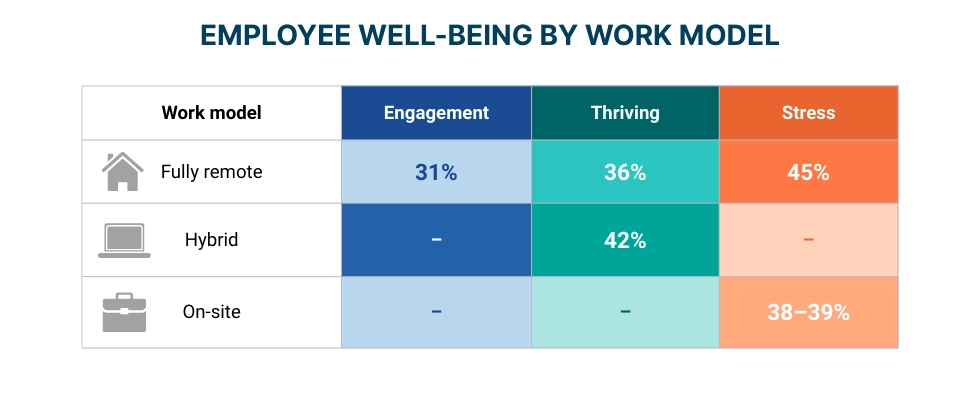
27. Fully remote employees report the highest engagement (31%) but are less likely to be thriving (36%). Those on hybrid schedules report thriving at 42%. Fully remote employees also report higher stress daily (45%) compared to on-site employees (38-39%).
28. Mental fatigue is a growing concern in remote settings. 55% of remote employees say it is hard to feel connected to coworkers. Loneliness affects about 22% and erodes motivation over time. The lack of natural social interaction in the office is difficult to replicate through digital tools and video calls alone.
This is why many employers are turning to tools that can detect burnout signs early. Monitoring patterns in active time, overtime, and work hours can flag at-risk employees before they disengage or quit.
What remote work saves employers and employees
Remote work is not just a perk for employees. It is a financial strategy for employers.
29. Employers save an average of $11,000 per year for each offsite worker. These savings come from lower real estate costs, reduced turnover, and increased productivity.
30. U.S. companies collectively save over $30 billion annually from remote work through reduced real estate, operations, and maintenance. This figure reflects the combined impact of smaller office footprints, lower utility and maintenance expenses, and reduced overhead from supporting fewer on-site employees.
31. Remote workers save between $2,000 and $7,000 per year on commuting, meals, and work attire. These financial benefits are a big part of why so many employees prefer remote work arrangements.
32. Companies with flexible remote work policies experienced 21% higher revenue growth. This held true over three consecutive years compared to those with rigid in-office requirements.
33. Hybrid workers are 33% less likely to quit. Replacing an employee can cost 50% to 300% of their annual salary, so the retention benefits of flexible work often exceed all other savings combined.
34. Remote job postings attract 340% larger candidate pools. They also see 13% higher offer acceptance rates and 16% faster hiring (32 days vs. 38 days). For employers, expanding the talent pool beyond a single metro area is one of the strongest arguments for offering remote roles.
Return-to-office mandates and remote work trends
The biggest remote work trends in 2025 and 2026 center on the gap between RTO mandates and the data.
35. The latest workforce data confirms that 61% of U.S. companies now have formal RTO policies. Employers cite collaboration (68%), productivity (64%), and communication (61%) as the reasons. Amazon, JPMorgan Chase, Dell, and the U.S. federal government all pushed for increased in-office requirements.
36. Studies indicate that 54% of businesses say major corporations' RTO decisions influenced their own remote work policies. The federal government's mandate had a trickle-down effect, with 35% of companies saying it shaped their approach.
37. Despite all RTO mandates, remote work was higher in early 2025 (23.7%) than in October 2022 (17.9%). Research points out that badge-swipe data and cell phone tracking show employees are not coming in as much as their employers demand. There is a growing gap between remote work policies and reality.
Compare remote & in-office performance!
38. According to survey data, 8 in 10 companies admitted they lost talent due to RTO mandates. Gartner found that nearly three-quarters of HR leaders say return-to-office mandates caused organizational tension (Gartner, 2024).
39. RTO mandates significantly hurt job satisfaction. Research from the University of Pittsburgh analyzed millions of Glassdoor reviews and found no firm evidence that five-day office requirements improve business performance or stock prices.
40. Structured hybrid scheduling outperforms rigid mandates. Coordinated days where teams overlap in the office, combined with off-site days for focused work, produce the best outcomes. For example, many companies designate Monday and Friday as work-from-home days. This requires visibility into how the work model is performing, which is where employee monitoring solutions come in.
Remote work by industry and demographics
Not all industries or demographics in the remote workforce experience this shift the same way.
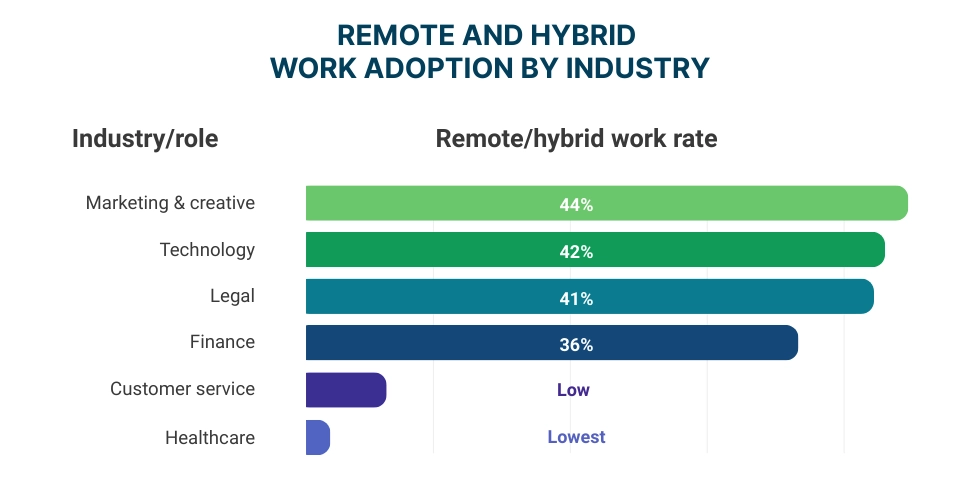
41. Marketing and creative roles lead with 44% remote or hybrid work. Technology follows at 42%, legal at 41%, and finance at 36%. Customer service representatives and healthcare employees have the lowest rates, though some customer service representatives now work from home using cloud-based systems.
42. The information sector has the highest overall work-from-home rate. It is followed by finance and insurance and professional services. Nearly half of all management and financial operations roles include some form of flexible work arrangement.
43. Remote work adoption varies dramatically by geographic location. In San Francisco, nearly 22% of job postings mention remote or hybrid options. In Miami, that number is under 5%. Cities with high costs of living consistently show the highest percentage of remote roles.
44. The global workforce has adopted remote work unevenly. Telecommuting is strongest in English-speaking countries. In the U.S., U.K., Canada, and Australia, employees average about 2 offsite days per week. In parts of Asia, employees average 4-5 in-office days, reflecting cultural preferences for face-to-face social interactions.
45. Millennials thrive most as remote employees, with 66% reporting higher productivity. Older employees show lower self-reported gains (46%). The remote workforce skews toward the 35-to-44 age group, which has the highest percentage of remote workers across all demographics.
How to manage offsite and distributed teams effectively
The remote work statistics are clear: remote work is here to stay. The question for business leaders is how to manage each work arrangement well.
46. Non-invasive monitoring takes a different approach. By tracking productivity metrics, attendance patterns, and active time without capturing personal content, WorkTime helps companies see the full picture while ensuring productivity in remote work environments. This approach builds trust rather than destroying it.
Go non-invasive & stay transparent!
47. The remote employee monitoring software market was valued at $587 million in 2024. It is projected to grow to $1.4 billion within the next several years (Fortune Business Insights). But not all monitoring is equal. Invasive monitoring increases stress by 18% and drives "productivity theater."
48. Measuring outcomes beats measuring hours. For example, a remote worker who spends four focused hours on a project may produce more than one who logs eight distracted hours. Productivity monitoring that tracks active time and application usage provides actionable data without micromanaging remote employees.
49. Comparing remote and in-office performance is one of the most useful data sources for any organization. Instead of guessing whether working on-site produces better results, employers can use tools that compare productivity by location. This replaces opinion-driven RTO mandates with evidence-based remote work policies.
50. Burnout detection is critical for remote teams. With 86% of fully remote staff reporting burnout, monitoring for overwork matters as much as ensuring productivity. Many employees will not speak up until it is too late. Automated burnout detection can alert managers to intervene early.
Spot early burnout signs -
with WorkTime!
51. Attendance monitoring ensures hybrid arrangements work. Research indicates that unstructured hybrid scheduling leads to empty offices on some days and overcrowded offices on others. Coordinating schedules in remote settings and tracking attendance helps both employees and employers gain deeper insights from their setup.
For companies in regulated industries such as healthcare, banking, and insurance, HIPAA-compliant monitoring provides the oversight they require without compromising sensitive data.
How has the shift to flexible work changed hiring and retention?
Remote work led to a fundamental shift in talent acquisition. The talent pool is no longer limited by geographic location.
52. Organizations offering remote roles access a 340% larger candidate pool. This is especially valuable in specialized fields where local talent is scarce. Hiring remote employees is 16% faster for offsite positions (32 days vs. 38 days on average).
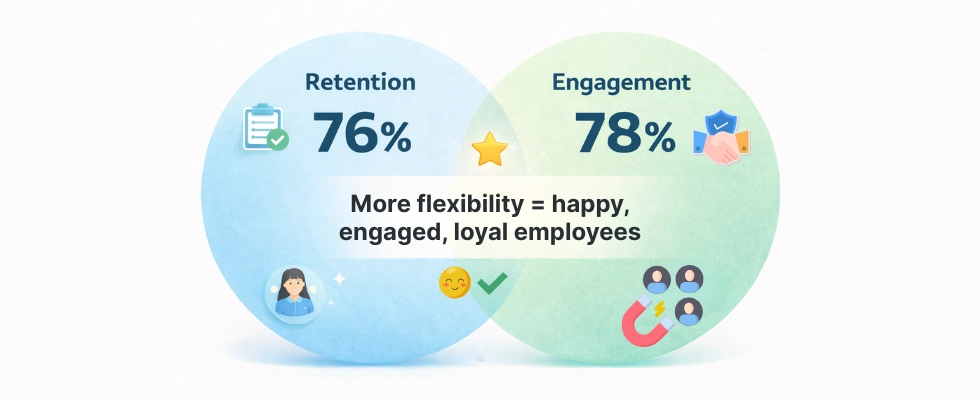
53. Companies offering flexible work arrangements see 76% greater retention and 78% higher engagement. The savings from reduced turnover alone can justify adopting flexible remote work policies for most companies.
54. Remote job opportunities continue to grow. Research reports that the leading industries for fully off-site positions in Q4 2025 included technology, marketing, finance, and customer service. Remote job seekers looking for the highest-paying roles, including project managers and account managers, can find positions above $100,000.
55. Cybersecurity risks are a growing concern for remote teams. When remote work is a factor in causing a breach, costs average $1.07 million higher than office-based breaches (IBM Cost of a Data Breach Report). 43% of offsite employees use personal devices, and only 55% meet corporate security standards.
Final thoughts
The remote work statistics tell a clear story: flexible work is here to stay, and the data backs it up across productivity, retention, and savings. The companies requiring people to return to the office five days a week are running counter to every major data point in this article.
But "let people work from home" is not a strategy by itself. Employers who pair flexibility with visibility see the best results. They know which teams are productive, where burnout is building, and whether hybrid schedules are actually working, all without resorting to invasive surveillance that damages trust.
WorkTime provides that visibility through non-invasive productivity scoring, active time tracking, attendance monitoring, and burnout detection, without capturing screenshots, keystrokes, or personal content.
Try WorkTime now!
FAQs
What percentage of the U.S. workforce works remotely?
About 22.8% of U.S. employees (36+ million people) work remotely at least partially. Among those with offsite-capable jobs, 52% follow hybrid schedules, and 27% are fully remote. ACS data from the Census Bureau and BLS surveys confirm these numbers have been stable since mid-2023 despite major RTO mandates.
How does remote work affect productivity?
Remote work does not reduce productivity. A Stanford study published in Nature found zero negative impact for hybrid schedules, and Stanford economist Nick Bloom's research found that well-organized hybrid teams are up to 5% more productive than fully in-office teams. The key factor is management quality, not location.
Are employers saving money with remote work?
Yes. Employers save an average of $11,000 per year per offsite worker through reduced real estate, lower turnover, and higher productivity. Remote workers themselves save $2,000 to $7,000 per year on commuting, meals, and attire.
Do return-to-office mandates improve productivity?
No. University of Pittsburgh research found RTO mandates hurt job satisfaction without improving business performance. According to data, 8 in 10 companies lost talent after implementing mandates. Despite widespread RTO policies, actual telecommuting rates rose from 17.9% in late 2022 to 23.7% in early 2025.
How should employers measure remote employee productivity?
Non-invasive monitoring that tracks productive time, attendance patterns, and application usage without capturing personal content is the most effective approach. 77% of employees say they would be less concerned about monitoring if their employers were transparent about it and let them know upfront (Dtex Systems/Harris Poll).
WorkTime
Employee monitoring software
Non-invasive - the only non-invasive software on the market
25+ years on the market
80+ reports: attendance, productivity, active time, online meetings, remote vs. in-office and more