• Deutsch

    Deutsch

  • English

    English

  • Español

    Español

  • Français

    Français

  • Italiano

    Italiano

  • Português

    Português

Employee time tracking with WorkTime

Track employee time on company's computers with WorkTime!
Non-invasive. In-depth productivity data.

WorkTime
Amika
School district
Dukascopy
Toyota
Coutts
Universal

Main time tracking features

WorkTime is Green socially time tracking software for employers.

WorkTime is the only non-invasive employee time tracking software on the market. It delivers full productivity analytics without capturing screenshots, keystroke content, or messages.

HIPAA compatible

GDPR compatible

GDPR compatible

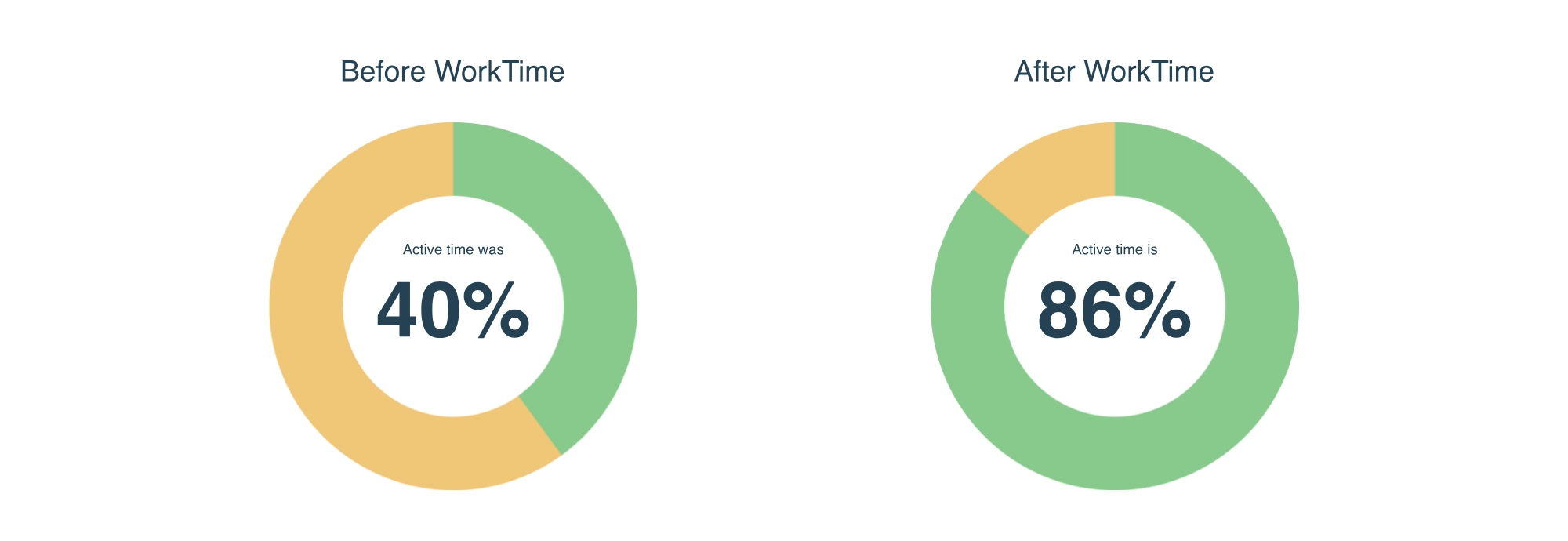
From 35-40% to 80-95!

WorkTime customers raise average employee active time from 35-40% to 80-95% after rollout.

WorkTime

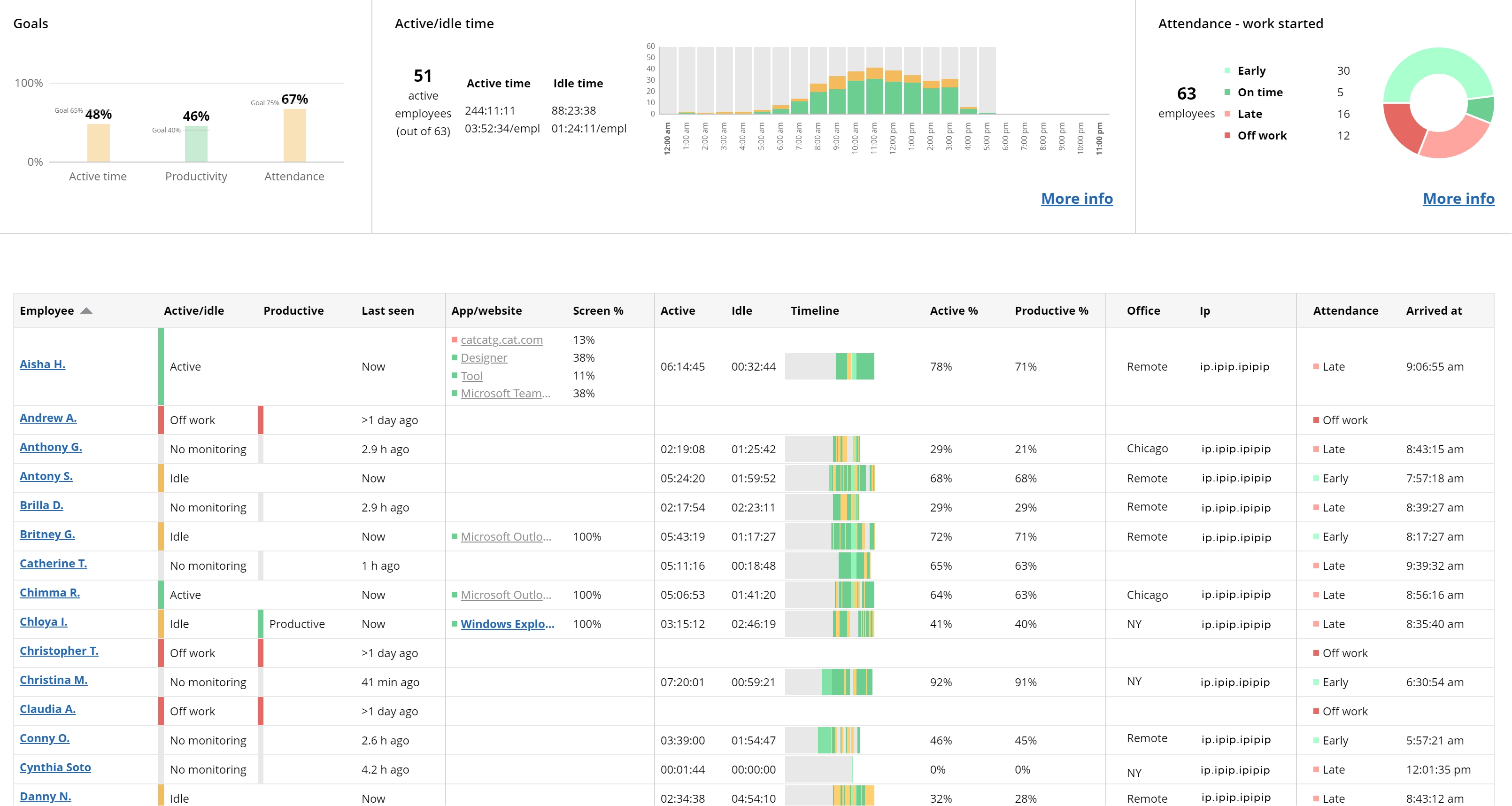
Track employees' current activities in real-time

The "What's now" dashboard from WorkTime shows who is active, who is idle, and which apps and websites are on employee screens. It analyzes live productivity without screenshots, so you see the work, not the person.

Try now 14 days free

Track employees' current activities in real-time

WorkTime

Track active time

WorkTime

Track active time

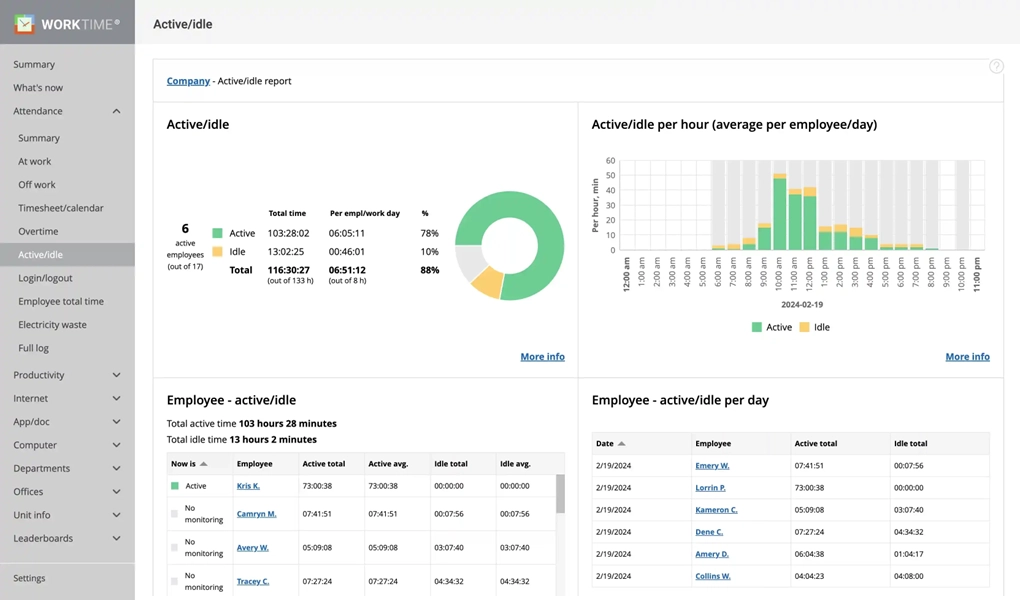
Track idle and active time per employee, department, or company-wide

Track idle and active time of employees and departments per hour, day, or any other period. Compare it to expected working hours.

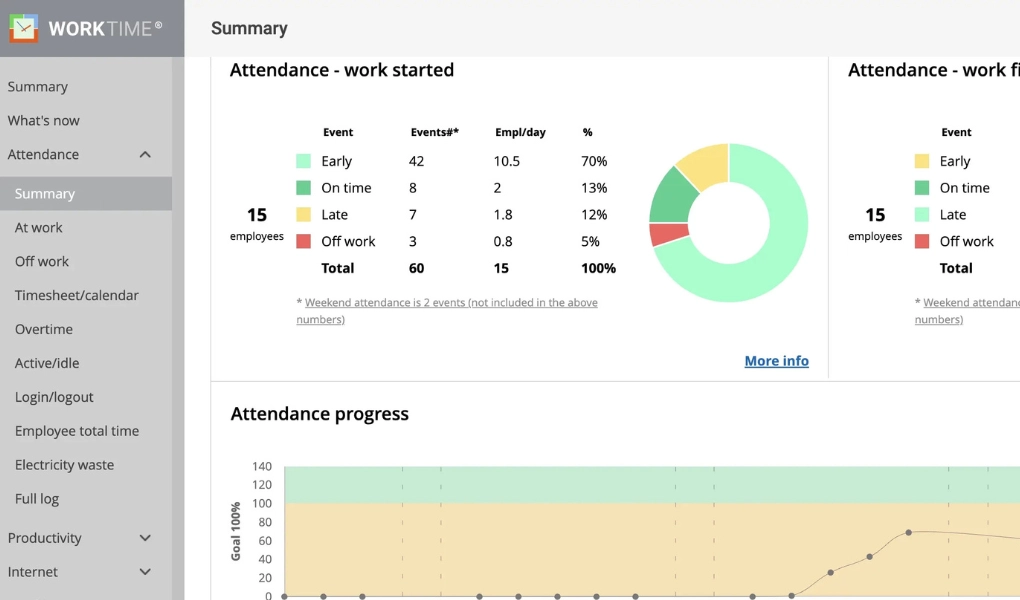
Track employee attendance & login/logout times

Track employee login/logout times and attendance, including arrival and departure times (early, on time, or late).

Track employee attendance & login/logout times

WorkTime

Track remote employees

Compare employee performance in-office and remote

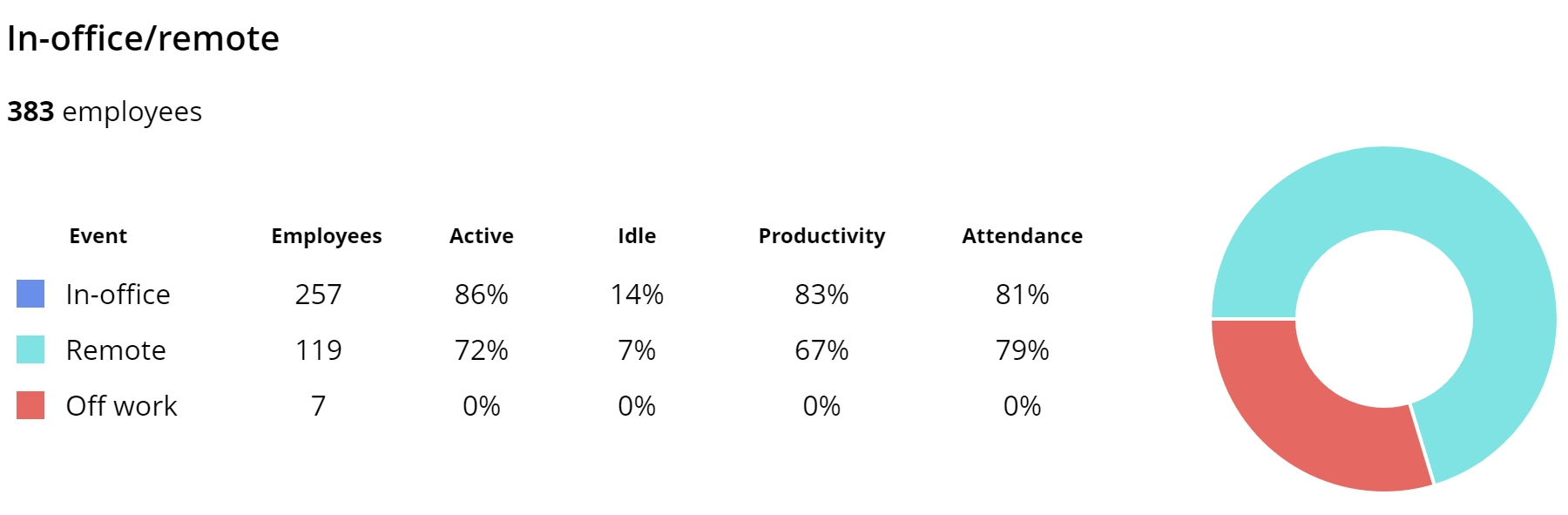
WorkTime compares in-office and remote active time using IP-based location, so you get real numbers, not guesses.

WorkTime

Success story

WorkTime
Industry

Telecom

Employees

20+

Team performance increased from 40% to 95%!

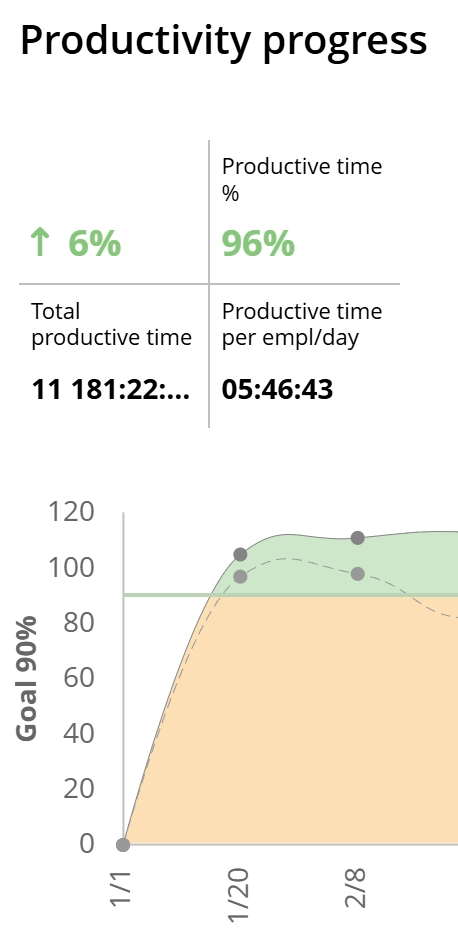
This telecommunication company successfully applied WorkTime to track employee performance. Non-invasive time tracking from WorkTime significantly improved employee attendance from 36% to over 105%, active time from 39% to more than 97%, and productivity from 40% to over 95%.

Read more
95%!

Productivity from 40% to 95%!

WorkTime
WorkTime

start monitoring now!

Start free trial

What is time tracking software?

Employee time-tracking software monitors how much time employees spend on computer activities and generates reports. It tracks login and logout, active versus idle time, attendance, and app and website usage, then shows where the workday actually goes. Non-invasive tools like WorkTime do this without screenshots or keystroke content, so the data works for managers and stays safe for employees. The result is automated tracking that keeps work in sync and focused on business goals.

What do I get from time tracking software?

Track employee time and attendance

Employee time tracking software keeps in-house and remote schedules and attendance in one accurate record, pulled from any location. It logs when employees start and stop, who arrives early or late, and how hours are spent across the day. Distributed teams in different time zones can work on their own schedules while their time is still accounted for. Real-time reports surface the trends that drag on workflow, such as late starts or idle stretches, so you can fix them early instead of finding out at month-end. The record stays consistent whether someone works from the office or from home.

Track work progress

Employee time tracking software shows how working time maps to tasks. You see who was active on which work, when, and for how long, based on app and document usage rather than manual entry. Reports are generated and saved automatically at set intervals, with real-time monitoring of who changed time entries, what changed, and when. Nothing relies on memory or end-of-week guesswork.

Feed payroll with accurate hours

Payroll runs on accurate hours, and that is where employee time tracking software helps. WorkTime logs active time, attendance, and overtime in real-time reports your payroll team can rely on, so paid hours match worked hours and false overtime gets caught before it is paid. WorkTime supplies the hours data. It does not process payroll or run billing itself. You export clean attendance and active-time figures and hand them to whatever payroll system you already use, with fewer disputes to chase.

Improve employee productivity

Employee time tracking software raises team productivity by making the workday visible. WorkTime generates real-time reports showing when employees are productive, active, or idle, and when they log in and out. Productivity scores rank work by application and document, so managers can spot who needs support and reinforce the attendance habits that hold gains in place.

Save company money

Employee time tracking software shows where paid time actually goes, which is where the savings start. WorkTime analytics reveal whether paid hours are spent on work or lost to idle time and non-work sites, by employee and by department. That visibility cuts wasted spend and false overtime, and it pays for the software many times over.

Save both time and energy

Employee time tracking software replaces paper timesheets and the hours spent compiling them. WorkTime tracks time automatically and builds the reports for you, so attendance and active-time data is ready without manual entry. That frees the team to spend energy on real work.

Motivate employees

Employee time tracking software builds work discipline by making expectations clear. When employees know their hours, task time, and login and logout are monitored, they manage their own day more carefully. WorkTime leaderboards and goal tracking turn that into motivation rather than pressure, since people can see their own progress and account for their work at the end of the week.

Must have qualities of time tracking software

1. Easy to use

Time tracking software should be simple to run. The point is to save time, so no one should lose hours learning the tool. Complicated software disrupts workflow, creates errors in time reports, and drags on productivity. You should not need to be an IT expert to use the system or its reports. WorkTime installs in minutes and runs on a clean dashboard, so managers read results on day one instead of waiting on a setup project.

2. Real-time tracking

Time tracking software should automatically capture time spent on their computer, various tasks/projects, websites, applications, documents, software, and the time employees were active or away from the computer in real-time.

3. Data security

Time tracking software should monitor only work-relevant data and keep it secure. WorkTime collects no screenshots, keystroke content, or messages, and protects what it does collect with AES-256 encryption. Our monitoring software supports multi-level access and offers an on-premise option. So, regulated teams keep data on their own servers.

4. Light on system resources

Time tracking software should stay light on the machines it runs on. Most tools use a monitoring agent to monitor computer use, and that agent has to be easy on the CPU. A heavy agent slows endpoints and frustrates the people you are trying to measure. WorkTime is built for the lowest system resource use among major monitoring tools, which matters when you deploy across hundreds or thousands of computers. Test CPU impact during the free trial before you commit.

5. Serving your monitoring goals

Pick the software that fits your actual monitoring goals, not the longest feature list. Decide first what you need to see, whether that is attendance, overtime, productivity scores, or a remote versus in-office comparison, then choose a tool that delivers it. WorkTime scales from basic time tracking to full productivity analytics, so you can start simple and add depth as your goals grow. Try it before you commit.

6. Real-time reporting

Reports are the core of time tracking software, and they should arrive in real time. WorkTime provides 80+ categorized reports covering attendance, active and idle time, overtime, productivity scores, and app and website usage. Each can be scheduled and delivered automatically, so managers get the numbers without building them by hand.

7. Clear licensing conditions

Licensing conditions must be clear and free of any hidden fees. When choosing an employee time tracking system, check the cancellation policy, what fees apply, and how often. Get this free checklist to start and maintain the time tracking process.

8. Technical support

Technical support from the time tracking software providers is very important. The support team should always be responsive and effective in answering all questions relating to the software.

Time tracking software features

1. Time tracking

WorkTime monitors login and logout times, active versus idle time, and attendance automatically on work computers. Our monitoring software captures when an employee starts, when they stop, and how long they are active or away, with no manual clock-in and no screenshots. The record builds itself in the background.

2. User activity tracking

User activity tracking gives managers a clear view of how work time is spent. WorkTime reports which applications and websites employees use and for how long, then groups them as productive or unproductive. It measures usage and duration only, with no content captured.

3. Productivity tracking

Productivity tracking scores the workday automatically. WorkTime reports show how much time goes to productive work and how much is lost, then rank employees and departments by productivity score. Managers spot high performers and people who are struggling without watching anyone, because the score comes from app and document usage, not surveillance.

4. Remote team management

Remote employee monitoring keeps distributed teams in sync across time zones. WorkTime tracks remote staff the same non-invasive way as in-office staff and compares the two side by side, so you know remote work stays as productive as office work. It also logs time spent in online meeting apps such as Zoom, Google Meet, Slack, Skype, Telegram, WhatsApp, and Viber, which is often where remote hours quietly disappear.

5. Dynamic real-time reporting

WorkTime reports let managers review attendance, active time, and time on apps, social media, and the internet as it happens. Live data makes it easy to read trends early and plan staffing around what the numbers show.

6. Accurate hours for payroll

Time tracking software monitors worked hours automatically, which keeps payroll disputes from starting. Employees log in and out, and their time is saved to the reports without manual entry. WorkTime hands payroll clean, accurate hours for salaried and hourly staff.

7. Labor-cost and license visibility

Time tracking software protects the budget by showing where paid time and software spend leak. WorkTime reports reveal how much working time goes to idle stretches, non-work software, and personal internet use, broken down by department and employee. It also surfaces paid software licenses nobody actually uses, a real saving for IT. Managers can compare submitted timesheets against the automatically generated reports to confirm that the hours line up. Idle time and personal use are captured automatically, so the gap between claimed and actual hours is easy to see.

8. Workload balancing

Workload balancing comes from seeing how each person spends their time. WorkTime shows how in-house and remote employees manage their hours against their work, so managers can rebalance the load before someone burns out or coasts. Team performance is available daily, weekly, and monthly, which makes it easy to set realistic priorities and deadlines based on what people actually deliver.

How WorkTime time tracking software helps your company?

1. Track employee time and attendance with WorkTime

WorkTime tracks employee time and attendance across in-house and remote teams. You see:
  • when employees clock in and out from their devices
  • who arrived early or late, who left before the end of the day
  • time spent on and away from the computer
  • which days each person worked.
WorkTime monitors all of it automatically, without screenshots or screen recording.

2. Monitor in real-time with WorkTime

WorkTime shows how time is spent as it happens. Reports show who is working right now, what they worked on and for how long, the time of their last activity, and a visual breakdown of task time across the week or month. You can see which tasks consume the most time and whether paid hours are going to real work, then act on it the same day instead of reviewing it later.

3. Save time on tedious administrative work with WorkTime

WorkTime automates attendance and time management, so managers and employees stop filling out manual timesheets. When an employee logs in and starts working, their time is tracked for them. The data shows up in the reports immediately and exports in a few clicks for payroll or review. The administrative busywork that used to eat hours each week mostly disappears.

4. Save company money with WorkTime

A US insurance company used WorkTime reports to find where paid time was leaking. The data showed a large share of company computers running social networks and non-work sites during paid hours, idle time right after login, and false overtime claims the team had never caught. WorkTime flagged both the unproductive time and the overtime claims, and the company cut the waste once it could see it. This is the pattern across regulated industries: the savings come from accurate, non-invasive data, not from watching people. WorkTime identifies the problem hours so you can fix them and recover the spend. WorkTime is a highly efficient & cost-effective solution to such situations. It identifies overtime claims as well as unproductive time. This enables the company to save money while also resolving such issues.

5. Improve employee productivity with WorkTime

WorkTime improves productivity by making lost time visible and recoverable. Reports split activity into productive and unproductive categories, giving employers a clear read on how each person and department works. Most teams lose a meaningful share of the paid day to poor attendance, idle time, non-work browsing, and socializing. WorkTime surfaces exactly how much, then helps recover it by raising attendance and cutting idle and personal time. As that lost share shrinks, productivity rises, and the gains hold as long as the data keeps employees and managers accountable.

6. Get answers with WorkTime time tracking software

  • Are my employees reporting to work on time?
  • Are my employees actively performing tasks during working hours?
  • How much time do my employees spend on the internet, and what internet activities do they engage in?
  • Do they use productive applications, and how much time is spent on them?
  • Are my employees actually spending extra hours on work activities or claiming false overtime?

WorkTime time tracking software

Understanding which time tracking software is best suited to your business goals

Decide what you want the software to fix before you shop for it. The two questions to answer first: how should time tracking support our business goals, and which tool fits our company? With thousands of options on the market, picking without clear goals is hard and usually ends in buying features you never use. Start from the reason you need it, whether that is cutting administrative work, seeing where task time goes, or feeding accurate hours to payroll. A good time tracking tool fits your existing setup, solves the problem in front of you now, and still serves your long-term goals as the team grows. Match the tool to the goal, not the goal to the longest feature list.

Choosing non-intrusive time tracking software

Choose how much the software is allowed to see, because that choice decides whether your team accepts it. Most time-tracking tools monitor time spent on computer activities during work hours, and some include website blocking to limit distractions. Others go further with screenshot recording and keystroke logging. Those features cross into employee privacy and often backfire, since people who feel watched get tense, not productive. WorkTime is built non-invasively: our monitoring software logs active time, attendance, and app usage, but never captures screenshots, keystroke content, or messages. That is why compliance and legal teams in regulated industries approve WorkTime.

Trying out the software before making any commitments

Try the software before you commit, since a tool you cannot test is a tool you cannot trust. Most vendors offer a free trial, and some offer a free plan for a small number of employees. WorkTime does both: a free tier for up to 3 employees and a 14-day free trial of every feature with no credit card required. Use the trial to run the software on real machines, check the reports you actually care about, and measure CPU impact across your endpoints. Contact the provider during the trial to ask how often updates ship and how support responds, because those answers matter once you are live. When you are ready to buy, read the licensing terms closely: cancellation policy, what fees apply, and any hidden costs. Testing first is how you avoid paying for software that does not fit, and it is free to do.

Time tracking software technology

WorkTime runs as a cloud web service or on-premise, so you choose where your data lives. With the cloud option, results are stored on WorkTime servers, the provider manages the monitoring process, and you open your reports in any browser. Regulated teams that cannot send data offsite can run the same software on their own servers instead. Both deployments give you the same non-invasive reports, with no screenshots either way.

On-premise software

Time tracking software is installed on your servers/computers, and you can directly monitor all your data. In other words, all monitoring reports is generated and stores locally.

WorkTime vs. competitors

When you compare employee monitoring tools, watch how time tracking and every other feature affect system resources. A heavy monitoring agent overloads the CPU, which is common across this category, and slows down the machines you deploy on. WorkTime is built for the lowest system resource use among major providers, which matters most when you roll out across hundreds or thousands of computers. See how WorkTime measures against five other monitoring tools on CPU and resource use in the performance comparison.

Frequently asked questions about employee time tracking software

Does WorkTime time tracking software use screenshots?

No. WorkTime is non-invasive and does not capture screenshots, keystroke content, emails, or chats. It monitors active and idle time, attendance, login and logout, app and website usage, and productivity scores. That is what lets compliance and legal teams in regulated industries approve it without employee-privacy concerns.

Is there a free version of WorkTime time tracking software?

Yes. WorkTime offers a free tier for up to 3 employees and a 14-day free trial of all features with no credit card required. Paid plans add productivity monitoring, attendance, and compliance-safe modes. Plan details are on the pricing page.

Can WorkTime track remote and hybrid employees?

Yes. WorkTime tracks remote, hybrid, and in-office employees in the same non-invasive way and compares remote and in-office active time using IP-based location data. There are no screenshots or screen recordings, regardless of where employees work.

Does WorkTime help with payroll and overtime?

WorkTime supplies accurate attendance, active-time, and overtime data that supports payroll accuracy and catches false overtime before it is paid. It does not process payroll itself. One US insurance company used WorkTime overtime data to find and stop false overtime claims and recover the related spend.