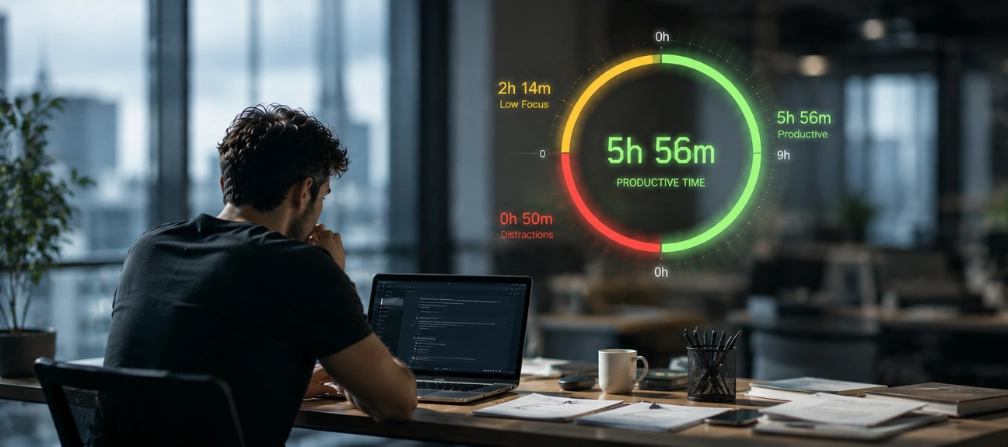
Workplace monitoring has gone from fringe to standard practice in just a few years. But the data tells two different stories depending on how you monitor. Here are the employee monitoring statistics every business leader needs to understand before deciding how to track, measure, and manage their workforce.
The article is presented by WorkTime, a monitoring solution that provides in-depth performance insights without intrusive tracking.
Employee monitoring adoption statistics
Workplace monitoring has grown faster than almost any other HR technology category. Here are the latest employee monitoring statistics on adoption.
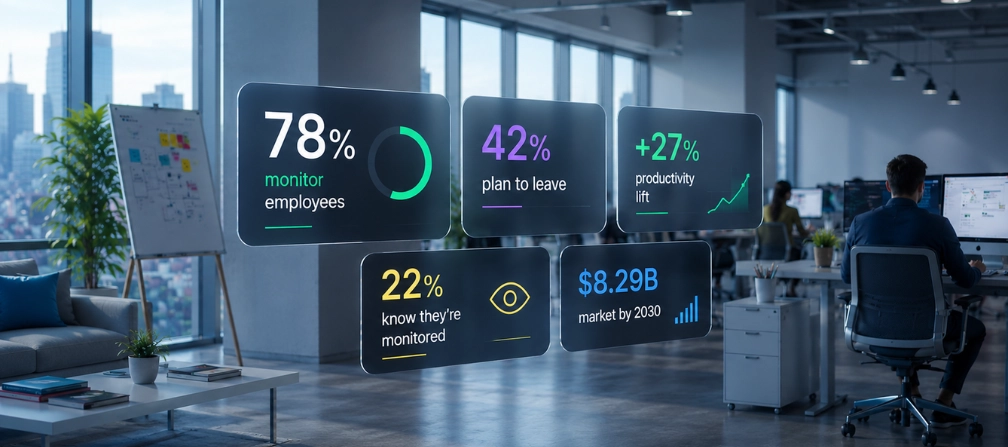
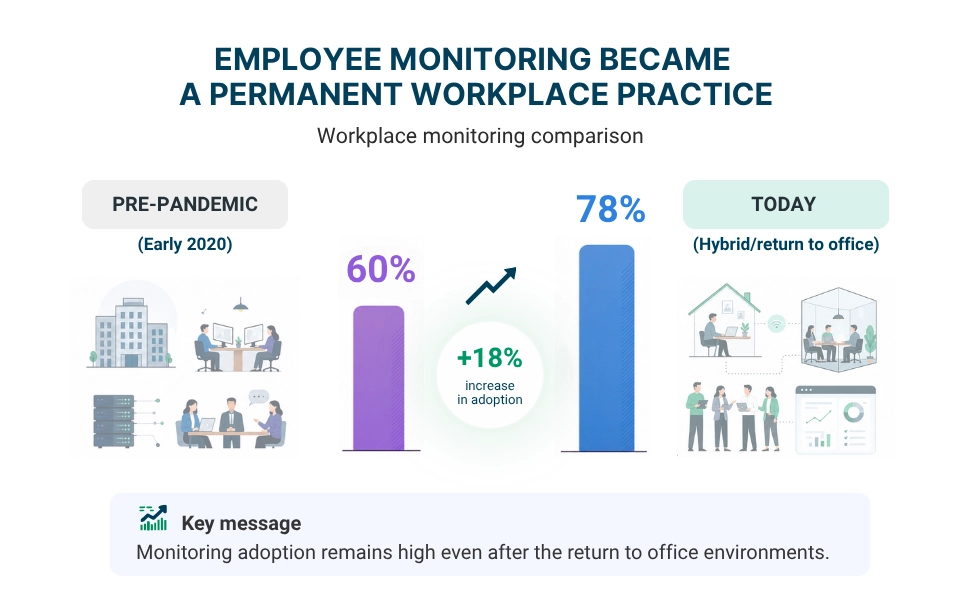
1. Research indicates that 78% of employers now use some form of employee monitoring, up from 60% before the pandemic. Adoption accelerated sharply after 2020 and has not reversed. Organizations that deployed monitoring tools to manage remote employees during the pandemic have largely kept them in place as hybrid work became permanent.
2. Notably, 74% of U.S. employers use online tracking tools, including real-time screen monitoring and web browsing logs. That figure comes from ExpressVPN's survey of 1,500 U.S. employers, one of the most thorough primary datasets on employer monitoring practices. Online tracking tools are now the default, not the exception.
3. According to the data, 75% of U.S. employers monitor physical workplaces using video surveillance and biometric access controls. Physical surveillance is nearly as common as digital monitoring. Employers in regulated industries, healthcare, finance, and government are most likely to combine both.
4. Gartner projected that 70% of large enterprises would actively monitor employees by 2025, up from 60% in 2022. That projection has proven accurate. The driver is not distrust; it is visibility. As workforces spread across locations, monitoring tools became the primary way organizations understand how work actually happens.
5. What stands out is that 73% of companies that adopted monitoring tools during the pandemic have kept them permanently. That retention rate signals a structural shift, not a temporary reaction. Employers who invested in employee monitoring tools discovered that the data was useful for reasons beyond pandemic management: workload distribution, burnout detection, and compliance.
6. The employee monitoring software market was valued at $3.89 billion in 2025 and is projected to reach $4.59 billion in 2026, growing at a 15.9% compound annual growth rate through 2030. The market is expanding across every segment, SMB, enterprise, and regulated industries. Growth is driven by remote work normalization, compliance pressure, and the shift from manual time tracking to automated workforce analytics.
7. North America accounts for roughly 38% of the global employee monitoring market, making it the largest regional market by a wide margin. Fortune Business Insights tracks this breakdown consistently. U.S. adoption is the primary driver, with healthcare and financial services leading industry-level demand.
WorkTime - HIPAA
& GLBA-safe monitoring!
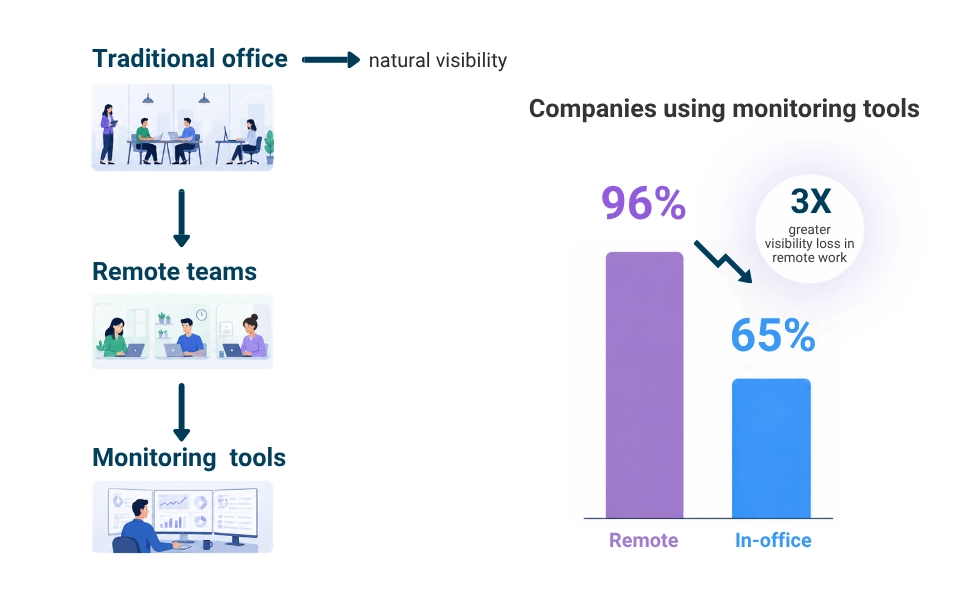
8. Research shows that 96% of remote companies use monitoring software, compared to 65% of fully in-office companies. The visibility problem that remote work creates is the clearest explanation for this gap. In-office managers can observe teams directly. Remote managers rely on monitoring data to understand what is happening.
9. The SMB segment is the fastest-growing buyer category, with 18% year-over-year growth in monitoring adoption. Small and mid-size businesses are catching up to enterprise adoption rates quickly. Lower-cost cloud-based tools and free trial options have made employee monitoring software accessible to organizations with 20 to 200 employees, not just large enterprises.
A note on market size figures: Different research firms define the monitoring software category differently, which is why estimates range from $648 million to $6.8 billion for 2025. Narrower definitions cover only dedicated surveillance tools. Broader definitions include workforce analytics platforms. The figures above use a broad, consistent definition aligned with how buyers actually search for these tools.
What employers are monitoring
Modern employee monitoring tools cover far more than clocking in and out. Here is what the data shows about the monitoring methods in use today.
10. Notably, 62% of employers log web browsing activity on company-owned devices as part of routine employee activity monitoring. Web browsing logs are the most common form of digital monitoring. Most organizations use this data to measure how much time employees spend on work-related versus personal online activity during work hours.
11. About 60% of employers use real-time screen monitoring to track what employees are doing on their screens. ExpressVPN's 2025 survey found screen monitoring is second only to web browsing logs in adoption. It is also the most contested; employees consistently rate real-time screen monitoring as the most intrusive form of digital tracking.
12. Analysts found that 69% of employers use video surveillance inside physical offices. Video surveillance in the workplace is so widespread that it is no longer remarkable in most industries. Retail, healthcare, and financial services have driven adoption, with office-based employers following.
13. Further research shows that 58.3% of employers use biometric access controls and location tracking systems, fingerprint scanners, facial recognition, and badge-based entry. Biometric data collection is growing alongside digital monitoring. At least five U.S. states now have biometric privacy laws governing how employers collect and store this data.
14. According to the data, 67% of U.S. employers collect biometric data from employees in some form, making it one of the most privacy-sensitive monitoring practices in use today. Organizations that collect biometric data must have clear retention and consent policies before deployment. The legal risk around biometric data collection is growing fast; Illinois, Texas, and Washington all impose specific requirements.
15. Across industries, 61% of U.S. companies use artificial intelligence to analyze employee behavior and measure productivity. AI-powered monitoring tools go beyond logging activity; they flag anomalies, score productivity, and surface patterns that manual review would miss. This capability is expanding rapidly as AI becomes embedded in workforce analytics platforms.
16. Almost 86% of employee monitoring tools available today include real-time activity monitoring capabilities. That near-universal availability makes activity monitoring a baseline feature, not a premium add-on. The differentiation now is between tools that capture content (screenshots, keystrokes) and tools that track patterns without capturing personal data.
WorkTime - instant productivity, zero intrusion!
17. Chat monitoring, webcam monitoring, email review, and employee activity logs are among the most contested monitoring practices. In some states, employers must disclose monitoring of electronic communications under the Electronic Communications Privacy Act and state-level equivalents. Employers that monitor employee online activity, including websites visited and app usage, must typically disclose this to employees. Employers who track employee activity through these methods face the strongest pushback.
18. Notably, 79% of employers say the main reason they monitor employees is to understand how they spend their time, making time tracking the most common purpose in employer monitoring surveys. Time tracking tools and time tracking software range from basic clocks to full workforce analytics platforms that include attendance tracking, active time, and idle time measurement. Most employers start with time tracking and expand from there.
19. Findings show that 56% of businesses use monitoring software to prevent data leaks and security threats. Another 78% say they use monitoring systems to stop computer viruses and unauthorized access. Security use cases now rival productivity use cases as the primary justification for employer monitoring programs.
Remote and hybrid work monitoring statistics
The surge in remote employees after 2020 is the single biggest driver of monitoring adoption. Here is where things stand.
20. The numbers reveal that 96% of remote companies use at least one monitoring tool, compared to 65% of fully in-office organizations. The 31-point gap between remote and in-office adoption tells the story clearly. Remote employees create a visibility problem. Monitoring tools are the most common solution.
21. Over 73% of employers are monitoring remote workers and hybrid staff using online monitoring tools, according to ExpressVPN's survey of 1,500 U.S. employers. As hybrid work became the default for office-capable roles, monitoring followed. Organizations that previously only tracked in-office employees extended their monitoring practices to cover remote employees within the same systems.
22. Managers report their top concerns for remote employees are maintaining engagement (29%) and reduced visibility (27%). Monitoring tools are the primary way managers maintain productivity visibility across distributed teams, enabling them to make data-driven decisions about hybrid schedules and workload distribution.
23. Notably, 85% of business leaders cannot verify that offsite employees are actually productive. Only 1 in 8 say they feel fully confident. That confidence gap is one of the clearest drivers of monitoring adoption. Organizations invest in monitoring tools not because they distrust employees but because they lack any other mechanism for visibility into remote work patterns.
24. Hybrid workers typically spend three days per week in the office. For in-office employees, monitoring tends to focus on attendance and application usage. Remote workers spend the rest of the week outside the traditional office environment, creating the visibility gaps that monitoring tools are designed to close.
25. In fact, 60% of managers say it is harder to evaluate remote employee performance, which is why tools built specifically for remote employees have grown faster than any other monitoring segment. Remote employees now account for the majority of new monitoring deployments. The difficulty of performance evaluation without physical presence is the single most common reason mid-size companies cite for adopting monitoring software.
26. The remote employee monitoring software segment was valued at $587 million in 2024 and is projected to reach $1.4 billion within the next several years. Fortune Business Insights tracks this segment separately from the broader monitoring market. The growth reflects how central remote employee monitoring has become to managing distributed teams at scale.
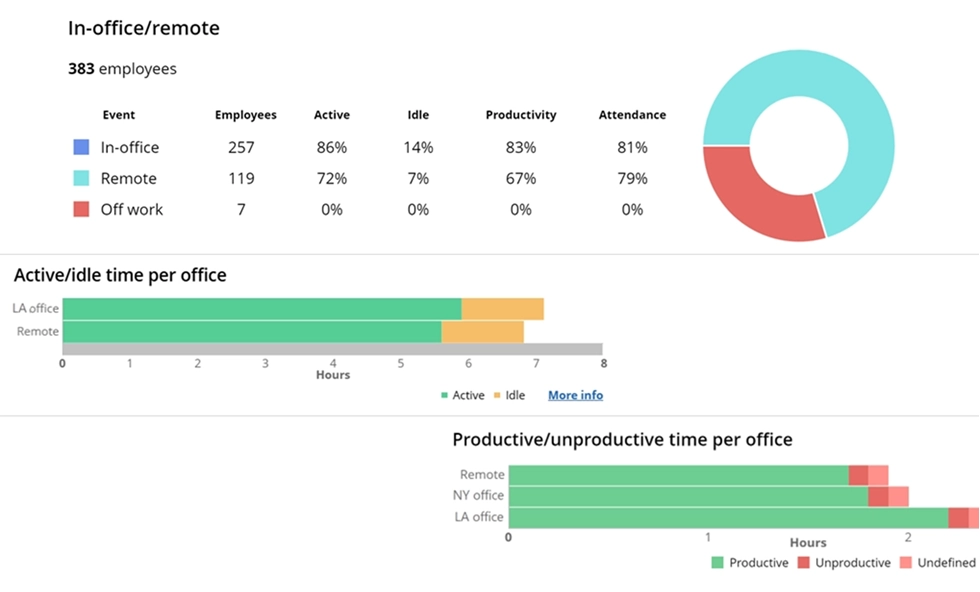
27. WorkTime's remote vs. in-office comparison feature uses IP-based location detection to show productivity patterns across work arrangements. Managers can see how remote employees and in-office staff compare on productivity and attendance side by side, without capturing screenshots or personal content. Remote employees get the same non-invasive treatment as everyone else.
Compare attendance and productivity across office, home, and remote environments. See work patterns by location and discover the tools your team uses most.
Does employee monitoring actually improve performance? The data is more complicated than most vendors admit.
28. Research published in Harvard Business Review found that monitoring used for control drives counterproductive behavior. When monitoring data is used to punish rather than support, such as tying surveillance outputs directly to performance reviews, employees are significantly more likely to engage in time theft, inattentiveness, and cyberloafing. Monitoring used to coach and support produces the opposite result.
29. Employees subject to monitoring show 2.3 times higher likelihood of intending to quit compared to unmonitored peers. Monitoring implemented without disclosure or a clear purpose drives significantly higher stress and quit intent than monitoring introduced transparently. The difference is not in the technology; it is in the framing and communication around it.
30. The American Management Association found that companies adopting monitoring solutions reported an average 22% increase in employee productivity after implementation. The AMA data reflects outcomes across a broad range of industries and company sizes. The productivity gains are real, but they depend on how monitoring is introduced and whether employees understand its purpose.
Boost productivity transparently!
31. About 72% of monitored employees say monitoring does not improve their own productivity. The gap between employer-level productivity gains and individual employee experience is one of the most important findings in recent monitoring data. Organizations benefit in aggregate while individual employees feel surveilled rather than supported.
32. Organizations that expanded monitoring after 2023 reported a median 21% improvement in measurable employee performance metrics within six months, according to a Gartner HR survey. The gains were concentrated in organizations that paired monitoring with clear goal-setting and transparent communication. Monitoring alone does not move the needle; the management practices around it do.
33. Outcome-based monitoring produces 19% lower presenteeism rates than surveillance-style approaches. Tracking deliverables and productivity scores rather than raw hours spent online produces better results. Employees who are measured on output rather than activity patterns show up more engaged and less likely to engage in performance theater.
34. Almost 50% of employees who can access their own employee activity data say it helped them become more productive. Employee-facing dashboards consistently outperform manager-only reporting for driving actual behavior change. When employees can see their own patterns, they self-correct without needing manager intervention.
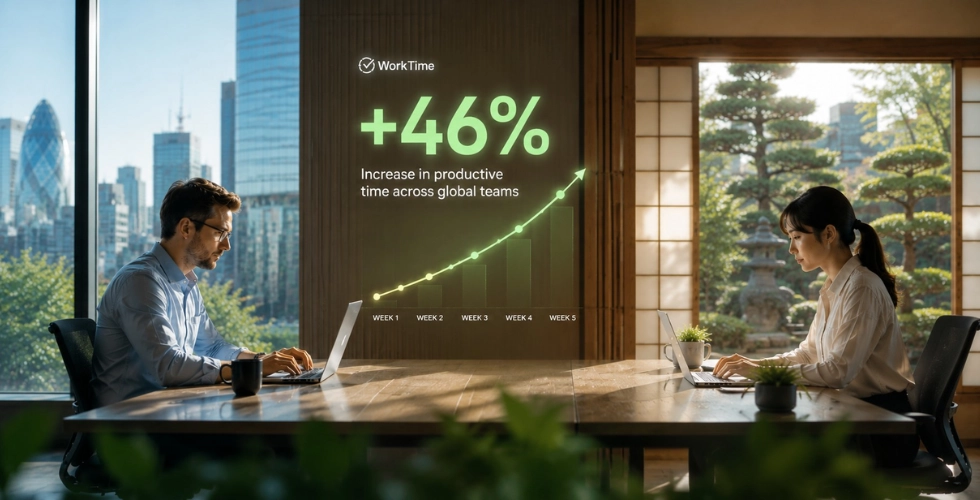
35. A UK bank with 170 employees saw a 46% increase in active time within three days of implementing WorkTime's non-invasive monitoring. M&M Insurance saved $50,000 in one year by eliminating false overtime claims identified through WorkTime's reports. These results reflect what happens when monitoring is used to surface patterns, not to surveil employees.
+46% active time in just 3 days!
+46%
Excellent boost!
Industry
Banking
Employees
170
This UK bank achieved a massive productivity boost after implementing WorkTime - non-invasively!
36. Time theft costs U.S. employers more than $11 billion annually in lost productivity and wages. Time tracking tools give employers a way to detect and address time theft without invasive surveillance. Automated attendance tracking and active time monitoring catch discrepancies that manual timesheets consistently miss.
Employee reactions to workplace monitoring
Employee reaction is where most monitoring programs fail. The data explains why.
37. Only 22% of employees know they are being monitored online, even though 74% of U.S. employers use online tracking tools. That gap is the root of most monitoring backlash. Employees who discover monitoring they did not know about react far more negatively than employees who were informed upfront.
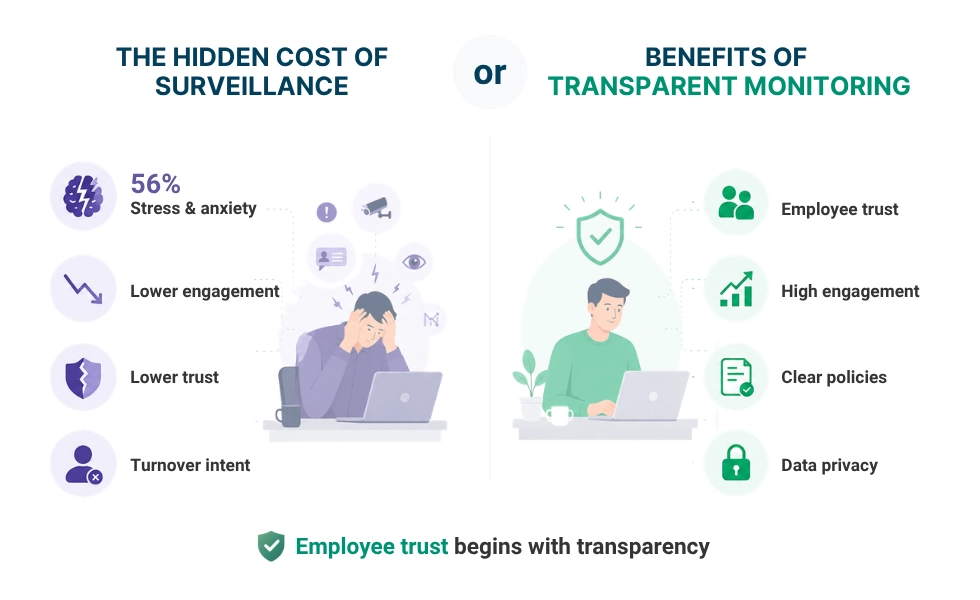
38. According to the ExpressVPN 2025 survey of 1,500 U.S. workers, 56% of employees report stress and anxiety caused by workplace surveillance. Surveillance stress shows up in reduced engagement, lower trust in management, and higher turnover intent. The stress response is stronger when monitoring is covert and weaker when monitoring is disclosed and explained.
39. Nearly 33% of employees feel constant stress, wondering if they are being watched. 24% take fewer breaks to avoid appearing idle. That change in employee behavior is a direct productivity cost of invasive monitoring. Employees who are afraid of appearing idle tend to engage in performance theater rather than focused work.
40. More than half of employees say monitoring negatively affects their mental health, and 1 in 3 say digital surveillance has hurt their mental health directly. Mental health effects from monitoring compound over time. Short-term surveillance stress can convert into chronic disengagement, absenteeism, and eventually turnover, all of which cost more than the monitoring program was designed to save.
41. Due to the surveys, 54% of employees say they would consider quitting if monitoring increased. 24% say they would accept a pay cut to avoid being monitored. Research quantifies how seriously workers weigh employee privacy when evaluating job offers. These are not abstract preferences. These preferences translate directly into recruiting costs and talent retention risk.
42. Significantly, 42% of employees at monitored companies plan to leave within a year, compared to 23% of their unmonitored peers. SoftwareSeni's analysis of industry data shows this employee turnover gap represents a concrete business cost that often outweighs monitoring ROI. Replacing a mid-level employee costs 50 to 200% of the employee's annual salary. Monitoring-driven attrition erases the savings that monitoring was meant to create.
Retain your best talent - with WorkTime!
43. About 46% of tech workers say they would quit if their employer implemented keystroke logging or screenshot capture. The more invasive the monitoring method, the stronger the employee pushback. This is especially pronounced in industries where talent is scarce, and employees have strong market alternatives.
44. Recent studies reveal that 71% of UK-based employees view constant digital tracking as unethical. Regulatory frameworks like GDPR reflect this sentiment at the policy level. Excessive surveillance is both a trust problem and a legal risk, and the two compound each other.
45. Nine in ten employees say they would accept employer data collection when it ties directly to growth opportunities, including personalized learning and career development programs. The issue is not monitoring itself. Monitoring that feels punitive or hidden is what drives resistance. Employees who understand what is being tracked and why are far more likely to accept it, and far more likely to use the data to improve their own performance.
Monitoring and trust: The transparency gap
Most monitoring programs are deployed without enough transparency. Here is what the research shows about the difference it makes.
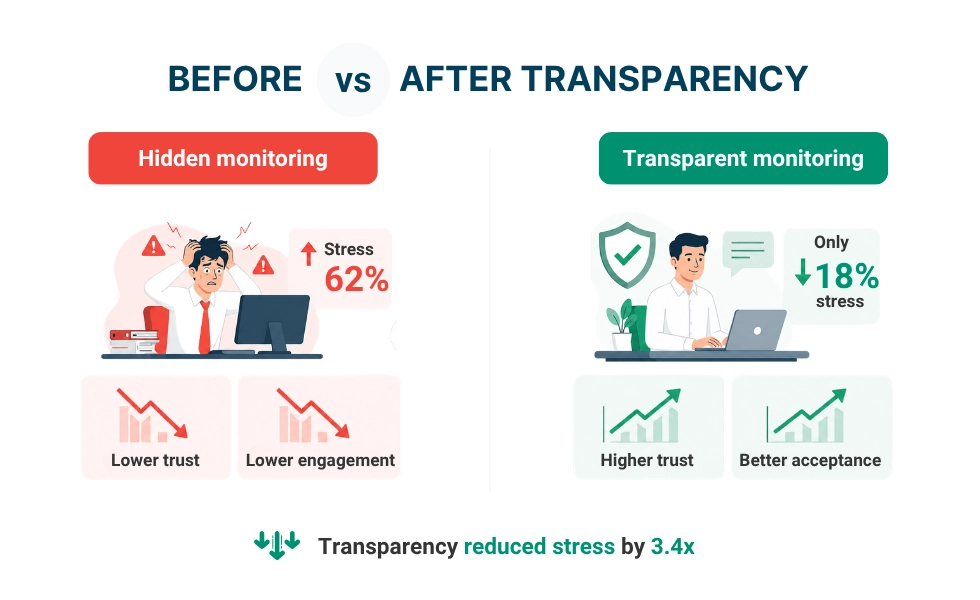
46. Employees whose monitoring was introduced without disclosure experience a 62% increase in stress. Employees whose employers were upfront about monitoring reported only an 18% stress increase. That 3.4x difference from transparency alone is the most compelling data point in the case for non-invasive, disclosed monitoring. The tool is the same. The communication around it determines the outcome.
47. According to the survey, 77% of employees say they would be less concerned about monitoring if their employer informed workers in advance and was upfront about what is being collected. The fix for most monitoring backlash is not better technology; it is better communication. Disclosure before deployment is the single highest-impact change most organizations can make to their monitoring programs.
48. Inside many companies today, 59% of employees say digital tracking damages workplace trust. Employers who track employees without disclosure lose trust on both sides. Employees trust employers less when monitoring feels like surveillance. Employers who don't monitor lose confidence in their ability to verify output. Non-invasive monitoring closes both gaps.
49. Non-invasive employee tracking software produces better employee buy-in than surveillance-based tools. Approaches that track productivity metrics and attendance without capturing personal content, screenshots, or communications generate significantly less resistance. When employers trust employees with their own monitoring data, 47% use it to improve their own performance.
50. WorkTime's non-invasive monitoring approach tracks productivity scores, active and idle time, app usage, and attendance without screenshots, keystroke content, or chat monitoring. WorkTime lets employers inform workers fully about monitoring practices because there is nothing invasive to hide. Employees who are told upfront about monitoring are far more likely to accept it and use the data productively.
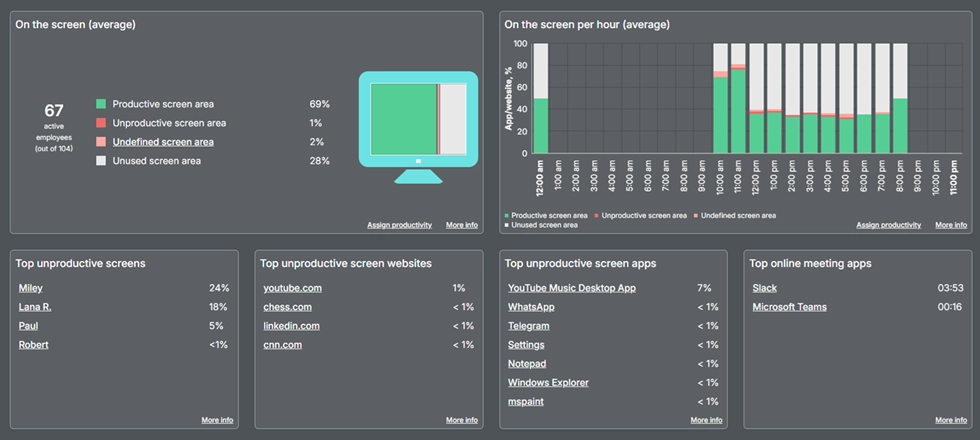
See how effectively screens are used with real-time productivity insights - no screenshots, spying, or content capture involved.
Monitoring is not just a productivity decision; it is a legal one. Here is what the compliance data shows.
51. The U.S. Office for Civil Rights collected $9.9 million in HIPAA fines in 2024, with an average penalty of $579,003 per case. HIPAA Journal tracks enforcement actions annually. Monitoring tools that capture protected health information, even indirectly, can trigger these violations. Healthcare organizations need monitoring software specifically designed to prevent PHI capture.
52. Amazon France was fined €32 million by France's data protection authority for using excessively intrusive methods to monitor employees in its warehouses. Workers were unaware of the scope of monitoring. The fine illustrates how quickly compliance risk compounds when monitoring is deployed without disclosure or proportionality. GDPR enforcement is accelerating, and the fines are material.
53. GDPR compliance costs ranged from $1.7 million for SMEs to $70 million for large enterprises in 2024. Building compliance into monitoring from the start is far cheaper than remediation after an enforcement action. Organizations that select monitoring tools with built-in compliance modes avoid the most common sources of GDPR and HIPAA liability.
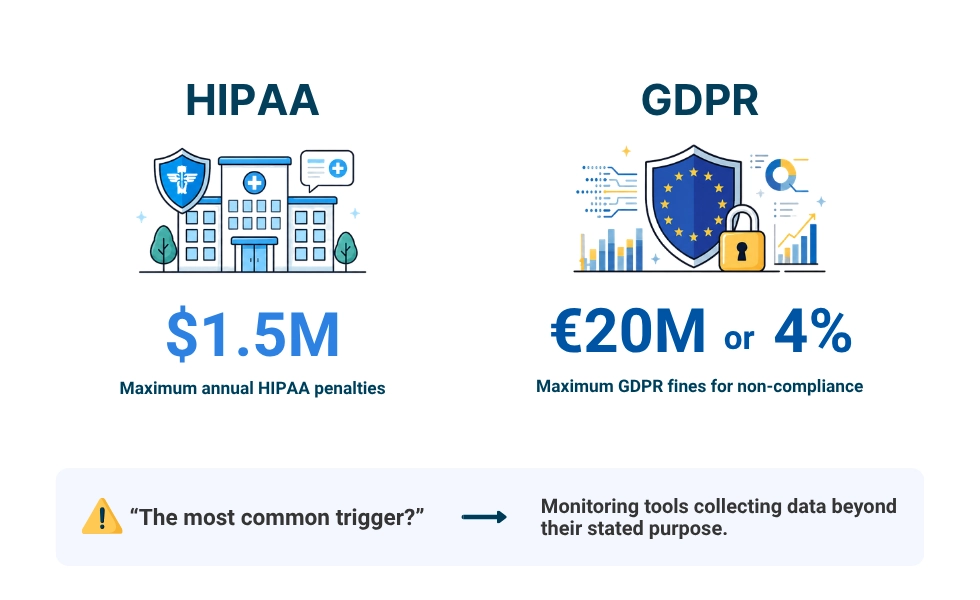
54. Non-compliance with HIPAA can result in penalties up to $1.5 million annually. Non-compliance with GDPR can reach €20 million or 4% of global turnover, whichever is higher. Those are not theoretical ceilings; they are the figures regulators use when calculating penalties for organizations that failed to take compliance seriously. Monitoring tools that capture data beyond their stated purpose are the most common trigger.
55. At least 15 U.S. states are expected to pass employee monitoring disclosure laws by 2028. Connecticut, Delaware, New York, and Texas already have specific notification requirements. State-level data privacy laws are moving faster than federal standards. Organizations that build transparency into their monitoring approach now will face fewer compliance surprises as the legislative landscape continues to shift.
56. California's proposed "No Robot Bosses" Act would require human review of automated monitoring decisions. Some employees have begun using anti-surveillance software and anti-tracking tools to limit what employers can collect, a trend that underscores why transparency is the more sustainable path. Organizations that fail to build employee privacy and psychological safety into their monitoring approach face growing legal and retention risk.
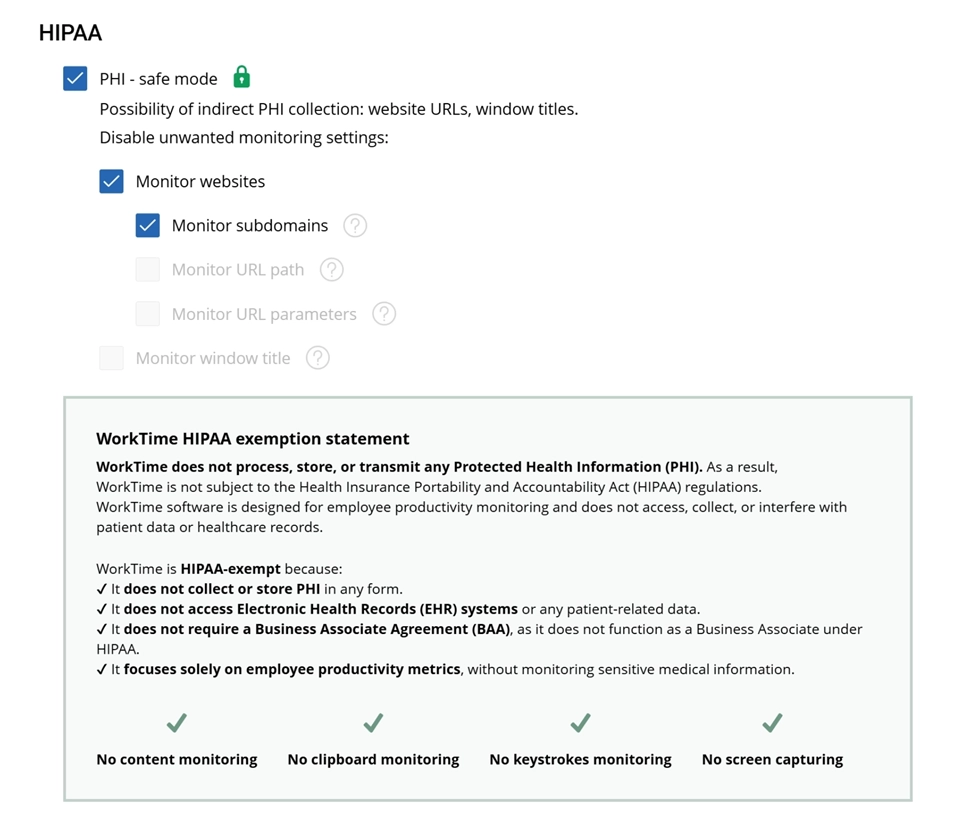
57. WorkTime's HIPAA-safe, GDPR-safe, and GLBA-safe modes are designed specifically for regulated industries. Available on the Enterprise plan, these modes prevent indirect collection of protected health information, personal employee data, and non-public personal financial information. Compliance is built into the product, not added afterward.
Interesting fact!
WorkTime keeps employee monitoring secure, transparent, and HIPAA-exempt.
The data points toward a clear conclusion. Monitoring is now nearly universal, but most programs are deployed without the transparency that makes them actually work. The difference between a monitoring program that improves performance and one that drives turnover is not the technology. It is the approach.
The monitoring approach that works is one where employees know what is being tracked, can see their own data, and are not subjected to content capture that they did not agree to. That kind of transparency converts a potential trust problem into a performance tool.
WorkTime has operated on this principle since 1998. No screenshots. No keystroke content. No screen recording. Just transparent productivity analytics, active time, attendance, and distraction data that managers actually need, across in-office, hybrid, and remote teams. Trusted by 9,500+ organizations in 26+ years of operation. Start your 14-day free trial - no credit card required.
Try WorkTime now!
Frequently asked questions
What are the most important employee monitoring statistics for 2026?
The most actionable finding is this: transparency is what separates monitoring that works from monitoring that destroys trust. Transparent monitoring, used to support rather than punish, reduces counterproductive behavior and improves performance. Covert monitoring produces a 2.3x higher quit intent and significantly elevated employee stress. The method matters as much as the decision to monitor.
How common is employee monitoring in the U.S.?
Very common. According to an ExpressVPN survey of 1,500 U.S. employers, 74% use online tracking tools, 75% monitor physical workplaces, and 61% use AI-powered analytics. Monitoring is now standard practice across industries and company sizes.
Does employee monitoring improve productivity?
It depends on how it is used. Transparent, outcome-focused monitoring produces real gains; the American Management Association found a 22% average productivity increase. Punitive or covert monitoring tends to drive stress, lower engagement, and higher turnover, all of which undercut the gains monitoring was supposed to create.
What is the difference between invasive and non-invasive employee monitoring?
Invasive monitoring captures content, screenshots, keystrokes, emails, and video recordings. Non-invasive monitoring tracks activity patterns, time, attendance, app usage, and productivity scores, without capturing personal content. Non-invasive approaches produce better employee buy-in, lower stress responses, and are safer under HIPAA, GDPR, and GLBA compliance frameworks.
What do employees think about being monitored at work?
Most employees accept some level of monitoring. What they resist is covert or punitive surveillance. 49% would consider quitting if monitoring increased. But 90% are open to data collection if it connects to career benefits. Transparency is the deciding factor.
What should I look for in employee monitoring software?
Look for tools that track outcomes rather than behavior content, offer built-in compliance modes for regulated industries, give employees access to their own data, and have a proven track record at scale. WorkTime has operated since 1998 and is trusted by more than 9,500 organizations.
WorkTime
Employee monitoring software
Non-invasive - the only non-invasive software on the market
25+ years on the market
80+ reports: attendance, productivity, active time, online meetings, remote vs. in-office and more