




TL;DR
- A BLS analysis of 61 industries found a positive link between remote work and total factor productivity growth, showing that remote and hybrid work arrangements do not drag down economic output.
- Hybrid work has zero negative impact on performance. A Stanford study published in Nature found no drop in productivity, with a 33% reduction in employee turnover.
- 85% of business leaders struggle to trust that remote employees are being productive, even though most research shows stable or improved output.
- Remote workers log fewer hours but maintain output. Gallup data shows employees in remote settings work about one hour less per day, yet macro-level productivity remains steady.
- 77% of employees accept monitoring when their employer is transparent about it, and they can access their own data.
In this article
The article is prepared by WorkTime - a non-invasive monitoring solution helping in-office, remote, & hybrid teams stay productive with full transparency.
Top 40+ data & statistics on remote & hybrid work productivity
1. According to recent data, 77% of remote employees report being more productive when working remotely. This is one of the most consistent findings across multiple surveys. Remote workers consistently self-report higher productivity in their home work environment compared to in office settings. 2. A BLS study across 61 industries found a positive association between remote work and total factor productivity growth. A one-percentage-point increase in remote work adoption correlates with a 0.08 to 0.09 percentage-point increase in total factor productivity. This relationship held even after controlling for pre-pandemic trends (BLS, October 2024). 3. Notably, 70% of managers say remote or hybrid work makes their teams more productive. Only 12% reported a decrease. Managers who have actually experienced remote work arrangements tend to view them favorably. 4. Companies on the 2025 Fortune 100 Best list show output nearly 42% higher than a typical U.S. workplace. Of those 100 companies, 97 support remote or hybrid work. Work culture and trust, not location, drive the difference.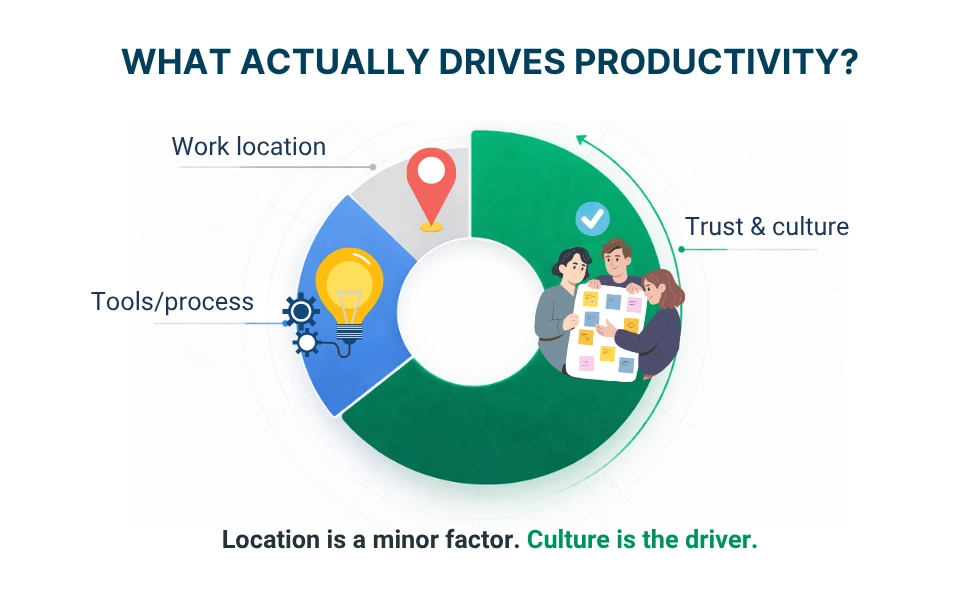
Remote work hours vs. actual output
One of the surprising findings in recent research is that remote workers log fewer work hours, but that does not translate to lower output. This disconnect matters for how we measure employee productivity in a remote work setting. 7. Remote workers in heavily remote roles work about one hour less per day compared to 2019 levels. By 2022, employees in remote settings were redirecting 30 to 60 minutes of that saved time to personal activities (American Time Use Survey, 2019-2023).
What research says about hybrid productivity
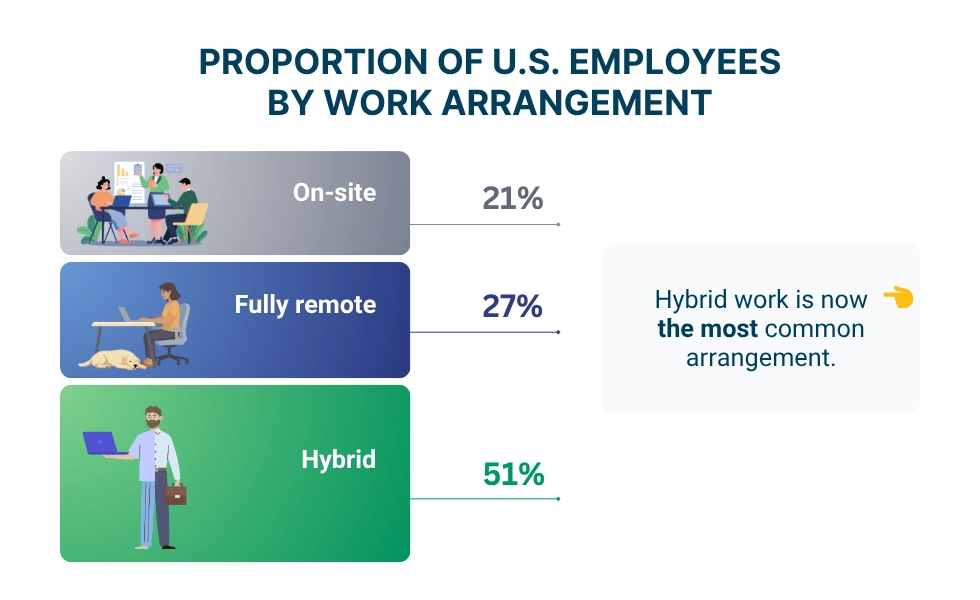
Hybrid work is the dominant model for the remote workforce in 2026. Here is what controlled studies show about how it compares to fully remote and fully on-site arrangements, especially for teams working remotely across different time zones.Monitor remote teams easily - with WorkTime!


The productivity paranoia gap
18. Studies indicate that 85% of business leaders say they struggle to feel confident that hybrid employees are productive. Microsoft calls this "productivity paranoia." It reflects a measurement problem, not a performance problem (Microsoft Work Trend Index). 19. Here’s the reality: 87% of remote workers say they are productive when working from home. The gap between manager perception and employee reality is one of the biggest challenges facing the distributed workforce today. 20. The findings show that 88% of remote employees feel they need to prove they are being productive.This pressure leads to performative work rather than actual output. Workers spend time on activities designed to look busy rather than complete tasks that matter. 21. Data reveals that 64% of employees keep their chat status set to active even when they are not working. When companies rely on digital communication tools as a proxy for productivity, employees game the system. This is productivity theater, and it hurts the entire organization. 2. Notably, 60% of managers say reduced visibility makes performance reviews more challenging for remote teams. Without the right digital tools, many businesses default to presence-based evaluation, which fails to capture actual productivity in a remote work setting. 23. The solution is not more surveillance - it's better visibility into actual work patterns. Non-invasive productivity monitoring that tracks productive time, application usage, and active time gives managers the data they need without capturing personal content. 77% of employees say they would accept monitoring if their employer is transparent about it.How monitoring affects remote work productivity
24. About 72% of employees are open to time tracking when given transparency and access to their own data. Allowing employees to view their own reports through remote platforms builds trust rather than resentment. The best remote work statistics on monitoring show that transparency is the deciding factor. 25. Invasive monitoring (screenshots, keystroke logging) is linked to higher turnover. In the early days of the pandemic, many companies rushed to implement surveillance tools without the right tools or strategy. Companies that still rely on invasive tracking often lose top talent within months. Remote workers leave for employers who offer more flexible work options and more trust when working remotely. 26. Companies that share monitoring data with employees and managers alike see a positive impact on engagement. Transparent monitoring helps employees alike understand their own patterns and self-correct, creating a balancing act between accountability and autonomy. 27. WorkTime's non-invasive approach tracks productivity, attendance, and distraction scores without capturing personal content. This allows managers to see work patterns across remote teams while maintaining the trust that keeps remote employees engaged.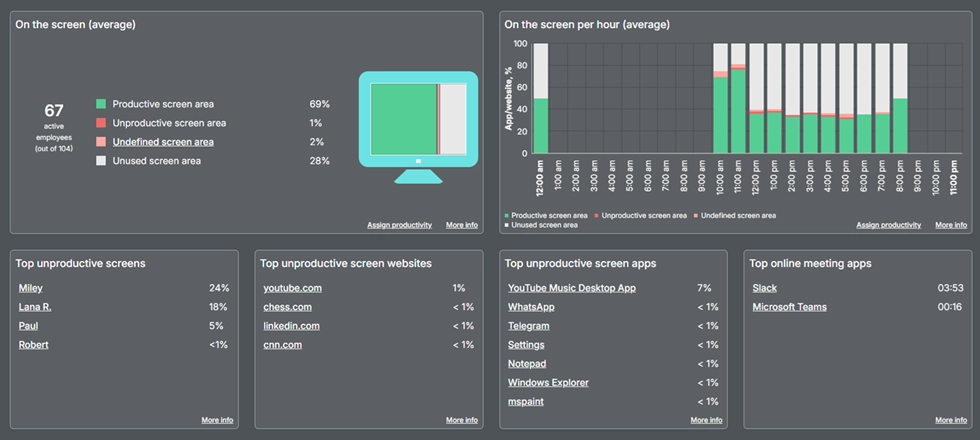

See how productively employees use their screens without screenshots or intrusive tracking. A clear screen productivity percentage helps ensure transparency and privacy
Start free trialRemote work productivity by industry
Remote work productivity varies across industries and administrative roles. Here is what the data shows. 29. Industries with the highest remote work adoption saw the biggest gains in total factor productivity. Information, finance, and professional services led the way (BLS, 2024). 30. Technology roles show the highest hybrid work rates, with 29% hybrid and 13% fully remote. Healthcare and administrative roles remain heavily on-site (Robert Half, Q4 2025). 31. The 35-44 age group has the highest remote work adoption at about 27%. Workers aged 16-24 have the lowest at just 6% (BLS, 2025).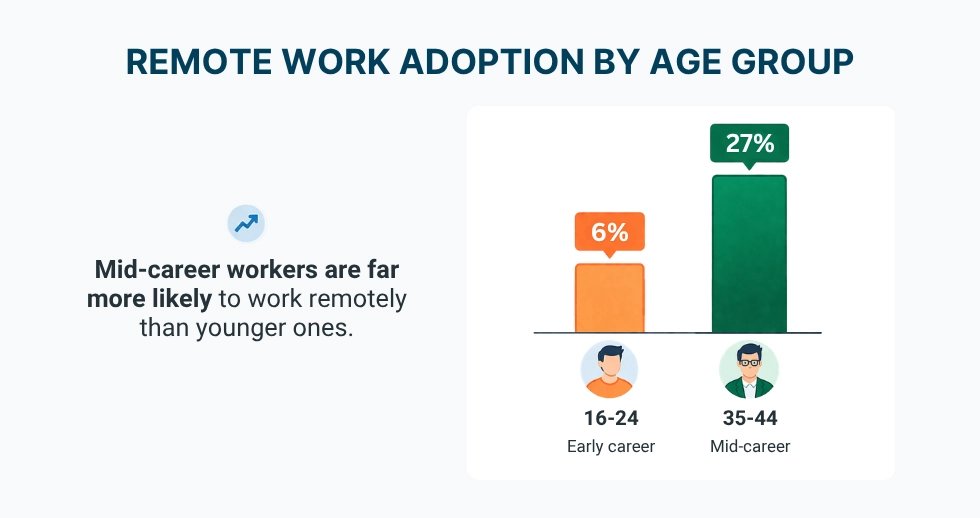
What remote work saves and costs
33. Employers save an average of $11,000 per year for each remote employee. This comes from reduced overhead, smaller office space requirements, lower turnover, and stronger output (Global Workplace Analytics). 34. Remote employees save $2,000 to $7,000 per year on commuting, meals, and work attire. These savings contribute to better employee well-being and reduced financial stress. 35. Remote work has reduced commuting traffic by roughly 10% and lowered carbon emissions across the U.S. Research links reduced pollution to improved cognitive function and performance (Nick Bloom, IMF, 2024). 36. About 40% of remote workers have upgraded their home internet to support digital collaboration. Companies worldwide are increasingly offering technology stipends, with 30-40% providing allowances to support digital infrastructure at home.What RTO mandates mean for remote work productivity
37. University of Pittsburgh research found that RTO mandates hurt job satisfaction without improving financial performance. Data shows 8 in 10 companies lost talent after implementing strict return-to-office policies. Despite these mandates, actual telework rates rose from 17.9% to 23.7% between late 2022 and early 2025.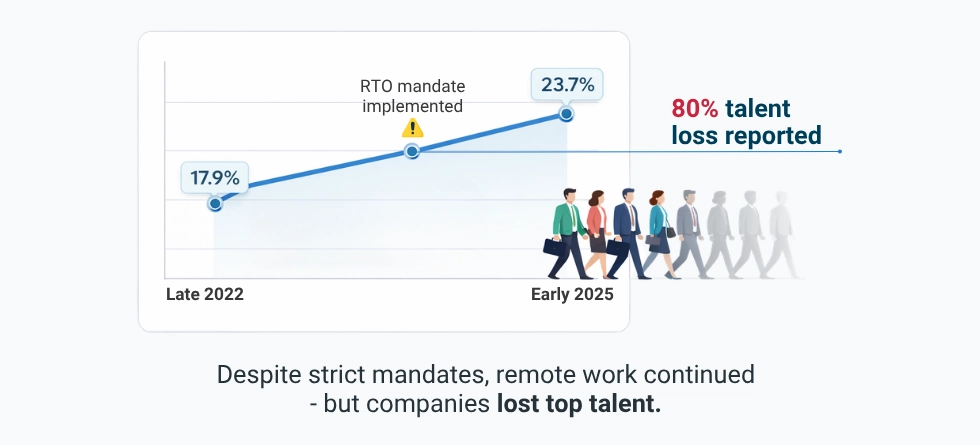
Boost remote productivity non-invasively
Maintain remote productivity non-invasively!
42. Companies that measure outcomes instead of hours see the strongest results from remote teams. Task completion rates, project delivery, and quality metrics give managers a clearer view of performance than tracking work hours (Gallup). 43. Clear expectations matter more than monitoring frequency. When employees know what success looks like, they perform well regardless of location. Project management and collaboration platforms, along with remote platforms, help distributed teams working remotely stay on track. 44. Significantly, 81% of employees at the Fortune 100 Best Companies describe their work environment as psychologically healthy. Only 45% at typical workplaces say the same. Employee well-being directly impacts performance and output. 45. Anchor days, where hybrid teams coordinate in office days together, produce better collaboration than random schedules. This approach captures more collaborative benefits than allowing employees to choose at random. 46. WorkTime allows managers to compare remote vs. in-office productivity using IP-based location tracking. This gives human resources teams data for making decisions about hybrid schedules rather than relying on assumptions.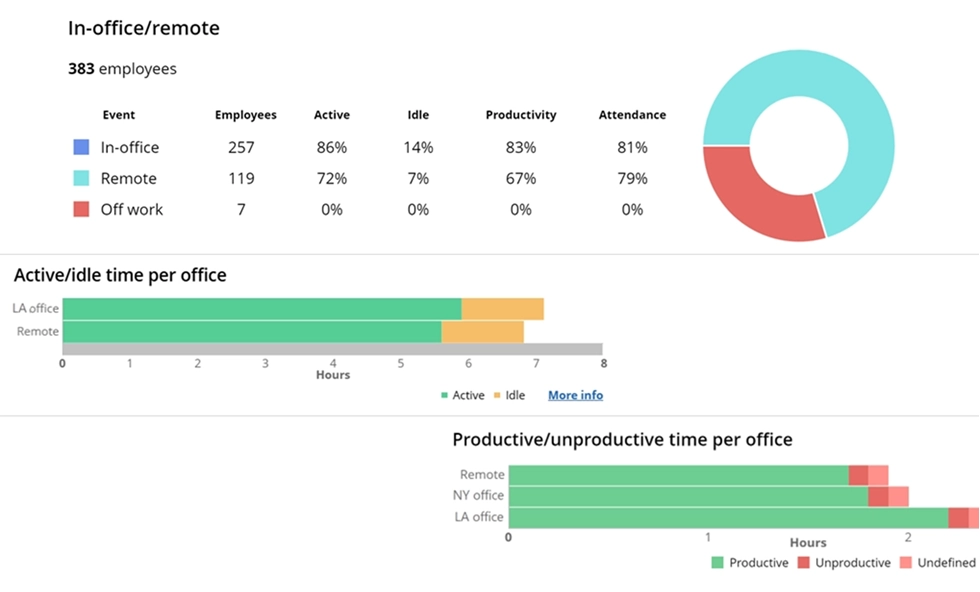

Analyze how employees perform across office, home, and remote setups. Track attendance, evaluate productivity by location, and discover which tools your team relies on most.
Start free trialOur final thoughts
The remote work productivity statistics are clear: hybrid and remote work do not hurt output when managed well. The biggest risk is not working remotely itself. It is the gap between what managers fear and what the data shows. Companies that close this gap with transparent, non-invasive monitoring see the best results. They track productive time, attendance, and work patterns without capturing personal data, and they share those remote work statistics with employees and managers alike. WorkTime provides that visibility through non-invasive productivity scoring, active time tracking, attendance monitoring, and burnout detection. Try it free for 14 days with all features, unlimited employees, and no credit card required.Try WorkTime now!