




TL;DR
- More than half of U.S. employees (55%) are currently experiencing burnout, with fully remote workers reporting the highest rates at 61%.
- Burnout costs employers $3,999 to $20,683 per employee per year, with 89% of that cost coming from presenteeism, not absenteeism (American Journal of Preventive Medicine).
- Younger workers are burning out earlier than ever. Gen Z hits peak burnout at age 25, a full 17 years earlier than the average American.
- Manager burnout drives team-wide disengagement. 70% of team engagement variance comes from the manager, and manager engagement has dropped to just 27% globally.
- Employees who feel they belong report burnout rates of 55%, compared to 78% for those who do not feel they belong.
In this article
The article is presented by WorkTime, a non-invasive monitoring solution with 25+ years of experience, designed to boost productivity, spot burnout early, and increase engagement.
Top 40 statistics on burnout & stress in the workplace
1. Recent data shows that 55% of the U.S. workforce is currently experiencing burnout. This figure comes from Eagle Hill Consulting's Workforce Burnout Survey, conducted by Ipsos in November 2025 with more than 1,400 full-time employees. Burnout is undercutting efficiency, customer service, and retention. 2. Notably, 72% of U.S. employees face moderate to very high stress at work, a six-year high. The 15th annual Aflac WorkForces Report found that chronic workplace stress has escalated to levels not seen since before the pandemic. Heavy workloads remain the top driver, reported by 35% of respondents (Aflac, 2025). 3. According to the Mercer Global Talent Trends report, 82% of employees are at risk of burnout. Yet fewer than half of employers have redesigned work with well-being in mind (Mercer, 2024). 4. Studies indicate that 66% of American employees report being burned out, an all-time high. A Modern Health study published by Forbes found that employee burnout has never been higher. The negative impact on workforce stability and business performance grows each year.Prevent employee burnout - with WorkTime!


What employee burnout cost employers
The financial toll of workplace burnout is far larger than most companies realize. Burned-out employees who show up to work but operate at reduced capacity cost more than those who call in sick. 8. Burnout costs employers an average of $3,999 per year for each non-manager hourly employee. For salaried non-managers, the cost rises to $4,257. For managers, it jumps to $10,824. For executives, it reaches $20,683 per year (American Journal of Preventive Medicine, 2025).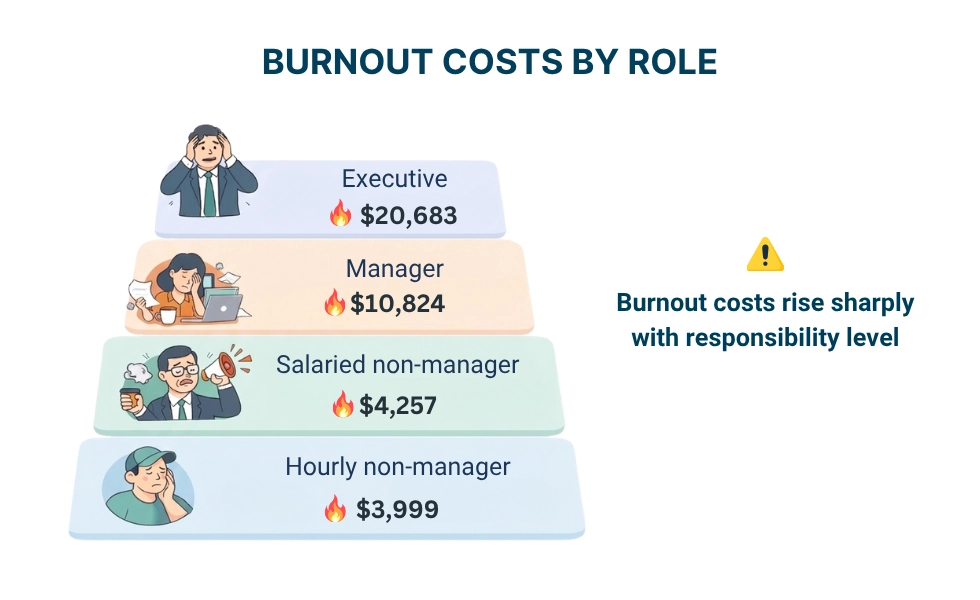
Employee burnout by generation
14. Gen Z (ages 18-27) reports the highest burnout rates at 74%. This makes Gen Z the most burned-out generation in the workforce, surpassing even Millennials. Many younger workers are dealing with financial strain, student debt, and global events, creating uncertainty about their professional lives (Aflac, 2025). 15. Gen Z and Millennials hit peak burnout at just 25 years old. The average American experiences peak burnout at 42. This 17-year gap signals a fundamental shift in how younger workers experience chronic stress in the modern workplace. 16. Burnout rates by generation: Gen Z 66%, Millennials 58%, Gen X 53%, Baby Boomers 37%. Eagle Hill's data shows that burnout levels drop steadily with age. Younger workers face unique stressors, including digital fatigue, pressure related to personal finances, and the feeling that they must constantly prove themselves (Eagle Hill, 2025).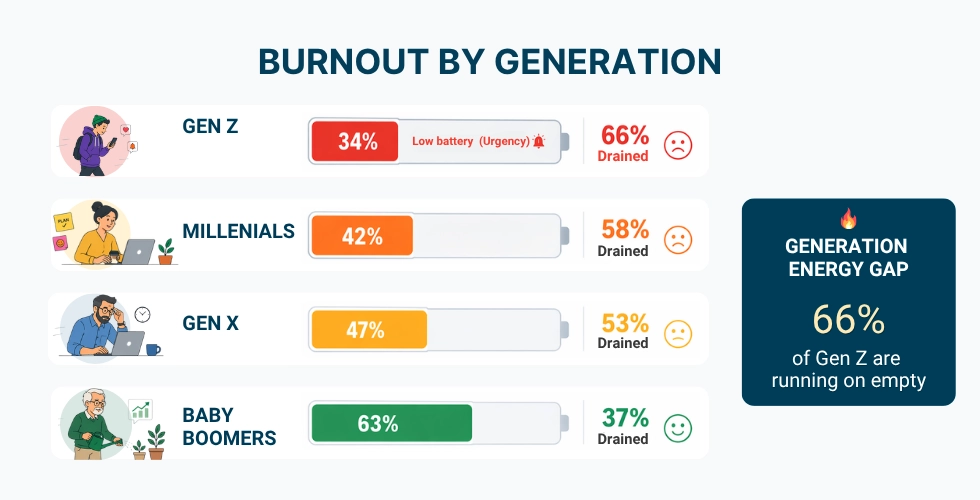
Burnout by work arrangement: remote, hybrid, and on-site workers
Does working remotely prevent burnout, or does it create new risks? The burnout statistics by work arrangement show that no single model eliminates burnout. The work environment and employees' experience of burnout depend on management, not location. Work stress shows up differently in each setting. 19. Fully remote workers report burnout at 61%, compared to 57% for hybrid and 55% overall. This is one of the most important findings in recent burnout research. Those working from home are more likely to report burnout than on-site workers, despite having more flexibility. The always-on culture and isolation of remote work contribute to a higher risk of burnout (Eagle Hill, 2025). 20. Fully remote workers report the highest engagement (31%), but only 36% say they are "thriving." Hybrid workers report 42% thriving. This paradox suggests that engagement without well-being is not enough. Employees can be deeply involved in their work life and still burn out (Gallup, 2025).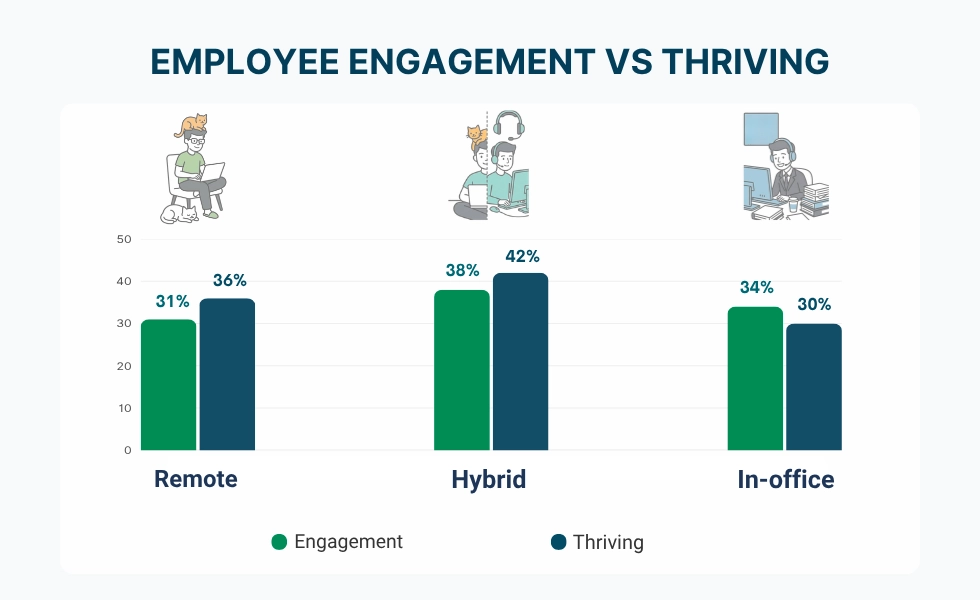
Monitor remote teams non-invasively!
Manager burnout and the cascading effect
Manager burnout is the most underreported driver of team-wide disengagement. When managers burn out, their teams follow. These burnout statistics on middle management reveal why addressing burnout at the top matters most. 24. Manager engagement dropped to 27% globally in 2024. This decline is significant because managers account for 70% of the variance in team engagement. A disengaged manager creates disengaged individual contributors, and workplace burnout spreads rapidly (Gallup, 2025). 25. Only 44% of managers globally have received any formal management training. This means more than half of middle management responsible for supporting employees through chronic stress have never been trained to do it. When employees experience burnout and seek mental health support, untrained managers often lack the tools to help (Gallup, 2025). 26. Burned-out employees are 63% more likely to take a sick day and 13% less confident in their performance. When individual contributors experience burnout, it shows up as reduced professional efficacy, more errors, lower quality work, and energy depletion that spreads to the rest of the team (Gallup). 27. Coaching-trained managers see 20-28% improvements in team performance. Investing in manager development is one of the most cost-effective ways to reduce burnout. Companies that develop strategies for supporting managers see measurable gains in employee engagement and retention.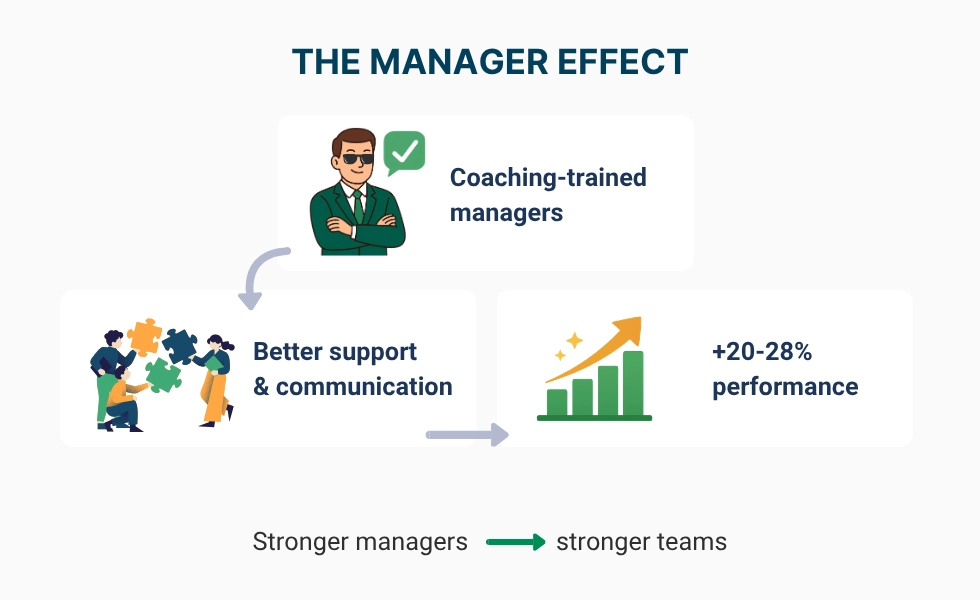
What actually drives employee burnout
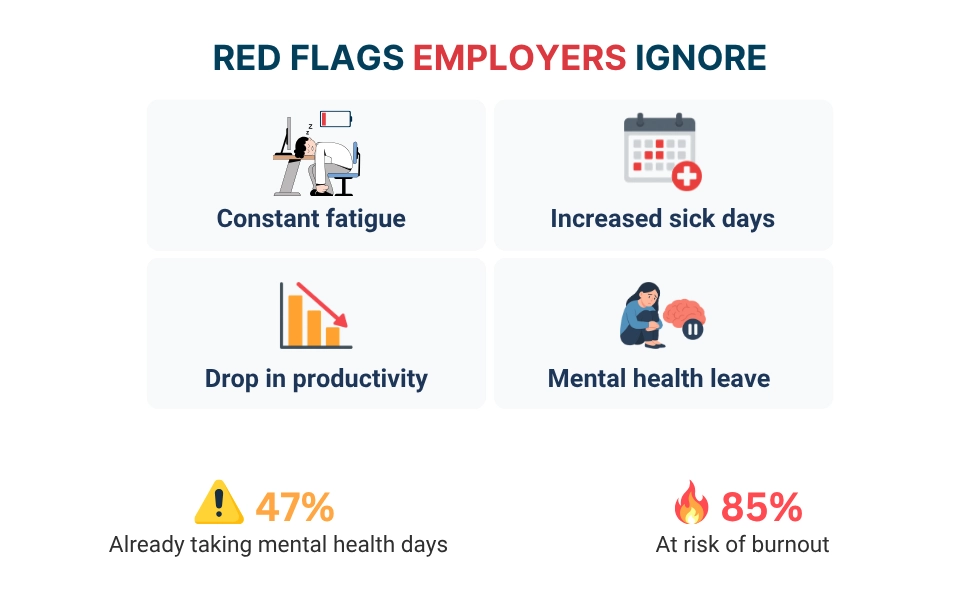
Understanding the root causes of workplace burnout is the first step to addressing it. The data shows that burnout is driven by systemic workplace conditions, not individual weakness. 28. Employees attribute burnout equally to the work itself (50%) and the people aspect of work (50%). Workload and work type account for half, while collaboration, relationships, and workplace culture account for the other half. Both need to be addressed to successfully reduce burnout (Eagle Hill, 2025). 29. About 35% of employees cite heavy workloads as the top driver of workplace stress. This is followed by personal finances concerns, job insecurity, and lack of work-life balance. More than three-quarters of employees dealing with burnout say their workload has been unsustainable for months. 30. Employees who feel they belong experience 30% workplace stress vs. 56% for those who do not. Belonging also cuts burnout rates from 78% to 55% and raises job satisfaction from 28% to 77%. A healthy work environment in which employees feel connected has a stronger effect on employees' mental health than any individual wellness program (Aflac, 2025).
What actually reduces employee burnout
The research on burnout prevention is clear: systemic changes to workload, management, and workplace environment produce better results than individual wellness perks. Here is what the data says about what works to support employees and reduce burnout. 34. Companies that prioritize well-being see a 67% boost in performance and are 21% more productive. The ROI of burnout prevention is strong, but fewer than half of employers have invested in it. Organizations that develop strategies around employee well-being see improved employee engagement and lower turnover. 35. Manager training is the most effective single intervention for reducing burnout. When managers receive formal training, active disengagement drops by half. When they receive coaching training, team performance improves 20-28%. This is the most cost-effective way to improve employee engagement and reduce burnout at scale (Gallup, 2025). 36. Employees understand monitoring when it is transparent and non-invasive. 77% of employees say they would be less concerned about monitoring if employers were transparent and communicated what was being tracked (Dtex Systems/Harris Poll). Non-invasive monitoring that tracks active time, attendance patterns, and overtime can identify burnout risk before it leads to turnover. 37. WorkTime's burnout detection tracks signs of overwork without capturing personal content. By monitoring overtime patterns, after-hours activity, and changes in active time, managers can spot employees at risk of burnout early. WorkTime's non-invasive approach means employees are not subjected to surveillance that increases their chronic stress.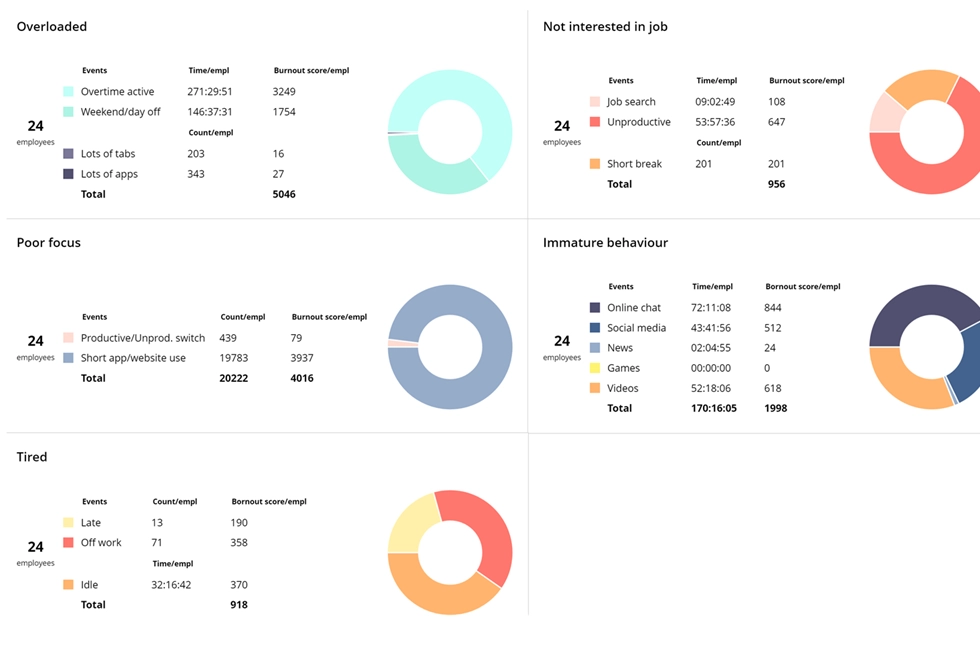

Spot burnout risks before they impact performance. WorkTime report reveals patterns across teams, enabling early intervention and smarter workload management.
Start free trialConclusion
The employee burnout statistics are clear: burnout is not a personal wellness problem. It is a business performance problem that costs employers thousands per employee every year, most of it invisible. Addressing burnout starts with visibility. When managers can see who is overworked and who is showing signs of energy depletion, they can intervene before the damage is done. Invasive surveillance makes burnout worse. Non-invasive monitoring helps prevent it. WorkTime provides that visibility through burnout detection, active time tracking, attendance monitoring, and realistic goal setting. Try it free for 14 days with all features, unlimited employees, and no credit card required.Try WorkTime now!