



TL;DR
- 52% of remote-capable U.S. employees now work hybrid, making it the dominant work arrangement for knowledge workers in 2026
- Workers in a hybrid model saw turnover drop by one-third compared to those required to be in the office full time, with no measurable impact on performance (Stanford, published in the journal Nature)
- 40% of office workers would start looking for a new job if their employer eliminated remote flexibility entirely
- Companies with a hybrid policy save 10% to 50% on office space costs through reduced real estate footprints and better utilization (CBRE)
- 57% of people in a hybrid arrangement report burnout, compared to 61% of those who are fully remote, suggesting that structure and flexibility together support better mental health outcomes (Eagle Hill Consulting).
In this article
The article is brought to you by WorkTime - a non-invasive employee monitoring solution for hybrid, remote, and in-office teams.
Top 30+ data & statistics on hybrid work arrangements
1. Data shows that 52% of remote-capable employees in the U.S. work in a hybrid arrangement. Another 27% work remotely full-time, and just 20% are fully on-site. Eight in ten knowledge workers now have some form of location flexibility (Gallup, Q2 2025). 2. Hybrid and remote work has stabilized globally at roughly 1.2 days per week from home. Among college-educated workers globally, about 25% of all workdays are now done from home. The retreat from pandemic-era levels leveled off after 2023 (Aksoy, Barrero, Bloom, Davis, PNAS 2025). 3. Notably, 88% of U.S. employers offer some form of flexible work option. A quarter extends the hybrid model to all employees, while the rest offer it selectively by role or seniority. Most employees with remote-capable jobs now have at least partial flexibility (Robert Half, 2025). 4. Remote job postings grew from 9% to 24% of all U.S. listings between 2023 and late 2025. On-site-only postings dropped from 83% to 66% over the same period. Separate remote job postings also increased, reaching 11% in Q4 2025 (Robert Half).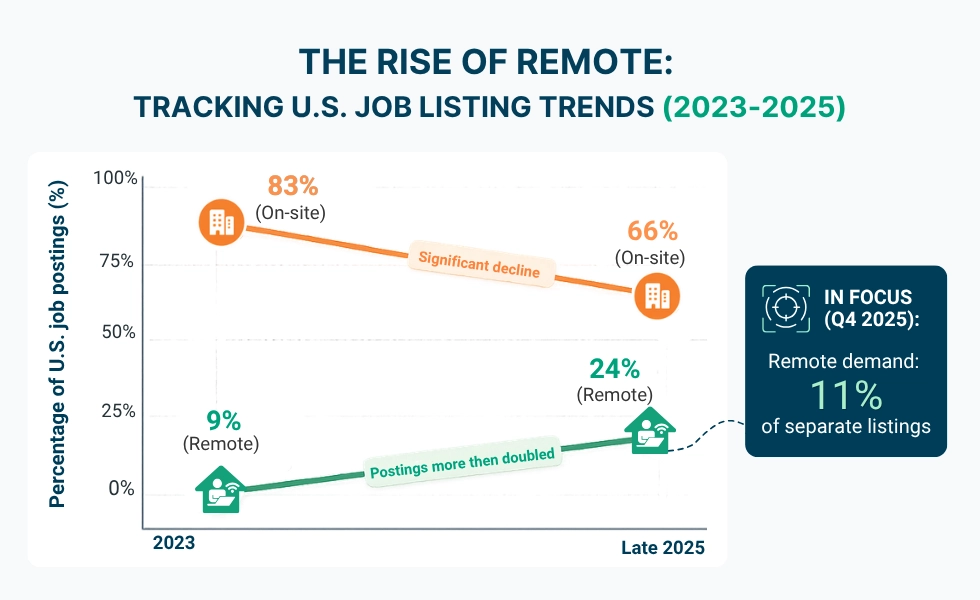
Hybrid work productivity statistics
One of the biggest questions business leaders ask about the hybrid work model is whether it actually works. Here is what the research shows about productivity for remote and hybrid workers. 9. Stanford's six-month experiment with 1,612 employees showed no productivity loss from hybrid arrangements. The study, which appeared in the journal Nature, compared performance reviews, promotion rates, and code output between hybrid and on-site groups. The results were identical across every metric (Bloom, Han, Liang, 2024). 10. Managers who initially expected productivity to drop changed their minds by the end of the experiment. They predicted a 2.6% decline before the study began. Afterward, they estimated a +1.0% improvement. A journal article in Nature found that leadership assumptions about hybrid work were wrong more often than right. 11. The numbers reveal that 69% of managers say remote and hybrid work has improved their team's performance. This represents a significant shift in how business leaders view hybrid and remote work. The data is from Owl Labs' 2025 State of Hybrid Work report, which surveyed 2,000 full-time U.S. workers.Monitor hybrid teams & boost productivity!


Employee preferences and the return to office debate
What do remote workers and hybrid employees actually want? And what happens when companies try to force everyone back to the office? 15. Across industries, 40% of people in hybrid and remote roles would start job hunting if their employer removed the option to work remotely. An additional 22% would expect a raise to compensate, and 5% would quit outright. Nearly half of hybrid workers see flexible hours and remote flexibility as non-negotiable (2025 State of Hybrid Work). 16. About 29% of employees say they would look for a new job if their role became fully in-person. A Deloitte survey found that 65% of Gen Z and Millennials would leave if forced to return to full-time work. Career growth and better work-life balance rank alongside pay as top reasons remote workers and hybrid employees choose flexible arrangements (SurveyMonkey, 2026; Deloitte, 2025).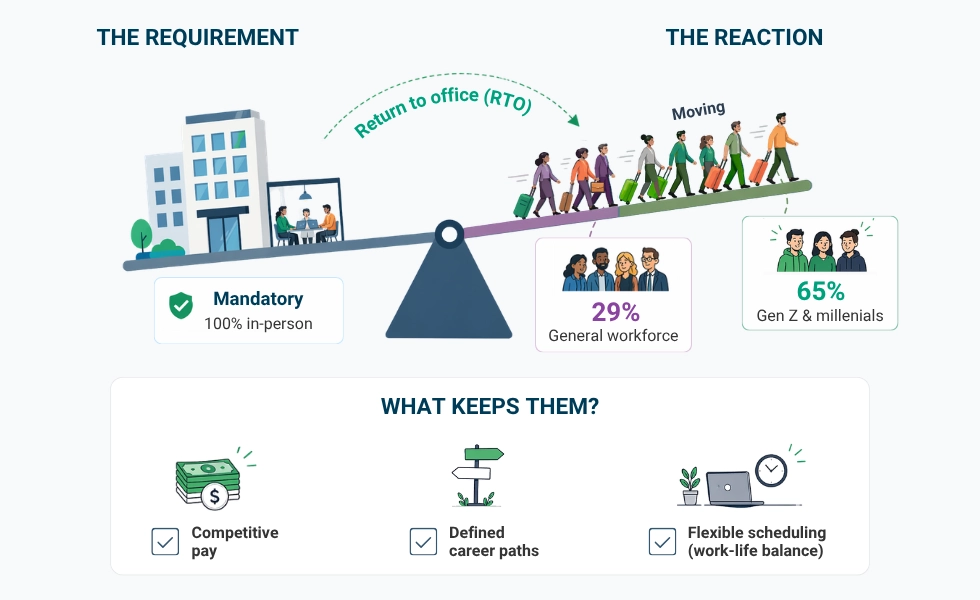
Burnout, mental health, and work-life balance
Flexible work helps with work-life balance, but it also introduces new risks. Here is what the hybrid work statistics show about well-being for remote and hybrid employees. 20. Findings show that 57% of people in a hybrid arrangement report burnout. That is lower than the 61% rate among those who are fully remote and slightly above the 55% overall average (Eagle Hill Consulting, Nov 2025). 21. Gen Z reports the highest burnout rates at 66%. Millennials follow at 58%, Gen X at 53%, and Baby Boomers at 37%. Younger Gen Z remote workers face unique challenges, including digital fatigue, financial pressure, and difficulty disconnecting after work hours. Most workers under 35 report struggling with exhaustion (Eagle Hill, 2025).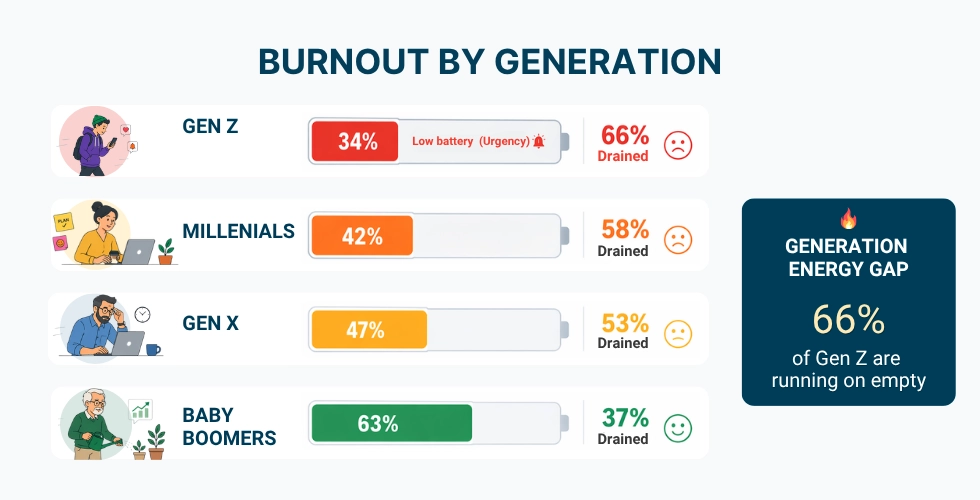
Cost savings and financial impact
Flexible work arrangements affect both employer budgets and employee wallets. 26. Companies shifting to the hybrid model save 10% to 50% on office space costs. Reducing real estate footprint, improving utilization, and reallocating resources toward collaboration tools, food services, and employee experience drive these savings (CBRE, 2025). 27. Employers save up to $11,000 per year for each employee who works remotely two to three days per week. Savings come from reduced office space, lower utilities, and fewer supplies. Commuting costs drop for employees, too (Global Workplace Analytics). 28. Recent findings suggest that 79% of companies with a hybrid policy report cost savings. Additionally, 72% report increased employee productivity, and 71% say flexible work helps attract and retain talent (IWG, June 2025).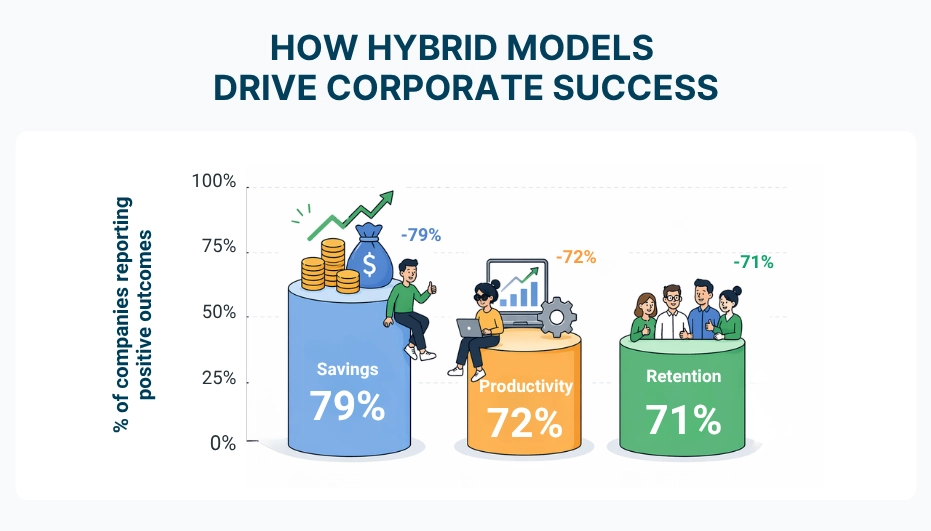
Monitoring and compliance in hybrid environments
Managing remote and hybrid teams requires visibility, but the approach matters. Here is what the data says about employee monitoring in flexible work arrangements. 30. About 68% of North American employers with 500 or more employees use employee tracking software. This number has grown steadily as flexible work became permanent. Most companies use monitoring for productivity insights, compliance, and security (Gartner). 31. According to the recent data, 86% of employees believe it should be a legal requirement for employers to disclose monitoring tools. Transparency is the dividing line between monitoring that builds trust and monitoring that destroys company culture. Hybrid workers and on-site staff alike expect disclosure (2024 State of Hybrid Work). 32. Significantly, 51% of electronically monitored employees feel micromanaged at work. The American Psychological Association found that invasive methods create more problems than they solve. Non-invasive monitoring that tracks productivity scores and active time without capturing personal content avoids this backlash.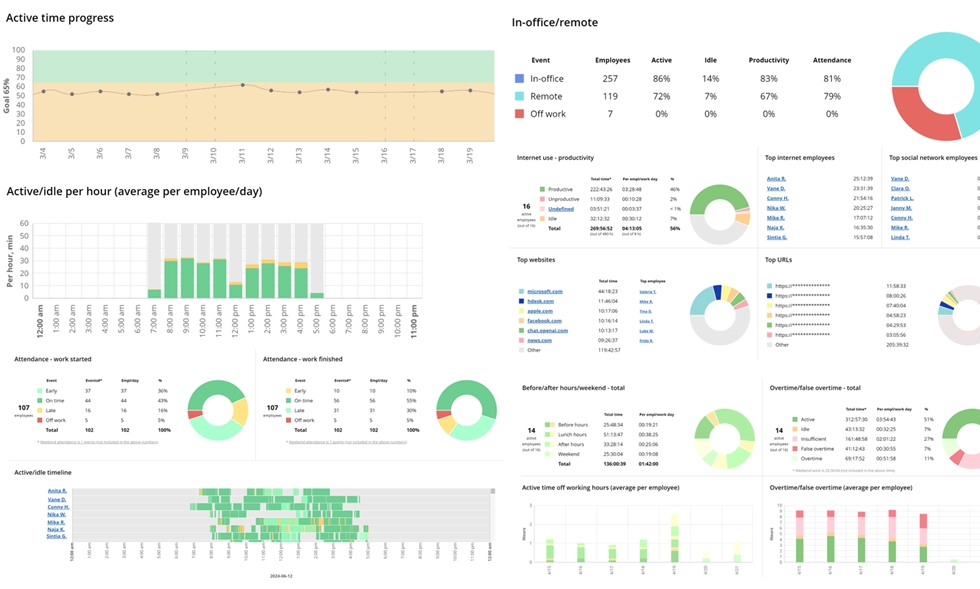

WorkTime offers 80+ comprehensive reports for in-office and remote performance analytics. All reports are transparent and privacy-safe, with no personal content captured.
Start free trialGenerational differences
Gen Z, Millennials, and older workers experience flexible work differently. 34. Only 23% of Gen Z prefer to work remotely full-time, compared to 35% of Millennials, Gen X, and Boomers. Gen Z values in-person collaboration more than older generations. They want the social connection that office space and hybrid meetings provide, but still expect flexibility (ADP Research Institute, 2025).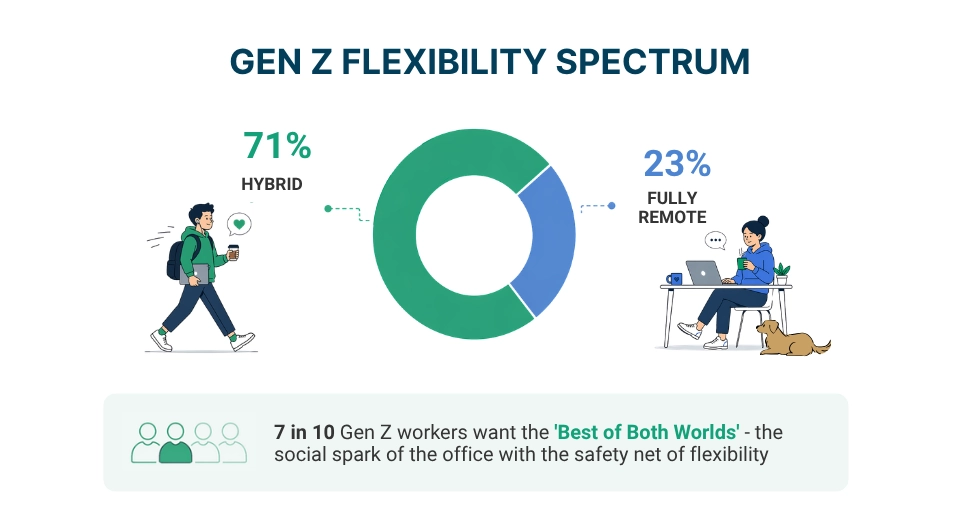
Future outlook
Where is flexible work heading? The future outlook points toward more structure, not less. 37. The average required time on site has climbed to just under three days per week. Three days has quietly become the default, and a growing minority of companies are now pushing for four (CIPD, Archie, 2025). 38. The survey found that 27% of fully on-site employees now work with teams spread across different locations. This figure doubled from 13% in 2023, weakening the argument that in-office employees automatically collaborate better (Gallup, 2025).Monitor in-office, remote,
& hybrid teams!
Final thoughts
The hybrid work statistics paint a clear picture. Flexible work is permanent, productivity holds up, and the companies still pushing everyone back to in-office full-time are working against every major data point in these remote work statistics. But flexibility alone is not a strategy. The organizations seeing the best results pair it with transparent productivity data so they know which teams are performing and where burnout is building. WorkTime provides that visibility through non-invasive productivity monitoring, remote vs. on-site comparison, attendance tracking, and burnout detection. No invasive data collection. Just the metrics that matter. Try WorkTime free for 14 days.Try WorkTime now!