



TL;DR
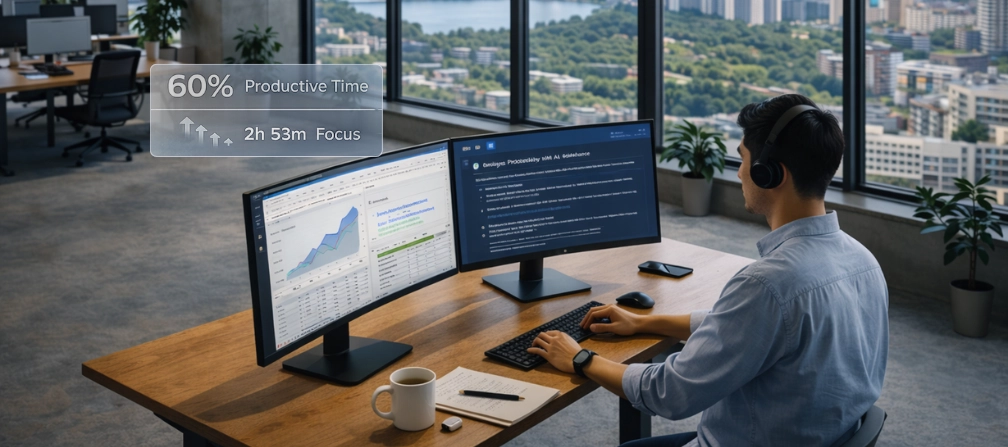
- The average employee is productive for about 60% of the workday. Office workers drop to roughly 2 hours and 53 minutes of focused work per 8-hour shift.
- Global employee engagement fell to 21% in 2024, and the 2-point decline alone cost the global economy $438 billion in lost productivity (Gallup 2025).
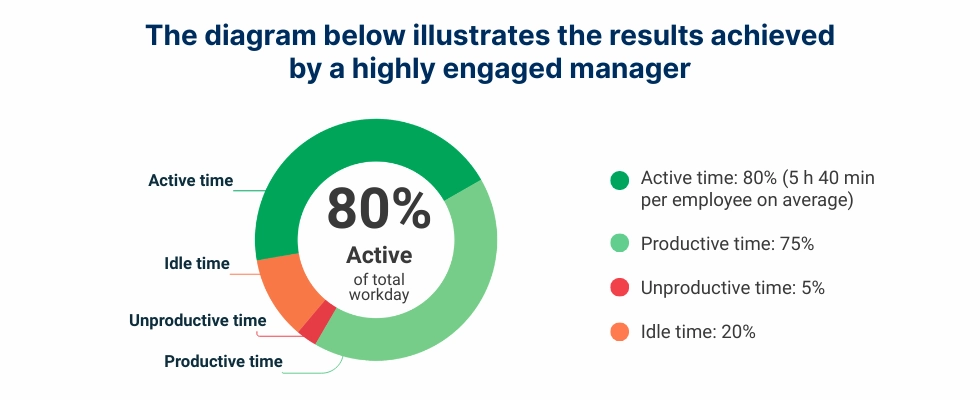
- Highly engaged managers boost team productivity - employees stay active 80% of the day, with 75% of that time spent on productive work (WorkTime statistics 2026).
- Remote workers log 29 more productive minutes per day than in-office employees, and hybrid workers are 33% less likely to quit.
- YouTube is the #1 workplace distraction globally - ranking as the top unproductive site in most countries (WorkTime statistics 2026).
- 72% of employees accept productivity monitoring when it is transparent, and they have access to their own data.
In this article
This article is prepared by WorkTime, an ethical monitoring solution that helps organizations measure productivity, spot early disengagement, and improve performance without surveillance.
How productive is the average employee?
The most widely cited employee productivity statistics paint a sobering picture. Here is what the data shows about how the average employee actually spends their workday. 1. The average employee is productive for only about 60% of the workday. Across all professions, nearly half of every workday is lost to interruptions, context switching, and low-value activities. 2. Office workers average just 2 hours and 53 minutes of actual focused work per 8-hour shift. Research from VoucherCloud found that in-office employees are significantly less productive than the cross-industry average. 3. Research shows 89% of workers admit to wasting time every day. A poll found that nearly 9 in 10 employees report wasting time during working hours. WorkTime computer usage statistics support this: Friday tends to be the lowest-activity day, while Tuesday and Wednesday look almost the same. Monday and Thursday also track closely. Hourly patterns show that activity is strongest between 9 AM and 3 PM on average.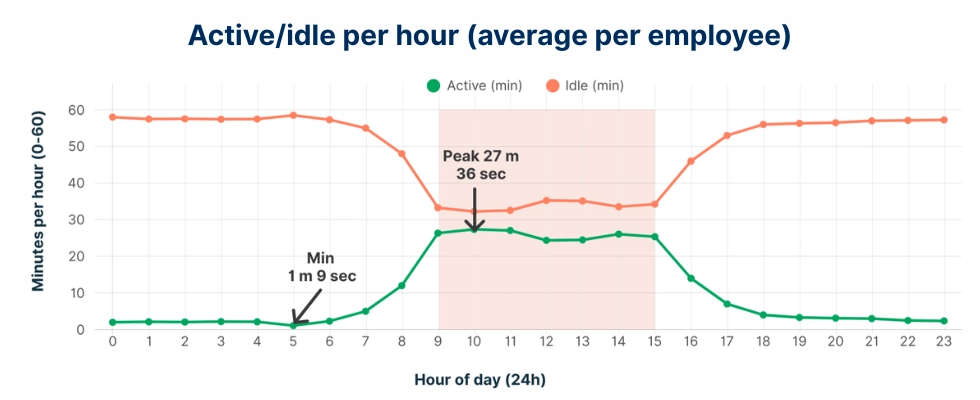
U.S. labor productivity growth
On the macro level, the Bureau of Labor Statistics tracks labor productivity as output per hour across the economy. The latest global data shows strong productivity growth in the United States. 9. Nonfarm business sector labor productivity increased 4.9% in Q3 2025. Output rose 5.4%, and hours worked increased just 0.5%. Year over year, productivity growth was 1.9%. 10. Manufacturing productivity growth reached 3.7% in Q3 2025. This was the largest four-quarter gain since 2021 in the manufacturing sector. 11. Unit labor costs decreased 1.9% in Q3 2025. This means businesses achieved more output per dollar spent on labor, a sign of genuine workforce productivity gains rather than just employees working longer hours. 12. Over the current business cycle (Q4 2019 to present), labor productivity has grown at an annualized rate of 2.0%. That is above the 1.5% rate of the previous cycle and just below the long-term average of 2.1% since 1947. These labor statistics confirm that the broader U.S. economy is getting more efficient, even as individual productivity at the desk level remains stubbornly low. 13. Total factor productivity increased in 12 out of 21 major industries from 2019 to 2024. This accounts for innovation and efficiency beyond just labor input.
Employee engagement and its effect on workplace productivity
Few factors affect employee productivity as directly as engagement. Gallup's State of the Global Workplace 2025 report revealed a workforce-wide problem in these employee productivity statistics. 16. Global employee engagement fell to just 21%, the lowest since the pandemic lockdowns. In the U.S., only 31% of employees reported being engaged in 2024, the lowest figure since 2014, though early 2025 data shows a slight recovery to 32%. 17. Actively disengaged employees cost approximately $2 trillion in lost productivity in the U.S. alone. Globally, low employee engagement costs $8.9 trillion per year, equivalent to roughly 9% of global GDP.
Remote and hybrid work productivity statistics
Remote and hybrid work remain the top reasons companies seek monitoring solutions, and productivity statistics support this. 23. Remote workers log 29 more productive minutes per day than other worker types. These workforce productivity numbers challenge the assumption that office workers are inherently more productive. 24. Statistics reveal that 53% of employees spend more than 60% of the year working remotely. The majority of the workforce is now operating outside traditional office settings for most of the year. 25. Hybrid workers perform just as well as office-based counterparts and are 33% less likely to quit. Stanford research found that remote and hybrid arrangements serve as retention strategies as much as productivity ones. 26. Nearly 70% of managers say remote and hybrid setups have made their teams more productive. Research confirms that managers' perception of distributed work arrangements has shifted significantly. 27. Employee surveys reveal that 90% of employees say their current hybrid work model makes them as productive or more productive than a traditional office setup. From the employee perspective, the numbers are equally clear. 77% of workers are more productive at home, and 26% specifically credit skipping the commute as a key factor in their increased productivity. 28. According to recent surveys, 85% of organizational leaders say they find it harder to measure productivity in a distributed environment. Without in-person visibility, many organizations struggle to know whether employees are hitting goals or quietly disengaging. Transparent monitoring tools that track attendance, active time, and application usage help bridge this visibility gap, especially for distributed and hybrid teams. 29. Workers who feel obligated to work after hours register 20% lower performance scores. Employees who maintain work-life balance perform better over the long term. Remote and hybrid models succeed when they support healthy boundaries rather than erode them. Employee retention improves when organizations respect this boundary; hybrid employees are 33% less likely to leave.How much time employees lose to distractions and meetings
Interruptions and unnecessary meetings are among the largest drains on work productivity. Understanding the scale of these productivity losses helps organizations target the right fixes. 30. Employees are interrupted every 3 minutes and 5 seconds on average. After each interruption, it takes over 23 minutes to regain focus and get back on track. A single distraction can steal nearly half of a productive hour. 31. Interruptions cost roughly $1.7 million per year for a 100-employee organization. These aren't minor inefficiencies. They compound across all teams and departments. By the way, this isn’t only about random browsing. In most countries studied, YouTube ranks as the #1 unproductive website - one of the most common triggers behind those costly interruptions.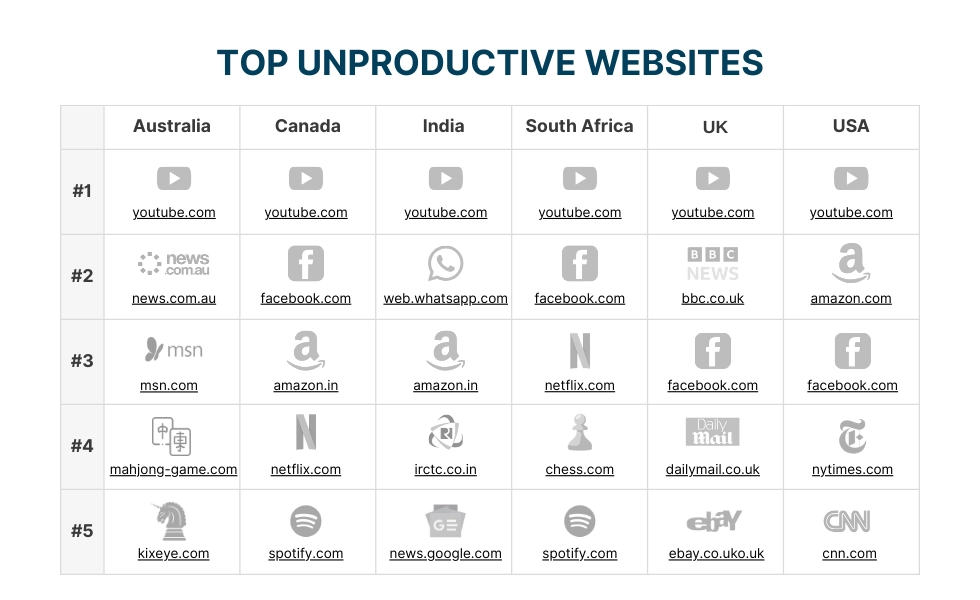
Prevent productivity losses - with WorkTime!


The impact of AI on workforce productivity
The newest chapter in employee productivity statistics involves GenAI. The data is moving fast, and the early results are significant. 39. Workers using generative AI reported saving 5.4% of their work hours. According to the Federal Reserve Bank of St. Louis, when calculated across the entire workforce (including non-users), that translates to a roughly 1.3% increase in aggregate productivity. Per hour of use, AI delivers a 33% productivity gain. 40. Adoption of generative AI at work continues to rise. 37.4% of U.S. workers use generative AI at work as of August 2025, up from 33.3% a year earlier. Three years after ChatGPT's launch, AI adoption already exceeds the rate of personal computer adoption at the same point in their rollout. The labor market is shifting accordingly, with the most AI-exposed occupations around the 80th percentile of earnings. 41. Daily AI users report dramatically better outcomes: 92% see tangible employee productivity benefits. A survey of nearly 50,000 workers found that 58% of daily users reported increased job security and 52% reported higher pay. But only 14% of workers currently use GenAI daily, suggesting massive untapped potential. 42. About 41% of workers have encountered AI-generated "workslop." Stanford research found that poorly written or inaccurate AI output requires nearly two hours of rework per instance. AI tools boost productivity only when applied thoughtfully, with proper oversight. Organizations seeking to improve productivity with AI need training, clear guidelines, and quality checks, not just access to tools.Try AI-powered productivity suggestions
Mental health, burnout, and the productivity connection
Employee well-being has a direct and measurable impact on workplace productivity. As mental health declines, so does output, and the current trends are concerning. 44. Only 33% of global employees rated their well-being as "thriving" in 2024, down from 35% in 2022. Data show that most workers worldwide are struggling, which directly translates into lower output. 45. Productivity anxiety affects 80% of employees, with Gen Z hit hardest at 30% daily. 43% of office workers report feeling burned out at their current job. Mental health issues don't stay contained. They spill into every productivity metric an organization tracks. 46. Global organizations lose an estimated $322 billion annually due to burnout-related turnover and productivity losses. Burnout doesn't just affect individual performance. It drives employee turnover, and turnover costs U.S. employers an estimated $1 trillion per year. 47. Survey data indicate that 95% of burned-out workers are actively searching or planning to search for a new job. When employees feel burned out, they disengage first, then leave. 48. Organizations that excel at positive employee experience are 1.6x more likely to report high performance. A positive employee experience directly counters these trends. Workers who regularly take breaks show 13% higher employee productivity. WorkTime research 2026 also found that highly engaged managers amplify this effect. When managers actively support employees and review the real factors behind performance (not just the numbers), productivity rises even further. In teams like this, employees average 80% active time (5h 40m per day), including 75% productive time.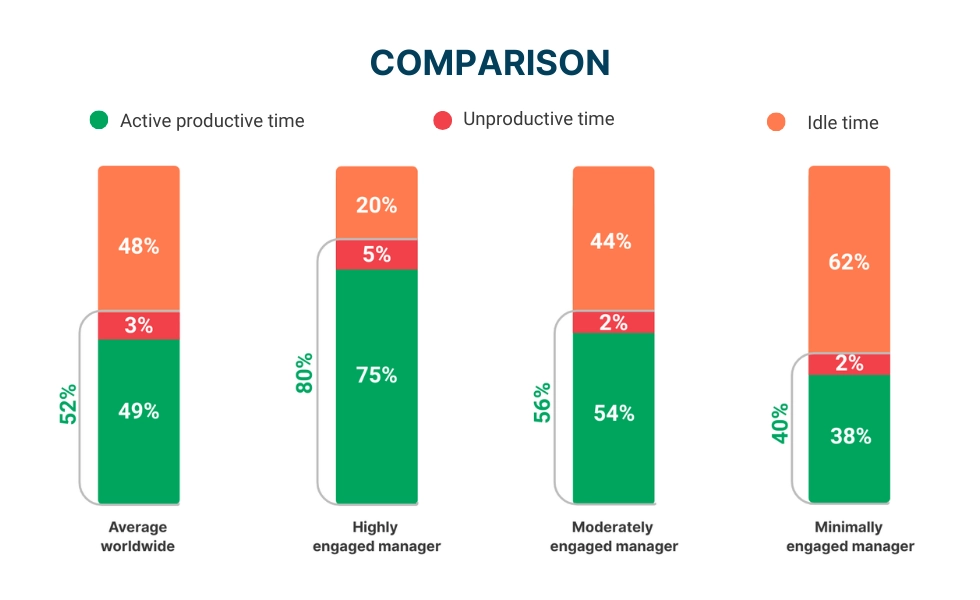
What the data says about measuring employee productivity
51. While 68% of managers believe productivity software boosts performance, 72% of employees feel it either has no effect or actually lowers productivity. A study of 1,000 managers and 1,000 employees revealed this major perception gap. These employee productivity statistics reveal a trust gap that organizations must address. 52. Employee resistance is tied to approach: 20% of employees said they would look for a new job if their employer implemented surveillance-style software. Resistance isn't to monitoring itself. It's an intrusive approach that feels like surveillance.WorkTime - transparent employee monitoring!


Final thoughts
The most effective approaches focus on outcomes rather than surveillance. Measuring productive time, attendance patterns, and application usage provides actionable data without triggering the resistance that invasive monitoring creates. Research shows employees accept and respond positively to transparent monitoring where they can access their own data. WorkTime uses non-invasive methods such as productivity scoring, active time tracking, and distraction analysis to boost productivity and provide visibility without capturing personal content.Try WorkTime now!