


TL;DR
- Micromanagement is rising because leaders want certainty, but constant control creates stress, slows execution, and fuels burnout.
- Most “visibility” problems come from measuring activity instead of outcomes.
- The shift is clear: teams want transparent employee monitoring that supports performance conversations without turning work into a courtroom.
- Non-invasive employee monitoring and trend-based employee productivity analytics help leaders see real patterns without crossing into surveillance.
In this article
The article is brought to you by WorkTime, a transparent employee monitoring solution that helps organizations improve productivity without micromanagement.
What is micromanagement?
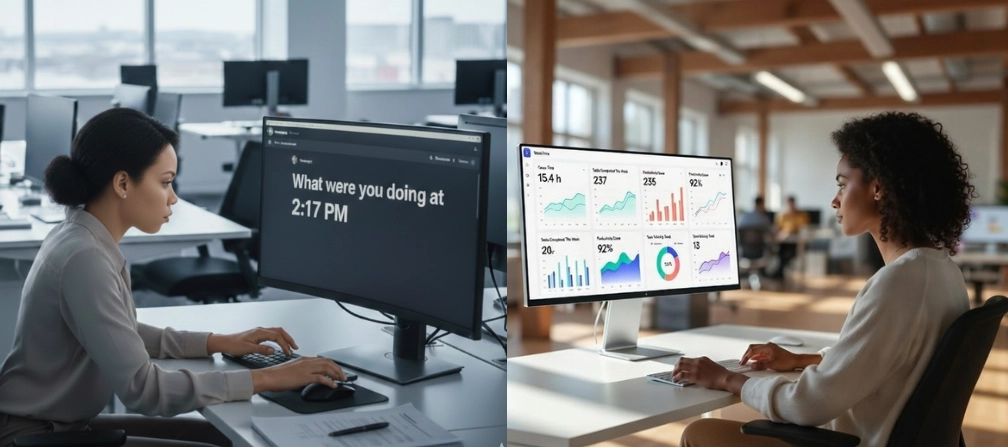
It's a management approach where leaders control how work is done at an excessive level, with frequent check-ins, constant oversight, narrow instructions, repeated corrections, and limited autonomy. For example, say management needs a document, and they are constantly coming into your office asking if it's ready. They proceed to check that the document is printed and then ask how many staplers it took to staple the document, followed by checking the stapler as proof of evidence for the number of staples that were just stapled. This is an extreme version of micromanagement, but it gives a general picture.The most important clarification is this: micromanagement is about control rather than results.A manager may be passionate about results, yet still manage in a normal way, like most normal people. When a manager cannot separate themselves from the project and desires total control, this is micromanagement.
What are the common signs of micromanagement?
Common signs of micromanagement at work include:- Status updates on unnecessary items that disrupt deep work
- Approval processes that require too many signatures for minor decisions
- Assessing employee performance based on online presence vs. actual job performance
- Managers "redoing" employees' work instead of providing guidance.
The difference between monitoring and micromanagement
Monitoring and micromanagement are not the same thing. Monitoring done right gives you the control that you need up to a certain point, while giving your employee enough freedom so that they don't feel like they are working under the weight of a totalitarian regime. Below are some of the key differences.| Category | Monitoring (done right) | Micromanagement |
|---|---|---|
|
Goal |
Support outcomes and planning |
Control behavior and reduce uncertainty |
|
Signal |
Trends, workload visibility, and deliverables |
Moment-by-moment activity and presence |
|
Employee experience |
Clear expectations, fair review, less noise |
Stress, defensiveness, performative work |
|
Risk |
Low when transparent and limited |
High employee surveillance risks + trust erosion |
Stress, turnover, & disengagement - the true micromanagement price
Micromanagement has consequences, and those consequences can be dire.What micromanagement tries to solve, and what it creates instead
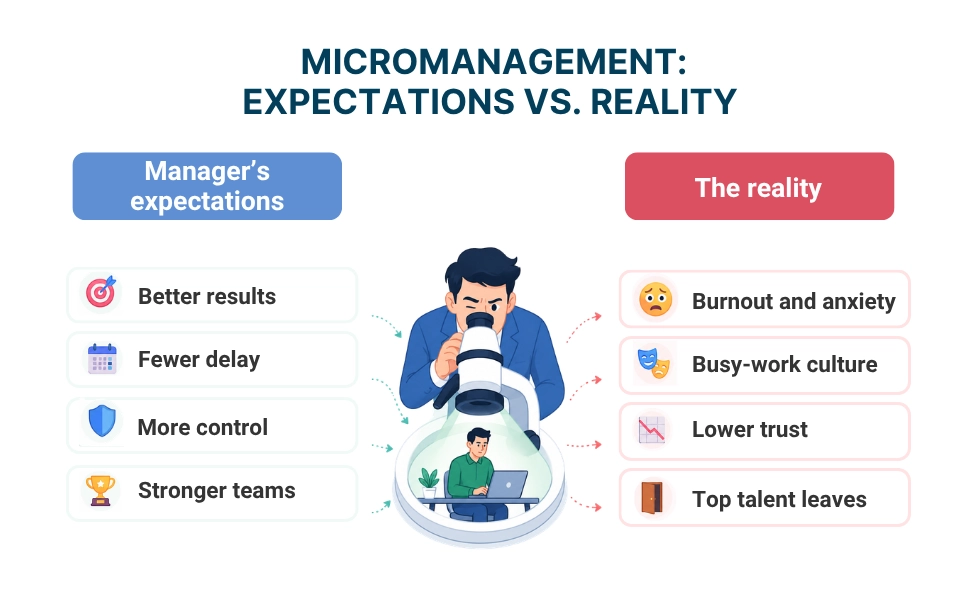
Micromanagement often starts as an attempt to improve quality and predictability. The problem is what it produces operationally over time. What leaders want:- Fewer surprises and missed deadlines
- Clear accountability
- Consistent execution
- Stress and anxiety: constant oversight raises pressure without improving clarity.
- “Looking busy” behavior: employees optimize for activity, not outcomes.
- Trust erosion: teams become guarded and less collaborative.
- Higher turnover: top performers leave first when autonomy disappears.
Why companies lean on control (and why it backfires)
The problem with many organizations’ decision to use micromanaging isn't that they are controlling and love to rule with an iron fist; it's simply because they can't tell what's going on with remote employees and hybrid teams. Management in these companies can feel disconnected from what is happening during each workday. In many cases, there are no systems in place whatsoever to manage things.When invasive monitoring becomes the fastest way to lose trust
A classic scenario that erodes trust all around is screenshot monitoring misuse when private messages and applications are exposed. Will that manager really completely forget this employee had an appreciation for overly muscular women? As it's hard to wipe memories from the human brain, at least yet, the fear of private digital communication making its way onto the screens of your employer can sow a culture of fear.- What do managers lose when trust drops?
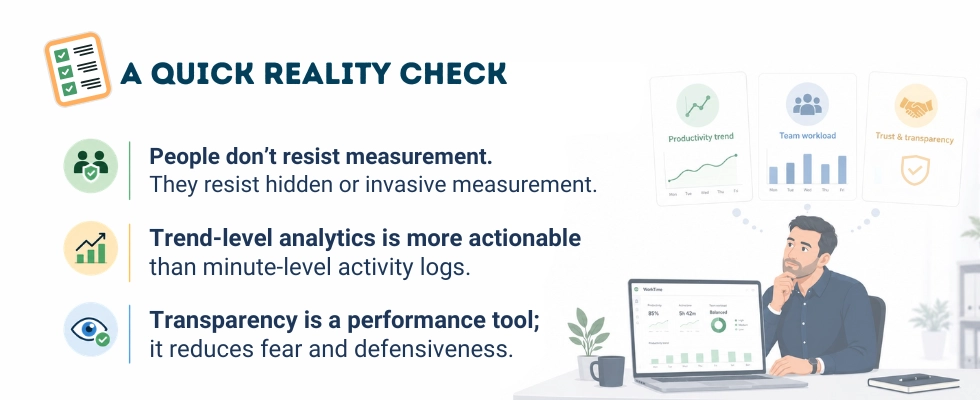
- Employees stop flagging problems early.
- Performance conversations become defensive.
- High performers disengage first (quietly).
- Leaders spend more time policing than coaching.
The shift to transparent monitoring
So, of course, companies need some type of visibility so that they know what's going on with their employees' workflow. Thus, the shift to transparent monitoring has been revolutionizing the remote work movement, making both employers and their employees super comfortable. The shift is happening for practical reasons:- Invasive monitoring tools create more conflict than insight
- Managers need decision-ready signals, not endless activity logs
- Employees want fairness, and fairness starts with transparency.
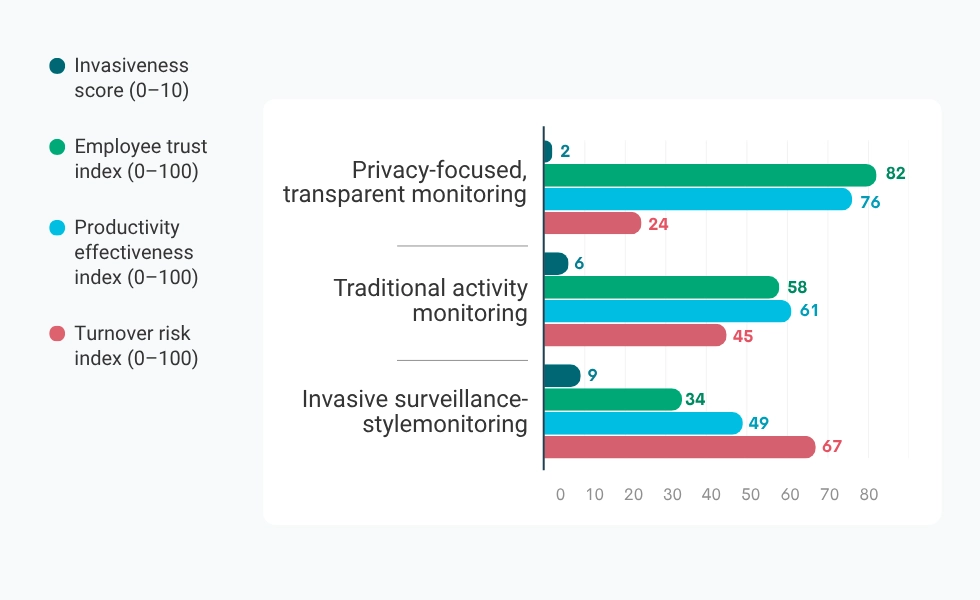
The modern expectation is simple: if you track work, explain what’s tracked, why it’s tracked, and how it helps performance. Transparency reduces fear. Fear reduces performance.This is also why “monitoring vs. micromanagement” now enters a bit of a grey area. If monitoring tools are hidden, invasive, or overly granular, they become exactly like micromanagement, but with a digital and dystopian element. If they are transparent and trend-based, they can reduce micromanagement because managers stop chasing tiny signals.
Privacy-focused monitoring: a productivity game-changer
Since the Enlightenment, human beings have been inclined to value privacy above most else, and monitoring that respects privacy is the model that works.Why businesses choose non-invasive tracking now
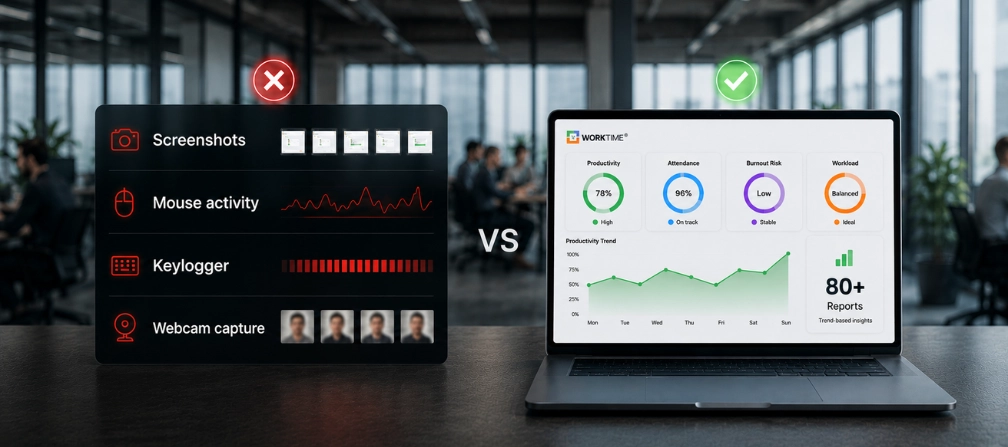
Organizations choose privacy-first employee monitoring and non-invasive productivity tracking because it supports better decisions while reducing surveillance risks. Instead of capturing content, it focuses on responsible signals and trends.| What leaders need | What privacy-safe analytics provides |
|---|---|
|
Workload visibility |
Trend-based capacity signals and imbalance detection |
|
Performance clarity |
Consistency patterns, coaching-ready insights |
|
Lower risk |
Reduced exposure to employee surveillance risks |
|
Healthier culture |
Trust-based measurement that employees can understand |
Meet WorkTime: Zero micromanagement, 100% transparency
WorkTime is designed for organizations that want productivity measurement without turning managers into detectives. Instead of relying on invasive monitoring tools, we focus on in-depth performance analytics.Transparency by design
WorkTime supports a transparent model where employees know what’s tracked and why. Managers gain clarity without overreach, and employees feel respected instead of watched.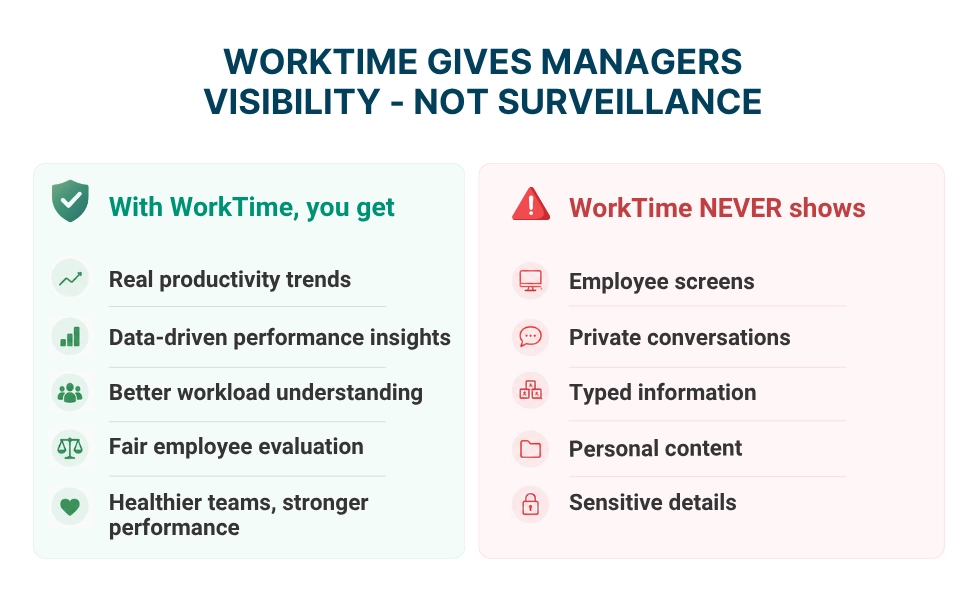
Privacy-safe modes for regulated environments
Many teams operate in regulated environments where privacy and compliance matter. WorkTime includes privacy-safe modes designed to help organizations avoid even accidental collection of sensitive data: GDPR-safe mode - transparent, non-invasive monitoring aligned with privacy expectations. HIPAA-safe mode - prevents collection pathways that could expose health-related data. GLBA-safe mode - no direct/indirect collection of financial and client-sensitive information.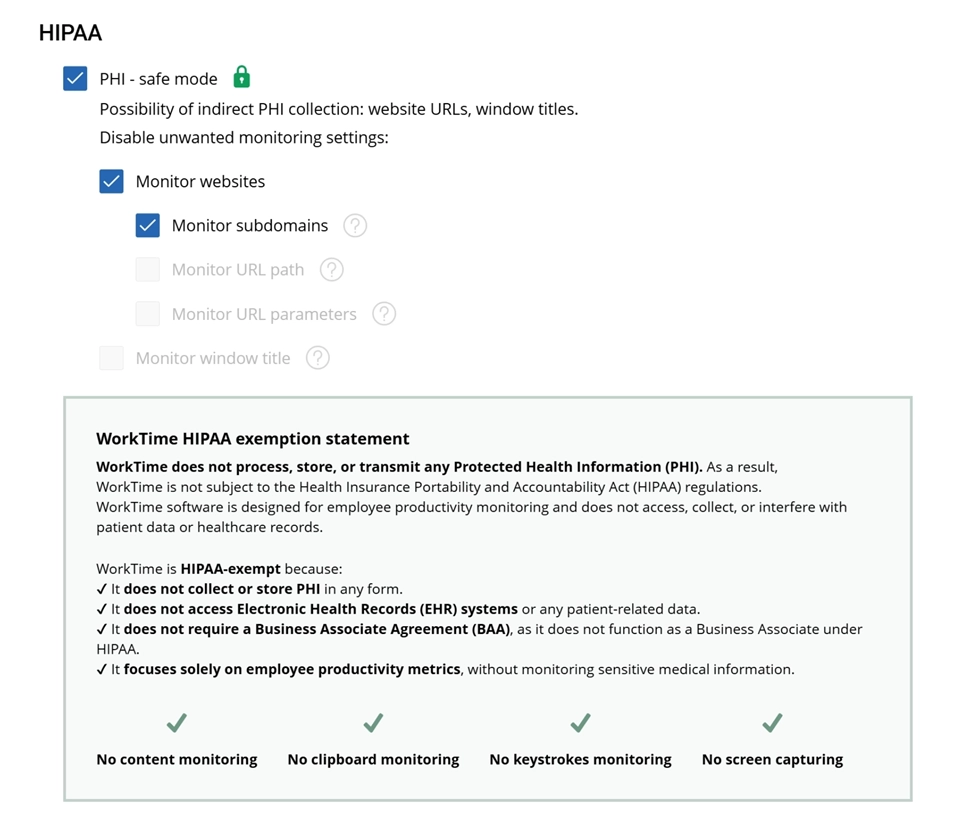

HIPAA-safe mode helps organizations maintain strict privacy standards by preventing any potential indirect collection of healthcare-related information during workforce monitoring.
Start free trialWhat managers gain without overreach
Managers don't need to monitor every action to lead effectively. They need reliable insights that help them understand how work is progressing. WorkTime replaces constant check-ins and guesswork with objective performance analytics, giving managers the visibility they need to support teams, improve productivity, and make informed decisions. With WorkTime, managers gain:- 80+ comprehensive performance reports for in-depth workforce analytics;
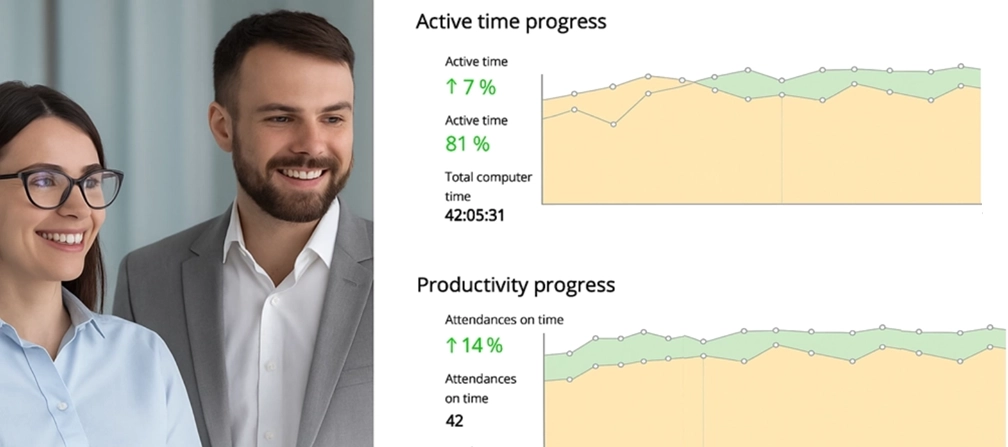
- Productivity trends that reveal long-term performance patterns instead of isolated moments;
- Attendance insights across in-office, remote, and hybrid work environments;
- Real-time team visibility without screenshots, keystroke logging, or other invasive monitoring practices.


Bottom line: the future of productivity is non-invasive
Everyone hates micromanaging. Even someone who micromanages themselves will loathe the day they themselves are micromanaged by a superior. No one wants the "eye of Sauron" watching their every move, and thus, to keep everyone on the team happy, both bosses and employees, non-invasive monitoring is the way things are headed. With technology as it is today, solutions like WorkTime offer you the best of both worlds - light monitoring with a focus on trends and goals and employees who feel trusted and valued.