



TL;DR
- Fake productivity is the gap between visible effort and real outcomes, a form of looking busy at work that often comes from fear and unclear expectations, not laziness.
- The core failure is confusing productivity vs. activity: full calendars, fast replies, and long online hours can coexist with low-impact output.
- Leaders fix this by shifting from surveillance to insight: employee productivity analytics should reveal patterns over time, not police moments.
- Ethical employee monitoring and privacy-first productivity tracking help managers see productivity patterns without turning work into a courtroom.
In this article
This article is prepared by WorkTime - giving teams clear productivity insights without screenshots, spying, or invasive tracking.
What “looking busy” really means
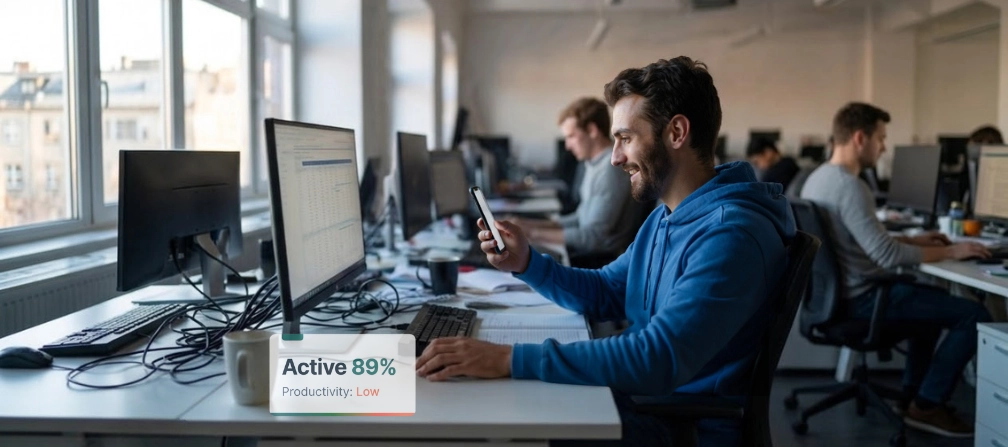
Looking busy is better classified as fake productivity, and fake productivity is work that looks like it is producing results, but behind the curtain, it's doing nothing. Although employees are doing their job and answering messages, attending meetings, and tracking their hours, they are not generating the results that should be forthcoming. And this is where "productivity" and "activity" differ. Activity with no meaning leads to nothing. Sometimes fake productivity is not the result of intentional action. Employees are motivated by incentives. If there is more visibility into immediate availability and speed of response, and less visibility into delivering meaningful results, employees will act accordingly. For instance, an employee may answer every message as soon as they receive them, attend five meetings per day, and stay logged onto their computer until the end of the business day; however, they will accomplish very few important tasks. In this case, employees are putting forth effort, but ultimately, the organization is paying for the activity rather than the actual value delivered.Activity vs. results: what leaders should measure instead
So, how to spot this scourge of fake productivity? Look for the signs.| Common “busy” signal | Why it can be misleading | Stronger result signal |
|---|---|---|
|
Full calendar |
Meetings can replace focus time |
Completed high-impact tasks |
|
Fast replies |
Responsiveness can crowd out deep work |
Meaningful progress milestones |
|
Long online hours |
Can reflect fragmentation or overload |
Finished deliverables and quality outcomes |
|
Many meetings attended |
Attendance is not a contribution or decisions |
Fewer blockers; clearer decisions |
|
Constant app switching |
Can signal shallow work, not productivity |
Protected focus blocks and completion |
How to detect fake productivity at work: key signs managers miss
The real way to identify "pretend-to-work" behavior is to find patterns of increased activity that are not followed by a corresponding increase in productivity. When you see this type of pattern emerge in your organization, it can be identified through the use of trends (ratios) and patterns of when employees are focused on their work versus busy with meetings or other non-productive activities.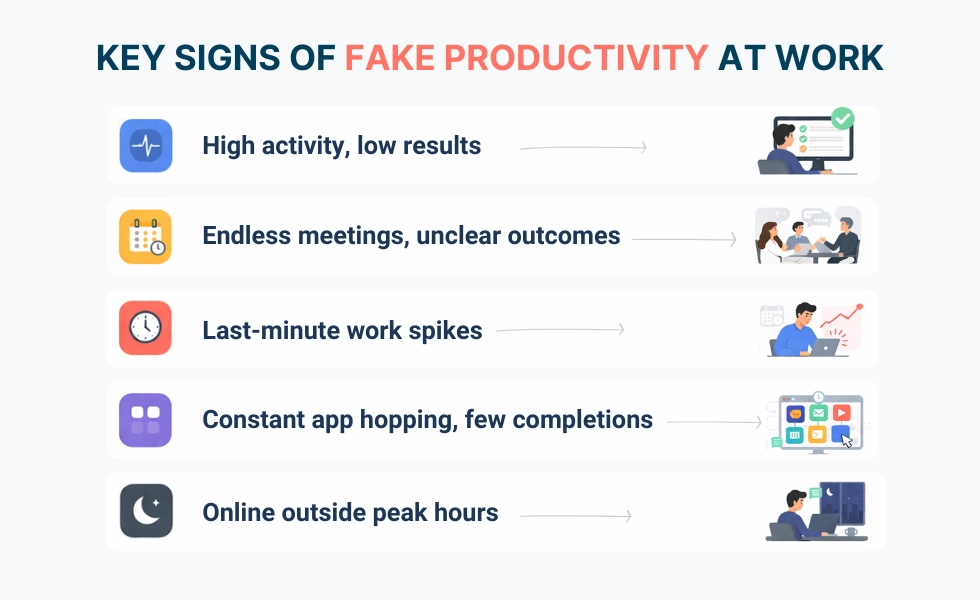
Why employees fall into the “looking busy” trap
Fake productivity is usually driven by fear. No one wants to lose their job for being perceived as lazy. Several drivers push teams toward visible busyness:1. Fear of being seen as idle
It is common in remote and hybrid teams. When managers can’t visibly see work happening, employees compensate by staying constantly available and responsive.2. Micromanagement pressure
It often happens when responsiveness is rewarded over completion. Leaders unintentionally train teams to optimize for visibility instead of meaningful output.WorkTime - transparent productivity monitoring!


3. Ambiguous KPIs
Unclear definitions of good performance? When expectations are vague, employees default to safe activity signals that “look like work.”4. Overwork culture
Long hours become a status symbol. Time spent working is praised, even when output stays flat.5. Meeting overload
Attendance replaces contribution. Being present in meetings becomes the default proof of productivity.The true cost of “looking busy” for workplace productivity
Looking busy seems harmless until it causes actual problems. And those problems can eventually lead to problems with your bottom line.Looking busy hides workflow and performance problems until they become expensive. Then, leaders are forced to react under pressure.
Cost 1: Burnout without progress
Constantly being responsive, changing tasks, and being available burn out employees; however, it does not move the work forward.Cost 2: Missed deadlines despite “full” schedules
When employees can't concentrate on their tasks (i.e., "focus time"), the pace of project completion slows. Projects fall behind because everyone appears busy throughout the day, yet the projects' backlogs do not diminish.Monitor employee attendance non-invasively
Cost 3: Managers misread performance
When managers use signs of activity as indicators of performance, they will be rewarding being responsive, attending meetings, etc., rather than achieving results. That creates an environment where output-based performance is invisible, and visible busyness is the safest way to operate.Cost 4: Top performers disengage or leave
Some high producers complete their work quietly. Once high producers see performative work being rewarded instead of actual results, they perceive the organization as unfair. At this point, the best employees exit first.When activity rises, but output falls: visualizing fake productivity
The pattern behind “looking busy at work” often becomes clear when you compare visible activity with real outcomes over time.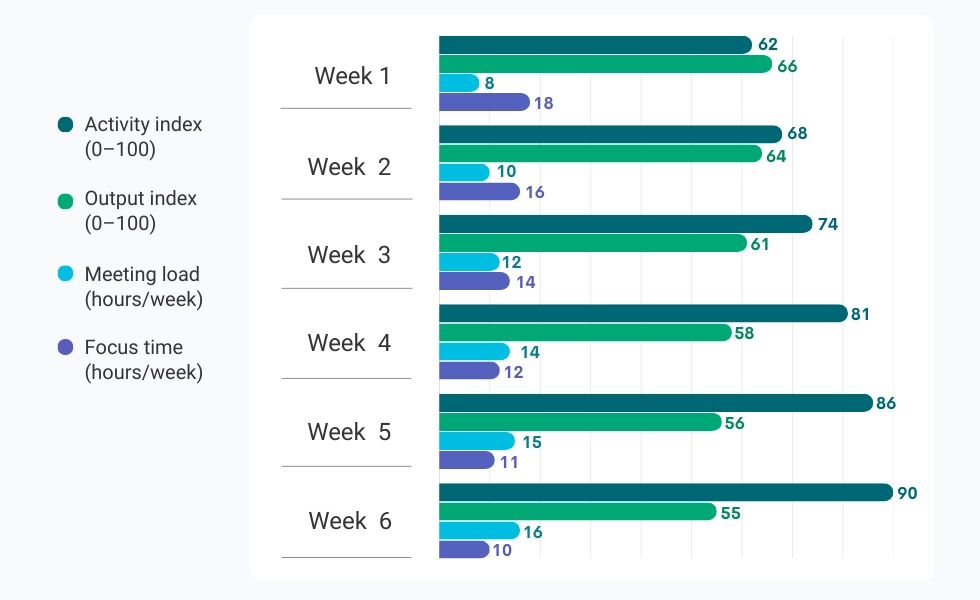
Fixing fake productivity without micromanaging: the WorkTime approach
The objective isn’t to "snag" or identify when employees are faking their work habits. The aim is to address the conditions that are making it easier for employees to be busy-looking as opposed to being productive. It's time to take some proper measures. Most traditional methods of monitoring exacerbate the issue by encouraging workers to continue engaging in productivity theatrics. Ethical employee monitoring looks toward the outcome and trends.
Shift from surveillance to insight
Surveillance-based tracking tends to capture isolated moments of activity. It rarely provides meaningful insight into progress, workload sustainability, or whether the team has become overly meeting-driven. WorkTime supports a different model of employee productivity tracking with privacy as the top priority.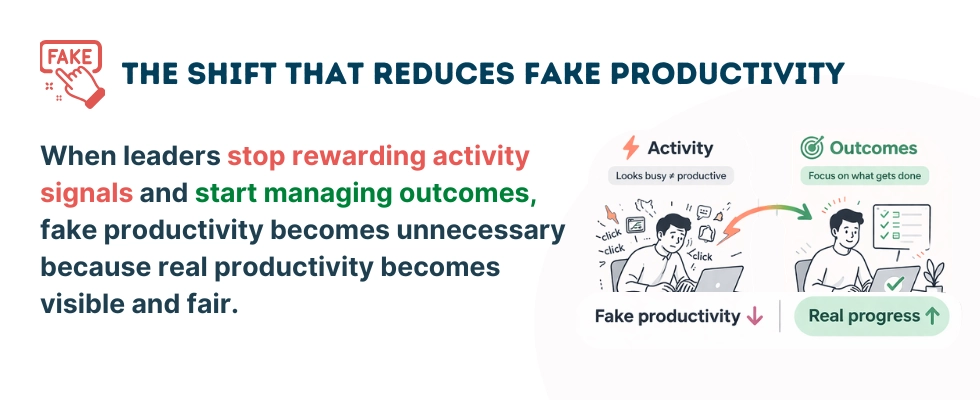
Measure productivity patterns over time
While fake productivity may be an immediate problem for most employees, it typically develops gradually. As meeting times increase, so does the amount of time employees spend focused on their work. Over time, focus quality declines, and so does real output. Employees may appear busy, but the work produced is often weaker and less efficient than expected. WorkTime solves that problem by looking at the following:- Meetings vs. output. Is time spent producing results? Track meeting load and compare it to delivery progress to identify meeting overload.
- Focus time vs. busy time. Can people do deep work? Spot when attention is fragmented and real productivity becomes structurally difficult.
- Consistency trends. Is the output stable or drifting? Identify productivity patterns over time to catch early declines before they become cultural.
- Workload imbalance. Who is carrying the load? Reveal when top performers are compensating for noise-heavy workflows.
Use transparent, privacy-first tracking
Privacy-first productivity tracking reduces that friction because it is built around transparency and minimal data capture. WorkTime’s approach supports ethical employee monitoring by focusing on trends and reporting instead of screenshots, keystrokes, or sensitive content capture.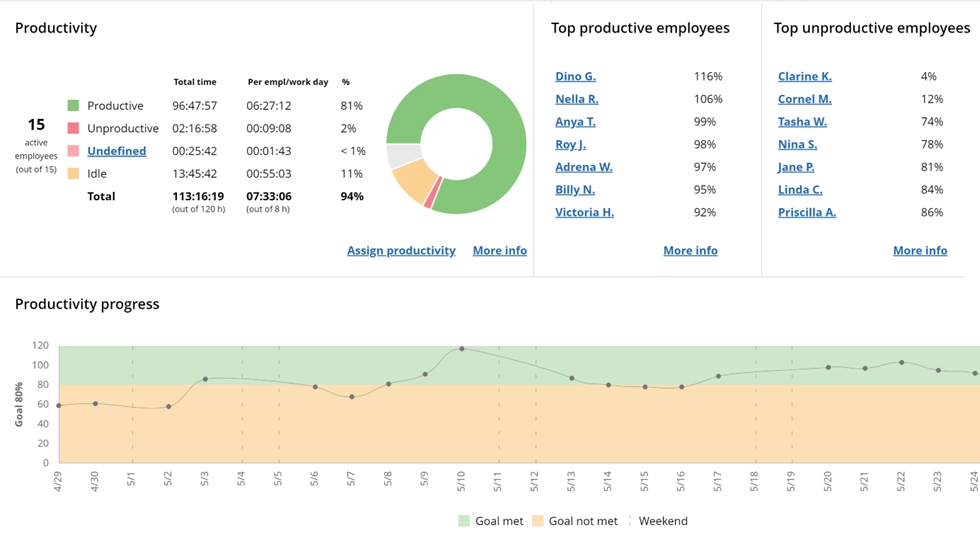

WorkTime analyzes an employee's screen productivity in a non-invasive manner. Take a glance at this report to evaluate your team's productivity right now.
Start free trialTurn fake busyness into real insights
Looking busy is kind of an art, and you might know some people who have mastered that art so well that they are actively being poached by other companies to "look busy" for them. But for employers, looking busy is a scourge that must be stopped, no matter how Oscar-winning the employee's performance. The goal is to gain real insight, and the only way to do that is to get a grasp of performance analytics with tools like WorkTimeTry WorkTime now!