


TL;DR
- Trust without accountability sounds empowering, but in remote teams, it often creates blind spots that quietly hurt delivery and morale.
- Remote team performance improves when leaders shift from “checking on people” to building shared visibility into workload and outcomes.
- Remote team accountability works best when it is fair, trend-based, and designed to support teams, not police them.
- Transparent monitoring and privacy-first monitoring make reporting usable because employees understand what’s tracked, why it matters, and how it’s used.
In this article
The article is brought to you by WorkTime, a non-invasive monitoring software designed for transparent & privacy-safe productivity insights.
Why trust alone fails in remote teams
Trust is something cultivated between human beings that usually takes place in person. As it's in person, everyone has complete visibility of everyone else, and even though their work isn't being tracked in real time, their presence in the office makes them "visible" to everyone. Without that visibility, trust can start to fall apart.Trust without visibility will create blind spots
This is where the phrase trust without accountability becomes practical. It doesn’t mean leaders distrust employees. Leaders have no way to detect:- Workload imbalance (one employee quietly taking on 2+ roles)
- Process bottlenecks (handoffs slowing down delivery)
- Meeting overload (Time disappears with no output)
- Hidden disengagement (less initiative, slower responses, fewer updates).
Maintain transparency & trust - with WorkTime!


Remote work trust without structure often creates fairness issues
Distributed teams are more likely to create an uneven "trust" dynamic because some individuals may be given greater latitude than others. Some roles may also be inherently more visible, while others will remain more hidden. To make your remote team accountable requires standards that are consistent across all members of the team. When a team has a lack of quality reporting metrics, leaders are left with their own perceptions about how the work is being completed. Those impressions are not always objective. The most common impression leaders develop tends to favor employees who are responsive, available, and online at all times (even if those employees are producing superior results in less noticeable or quieter ways).Accountability - the link between trust & performance
Accountability is often misunderstood. In remote teams, it does not mean surveillance. It does not mean micromanagement at work. And it does not mean turning people into dashboards. Accountability in remote teams means shared visibility into effort, time, and outcomes, so work can be supported and improved.Redefining accountability in remote teams
A healthy definition looks like this: remote team accountability = clear expectations + data-driven reporting + follow-through. Not “watching people,” but understanding patterns so leaders can coach and teams can plan. This is why remote work accountability should answer simple questions:| What’s happening? | Where is time going? | Who needs support? |
|---|---|---|
|
Understand the direction of work. |
See how effort is actually distributed. |
Identify overload and bottlenecks early. |
|
|
|
Why accountability benefits employees too
When there is transparency in both accountability and how to monitor it, employees can win, too. This data provides a visible record of which individuals have done additional project assignments, covered gaps, and/or done the "glue" work necessary to keep all elements of a business operational. This transparency also eliminates the "invisible tax" paid by many high performers. This "tax" is the fact that their efforts are ignored as long as they never voice a complaint.When monitoring goes too far, the trust breaks
Monitoring is not automatically bad. But many organizations confuse “monitoring” with “accountability.” When they implement invasive tracking, they do not create accountability; they create fear.Trust-breaking monitoring practices
Again, running a remote team properly is based on both trust and visibility, but sometimes visibility can get construed, and it turns into monitoring. Intense monitoring can have an adverse effect and break trust. For example, trust-breaking monitoring practices are usually easy to recognize. They include screenshot capture, keystroke logging, webcam or audio recording, and hidden or undisclosed tracking rules. While these tools are often introduced with the intention of improving oversight, they frequently have the opposite effect on remote work trust. What employees start doing in response is subtle but damaging. Instead of focusing on meaningful outcomes, people begin optimizing for “looking busy.”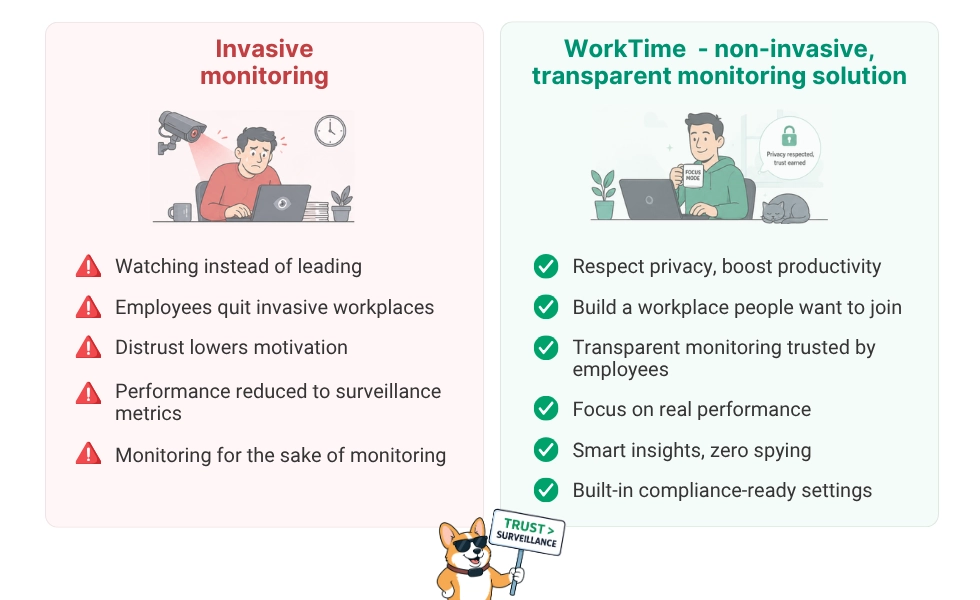
The business impact of trust-breaking monitoring
Monitoring that crosses a line will cause a steady decline in your team's performance, but usually not right away. You desire accountability with your remote employee, a stronger performance, and a better understanding of what is going on. That being said, invasive tracking can create an environment of fear, defensiveness, and "performance theater" as opposed to actual good work. People continue to keep screens active so they appear productive, send messages for optics, and create dashboards filled with data that increases the level of noise rather than clarity. Ethical monitoring will provide accountability by showing you patterns and results, and it doesn't lead to people fearing your "security state" of a business organization.How privacy-first reporting strengthens performance
Reporting is the middle path: it gives leaders performance visibility without turning work into surveillance. This is where privacy-first monitoring matters, because it shapes employee experience.What transparent reporting looks like
Transparent reporting shouldn't feel like surveillance; rather than looking at each individual task or event on a daily basis, healthy reporting should focus on overall trends, workloads, and performance over time. Privacy-first reporting typically includes:- Trends over time (week-over-week patterns)
- Team-level insights before individual deep dives
- Workload transparency and workload distribution signals
- Data-driven reporting that supports coaching, not punishment.
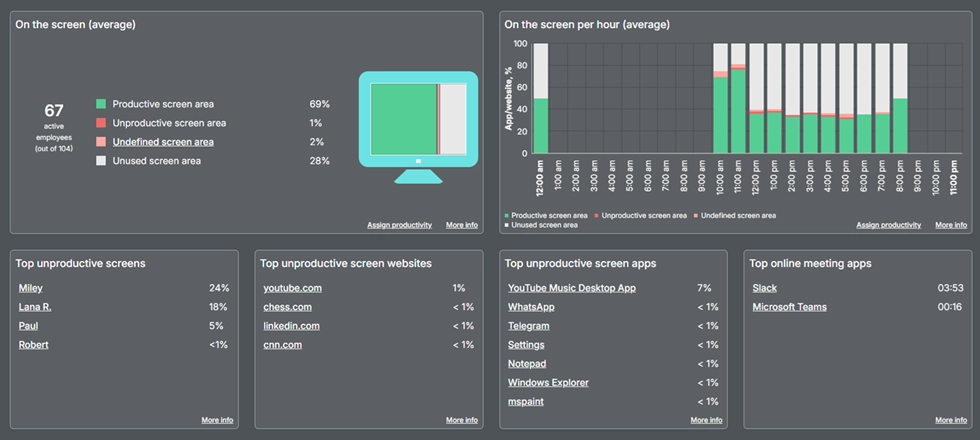

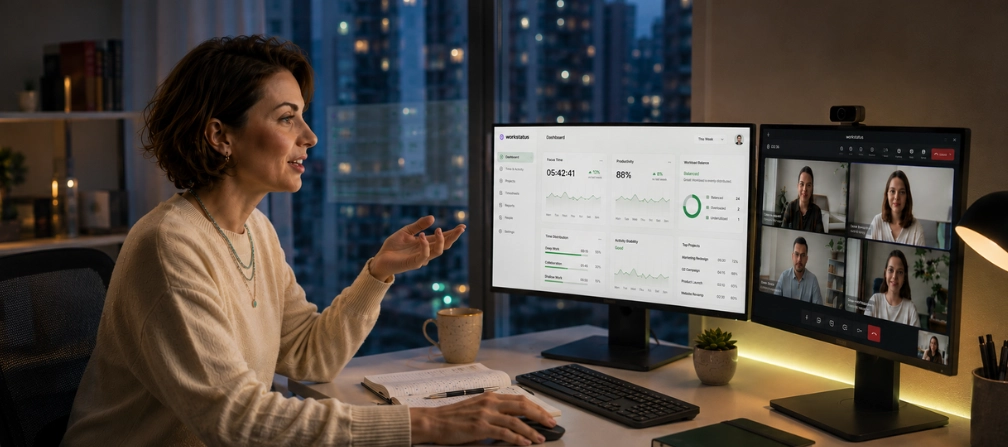
Analyze screen productivity without intrusive tracking. WorkTime categorizes apps, websites, and documents to provide a real-time productivity overview.
Start free trialHow reporting builds trust in remote teams
When reporting is transparent, there is less guessing. Instead of managers asking "How much are you working?", managers ask better questions, such as "Why was this week busier than last?" This is how transparency in monitoring builds a strong cornerstone for trust when managing your team. When a manager has no way to extract data regarding performance, they might overload the week with pointless meetings. Visible, trusted reporting, like WorkTime employee monitoring, alleviates blind spots and helps build the trust that is needed.Remote accountability works best when it answers the right questions
This illustration shows how remote accountability shifts as organizations move from guessing to accountability through privacy-first reporting. The figures below are based on a small fictional dataset with no association to any real company and were used to create a simple bar chart. The example illustrates how managers often rely on assumptions when reporting in the absence of visibility, compared to reporting supported by transparent data and productivity trends.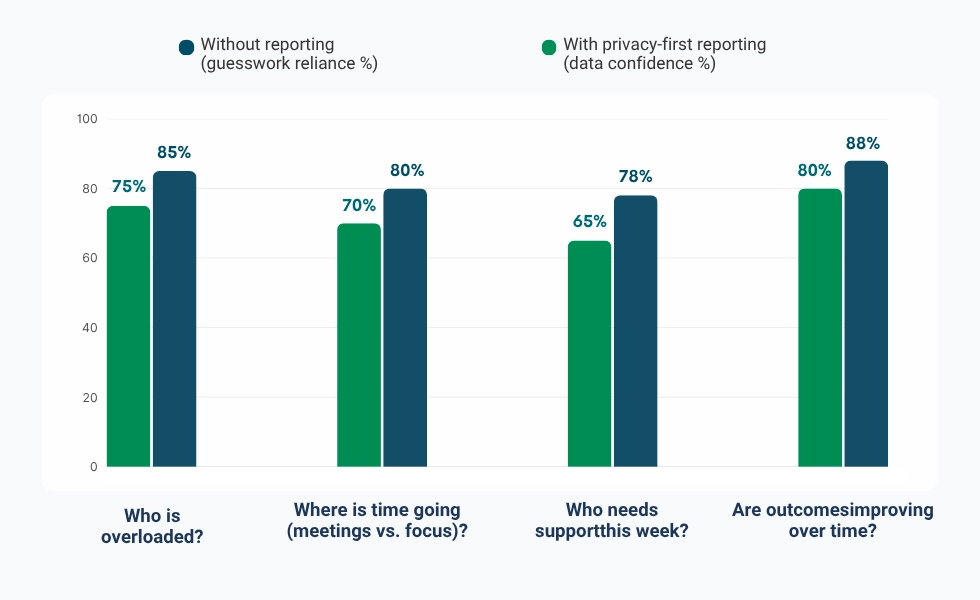
How WorkTime delivers accountability without breaking trust
WorkTime is designed to deliver in-depth performance analytics in a way that respects employee privacy while improving performance through enhanced visibility and transparent reporting.Non-invasive monitoring approach
WorkTime uses a privacy-first, non-invasive monitoring approach that gives businesses visibility into productivity without collecting sensitive personal data. The system is built to avoid invasive tracking methods commonly associated with employee surveillance software. That means:- No screenshots are taken;
- No keystrokes are logged;
- No private messages, emails, or chats are captured;
- No hidden employee surveillance practices.
Transparent performance trends
WorkTime provides privacy-first visibility through trends and reporting:- Remote workforce performance reporting through patterns and trend insights
- Productivity reporting that improves performance visibility without micromanagement
- Workload transparency signals that help protect high performers and reduce burnout risk
- Data-driven reporting that supports coaching conversations instead of policing.
Compliance-ready reporting
Organizations in regulated industries have mandatory privacy expectations, yet remote teams require some level of accountability. Organizations can leverage monitoring for accountability purposes without risking exposure of private information or creating risk for non-compliance. WorkTime offers a reporting approach with features designed to minimize the potential for collecting sensitive information by default and provide visibility into employee performance. Its GDPR-safe, HIPAA-safe, and GLBA-safe monitoring modes help organizations maintain productivity without creating unnecessary privacy or compliance risks. So, businesses in regulated industries can monitor performance while respecting employee privacy and protecting confidential information. What makes WorkTime compliance-ready?- Non-invasive monitoring without screenshots, keystroke logging, or content capture;
- Reduced exposure to regulated, confidential, or client-sensitive information;
- GDPR-safe mode that is designed around transparency and data minimization principles;
- HIPAA-safe mode that helps avoid indirect collection of Protected Health Information (PHI);
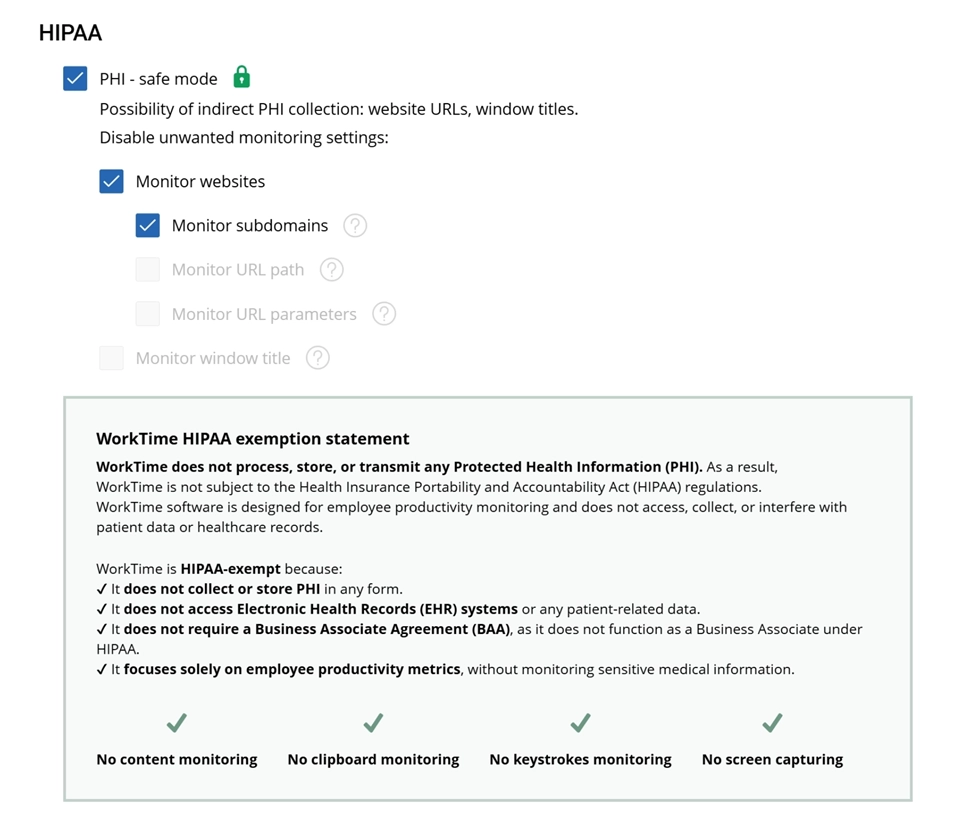

HIPAA-safe mode restricts data points that could indirectly contain healthcare-related information, supporting secure and compliant monitoring.
Start free trial- GLBA-safe mode that protects confidential financial and customer-related data;
- Transparent productivity reporting that supports accountability without invasive surveillance practices.
When trust meets transparent monitoring, performance follows
Remote teams have no ability to decide both how and when they are to be held accountable, nor do their peers. They should be able to choose from a model where accountability exists to allow for an environment that supports trust (and vice versa), to ultimately foster performance. To achieve this, remote teams need to eliminate invasive monitoring techniques to create a climate of fear and instead utilize reporting tools to provide clarity. Reporting tools would be created with trend analysis of employee performance, transparent workloads, and reasonable expectations of what the team can produce in a certain timeframe.Try WorkTime now!