



TL;DR
- Hybrid work can raise flexibility but also hide coordination and trust issues.
- Most hybrid work productivity problems come from unclear goals, not location.
- Invasive monitoring tends to backfire; transparent signals support managing hybrid teams.
- Hybrid works best when performance is visible without anxiety or privacy tradeoffs.
In this article
This article is prepared by WorkTime, a productivity-focused monitoring solution that helps hybrid teams boost output, maintain trust, and protect employee privacy.
The hybrid work debate: does it really work?
The hybrid model was adopted as an attempt to meet structural pressures as opposed to a cultural shift in the way leaders think. After the pandemic, when offices opened again, many employees were resistant to returning to the "old normal." Employers wanted to maintain operational consistency and implement a combination of in-office and remote work models. Hence, hybrid work was born and became commonplace. But does it work? With remote work, there are a few important tension points. Leaders need visibility into the work done by employees to hold those employees accountable. Employees often interpret increased monitoring as a lack of confidence in their ability to do their jobs. At the same time, employers need to use tools and quantifiable metrics to measure productivity. This creates conflict between organizational demands for accountability and employee concerns about surveillance and personal boundaries. These issues become especially visible in hybrid meetings, where in-room participants dominate the conversation, and remote workers struggle to say anything.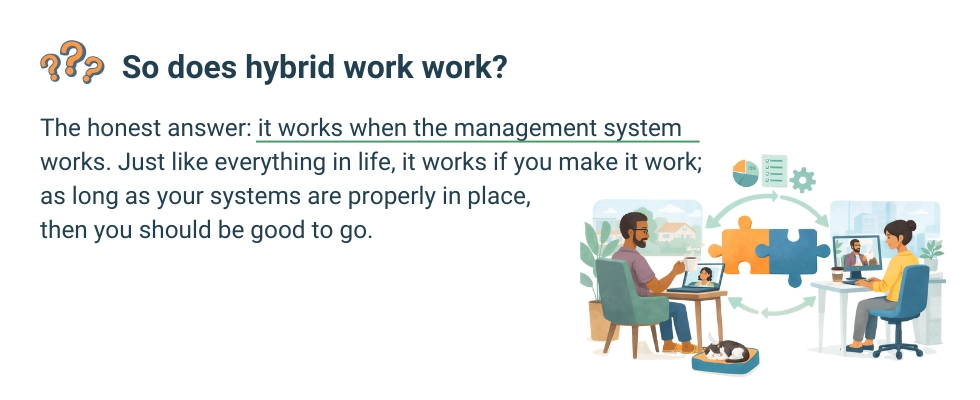
Why companies love hybrid work (and invest in it)
There is real upside to hybrid work for all the stakeholders involved, which is why it's sure to continue:| Stakeholder | Hybrid work benefit | What it improves | What can break it |
|---|---|---|---|
|
Company |
Broader hiring + retention |
Staffing stability |
Proximity bias; unclear performance signals |
|
Manager |
Flexible coverage |
Operational continuity |
Coordination overhead: “invisible work.” |
|
Employee |
Autonomy + less commute |
Focus and well-being |
Always-on culture; privacy anxiety |
Where hybrid work quietly breaks down
Having a presence in an office comes with challenges, and so does hybrid work. The manager’s side of hybrid work:- Difficulty tracking productivity without making employees feel policed.
- Coordination challenges between in-office and remote team members.
- Uneven workloads and missed deadlines as work becomes less visible.
- Ongoing concern about disengaged or “invisible” employees.
- Feeling constantly monitored or micromanaged.
- Privacy concerns tied to tracking software, screenshots, or granular activity monitoring.
- Feeling isolated or left out when decisions happen in the office.
- Difficulty separating work and home life increases the risk of hybrid work burnout.


Hybrid work myths that should be retired
Myth: "Remote workers aren't productive."
People assume that once someone leaves their workplace, their productivity ceases to exist and they lie lifelessly on a couch, doing nothing more. While location may play a role in how productive you can be, what determines your level of productivity is whether or not you clearly know what you need to accomplish, if your workload is manageable, and if you can remain focused on completing tasks that you need to complete. The two biggest factors that determine your productivity are not related to where you do your job but rather the quality of the system you are using and whether or not you are given clear expectations of what needs to be accomplished.
Myth: "Monitoring employees is good because it means they will produce better results."
While it is true that having a basic understanding of an employee's progress can be helpful to them and to management (it can identify potential problems, support informed decision-making, etc.), it is also important to note that excessive monitoring of employees can create a culture of fear. No one wants to exist in Stasi East Germany or Mao's China during the Cultural Revolution, and sometimes monitoring can conjure up those emotions. The goal is clarity and support, not an atmosphere that makes employees feel under constant scrutiny.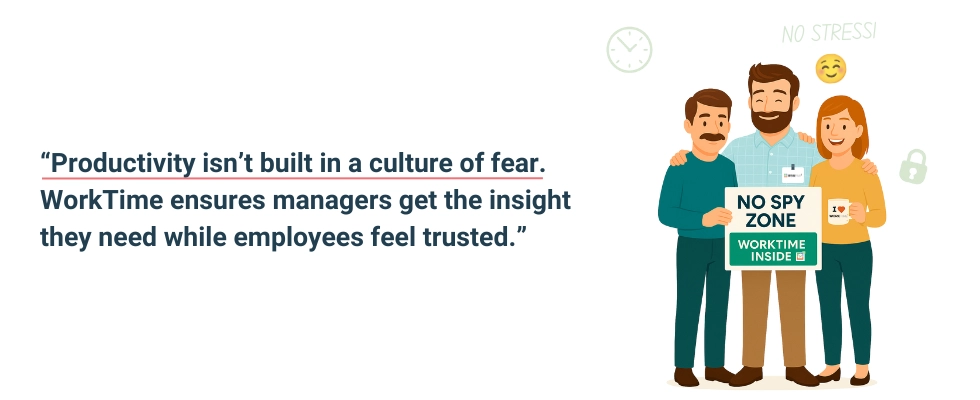
Myth: "Everyone wants to be able to work from home and then come into the office one day a week."
Most companies will never find a hybrid model that will satisfy everyone. Each position has different requirements regarding collaboration, and each person performs differently in different environments. Therefore, creating a hybrid policy that meets every employee's needs is nearly impossible and will likely create conflict and deep resentment.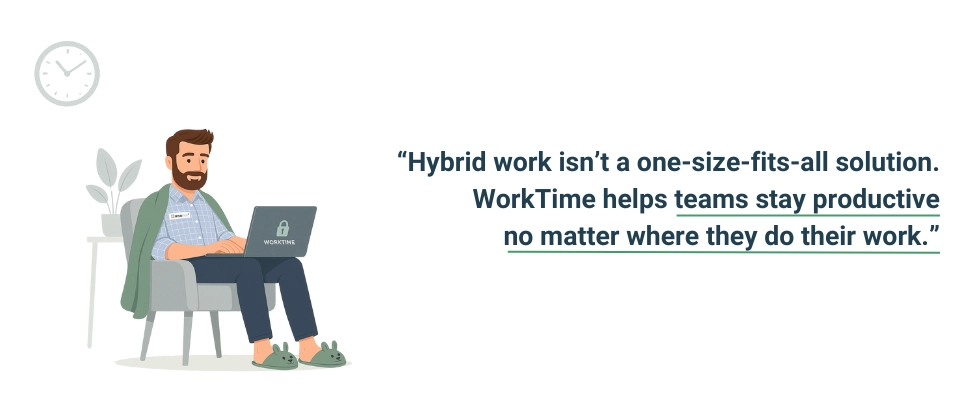
How to get the most from the hybrid model?
Making hybrid productivity real requires a basic shift in how performance gets measured. The focus has to move to outcomes instead of screens, because results will define value. The goal is to remove blockers and support progress, not to track every pause or click. That distinction matters because tools shape behavior. Invasive tools create defensiveness and anxiety, while transparent, privacy-first tools give managers clarity without triggering fear. That’s where WorkTime fits. It offers performance and attendance visibility without keystroke logging, using privacy-safe modes that limit overreach.What to do when productivity signals dip? A short checklist
- Check for context first: Deadlines, staffing gaps, meeting overload, time zones.
- Look for workload imbalance: Who’s in meetings all day vs. who gets deep work time.
- Ask, don’t accuse: “What’s blocking progress?” beats “Why were you inactive?”
- Fix the system: Clarify goals, reduce noise, rebalance tasks, tighten handoffs.
- Track trend, not moments: Focus on week-over-week patterns and outcomes.
Hybrid work done right: a real company’s success with WorkTime
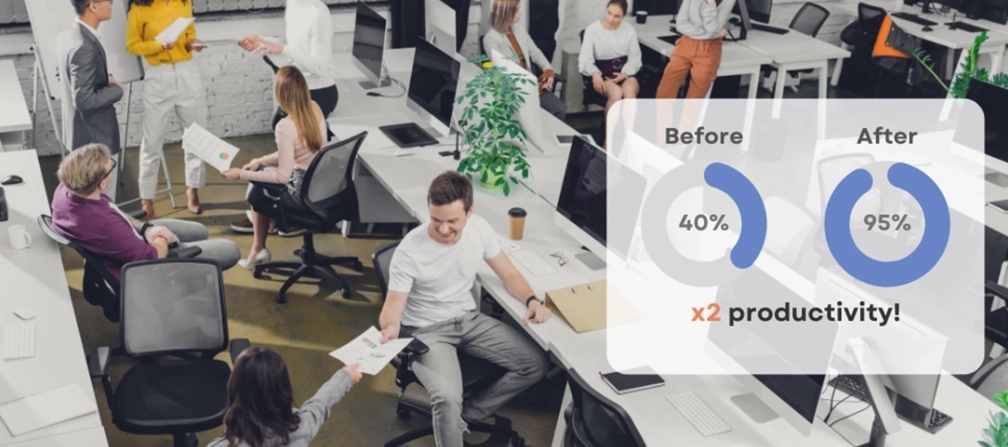
It’s easy to talk about hybrid work success in theory. It’s more useful to see what it looks like when an established organization does it in practice, without turning performance management into surveillance. WorkTime’s success story on a century-old insurance leader shows a familiar situation: a workforce split between office and remote, managers needing reliable visibility, and employees needing trust and privacy protected. The goal wasn’t to “catch” people; it was to see patterns early, reduce friction, and manage fairly across locations.| Before | What changed | After |
|---|---|---|
|
Limited visibility into hybrid workload and attendance patterns |
Introduced transparent productivity signals and reporting aligned to outcomes. |
Managers could spot blockers earlier without micromanaging individuals. |
|
Employees felt decisions happened “in the office” without them. |
Standardized communication norms and clarified expectations. |
Fewer surprises; better alignment across office and WFH days. |
Must-have tools to support hybrid teams
Communication and documentation
Hybrid teams need decisions to live somewhere shared, not only in conference rooms or hallway conversations. Strong documentation creates continuity and reduces rework by making handoffs clear and traceable. The risk is mistaking volume for clarity. More messages do not help if decisions stay buried or undocumented.Effective goal setting
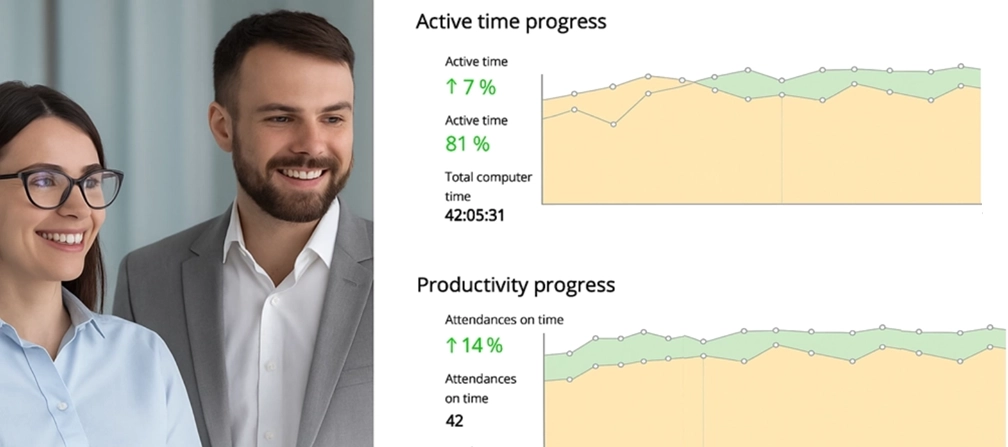
Tools like a goal tracker for active time help ground those expectations in measurable, work-relevant signals. WorkTime defines objectives by using categories for metrics like attendance, active time, productivity, and distractions.Hybrid work productivity improves when goals are explicit, and signals are trend-based, because you can manage performance without turning daily work into a courtroom.WorkTime also believes it's unrealistic to expect perfect metrics (such as 100 percent active time), because doing so will only create unnecessary anxiety."
Productivity and attendance signals
High-level productivity and attendance signals help managers spot blockers and workload issues early. Trend-based activity and patterns matter more than minute-by-minute data. When these tools become invasive, they shift from insight to surveillance and damage trust fast.
Transparent monitoring for office, WFH, & hybrid teams
One of the hardest challenges to hybrid work is fairness. Because leaders cannot monitor an employee's workload and progression, they often reward employees who are visible, which typically means those who are in physical space at the office. Proximity bias has a tendency to creep into organizations when visibility and physical presence become the most important metrics for rewards. Monitoring that is transparent is the opposite of "gotcha-type” monitoring. Good signals and agreed-upon outcomes are the best way to tackle remote working. The importance of the monitoring approach in the hybrid work environment is due to the fact that there are very real privacy issues in hybrid work environments. APA data indicate that monitored employees have higher stress levels than their unmonitored counterparts. Therefore, privacy-first employee monitoring is necessary to create a sustainable hybrid work environment as opposed to a fragile one.Real-time performance dashboards
Real-time visibility can sound scary because many teams associate it with screenshots, keystrokes, or a digital panopticon. But real-time monitoring doesn’t have to be invasive. In WorkTime’s framing, real-time monitoring is designed to answer practical questions without overreach: who’s working today, who’s in-office versus remote, and where is attention trending at a team level?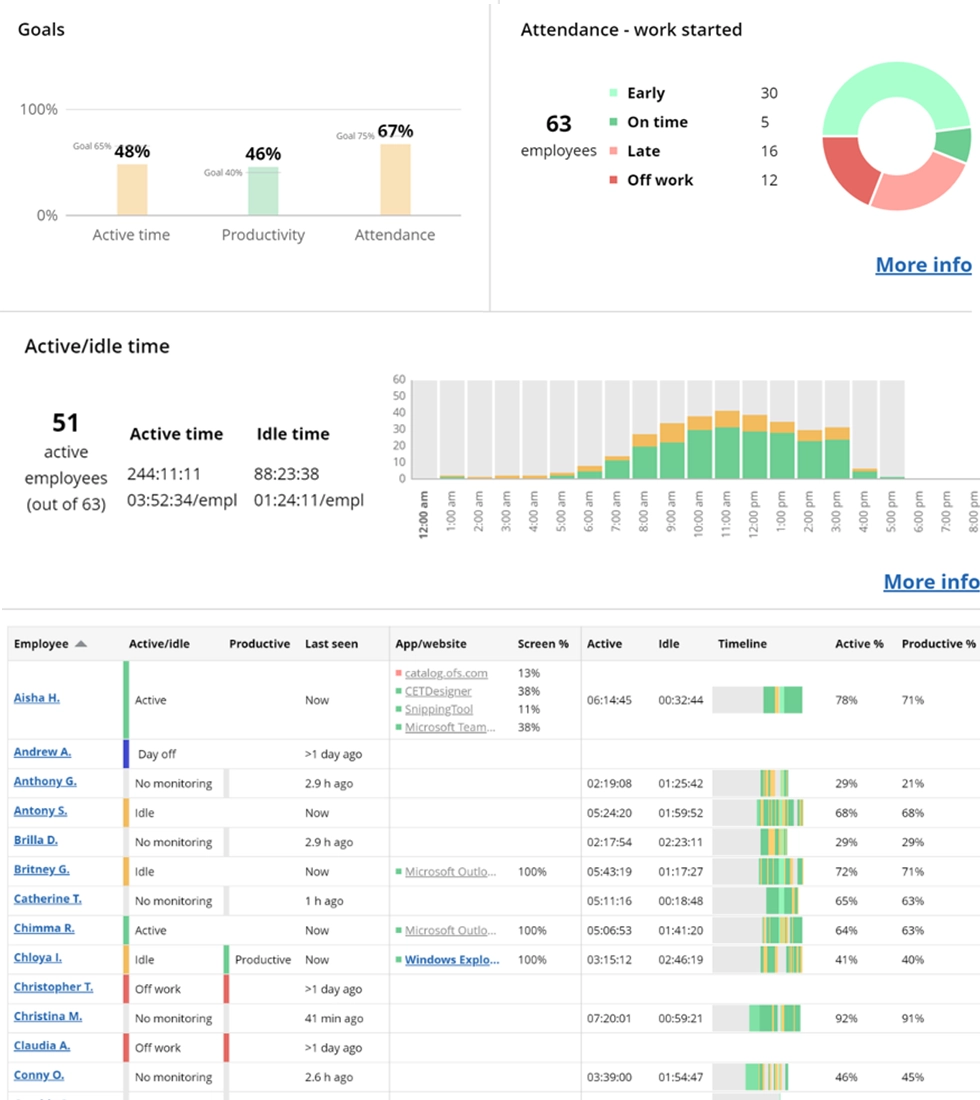

Curious about your company’s real-time performance? This report provides an overview of each employee’s current status, location, & other performance metrics.
Book demo