


TL;DR
- Employee monitoring must have a lawful basis under GDPR. The most common legal basis for monitoring online activity is legitimate interest, but it requires a documented assessment demonstrating that the monitoring is necessary and proportionate.
- Only collect the data you actually need. Data protection law requires data minimization. Monitoring practices that capture screenshots, keystrokes, or personal data beyond what's needed for a legitimate business purpose create unnecessary risk.
- Employees have data protection rights. Under GDPR, employees can submit a formal request to see what employee data has been collected. Your monitoring policies need to account for this.
- Non-invasive monitoring is the simplest path to compliance. When your monitoring tools don't capture personal data or sensitive data in the first place, most data protection compliance concerns disappear.
In this article
The article is prepared by WorkTime - a GDPR-safe employee monitoring solution built on transparency, a privacy-first approach, and in-depth performance analytics.
Why businesses monitor employee web activity
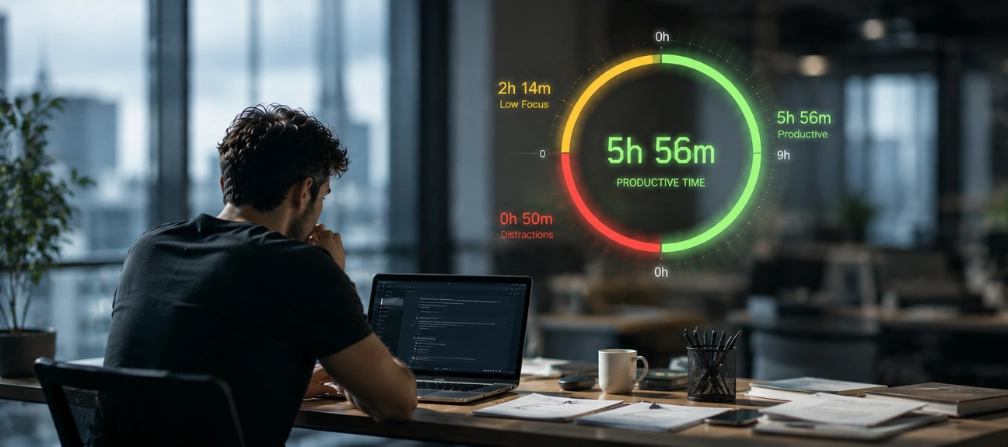
Employee monitoring of web activity is one of the most common forms of workplace monitoring today. Unmanaged web browsing is still one of the biggest drains on workplace productivity. Research shows employees spend up to 32% of their workday on social media platforms, costing U.S. employers an estimated $28 billion in lost productivity annually. In small to mid-sized teams, casual browsing, online shopping, and video streaming can consume hours of the workday without anyone noticing. Beyond productivity, there are security reasons. IBM's 2025 data breach report found that 20% of breaches involved "shadow AI," in which employees uploaded company data to public AI platforms such as ChatGPT or Gemini. Monitoring web activity helps organizations catch this before it becomes a data breach. But the method of monitoring matters just as much as the decision to monitor. When monitoring employees through invasive methods like keystroke monitoring, screen recording, or capturing employees' personal data, the legal and ethical risks multiply. The data collected through such monitoring falls under data protection regulations, and organizations that get it wrong face fines, employee trust damage, and legal obligations they weren't prepared for. That's where compliant employee monitoring comes in. The goal is to gain valuable insights into how internet time is spent without crossing into surveillance territory.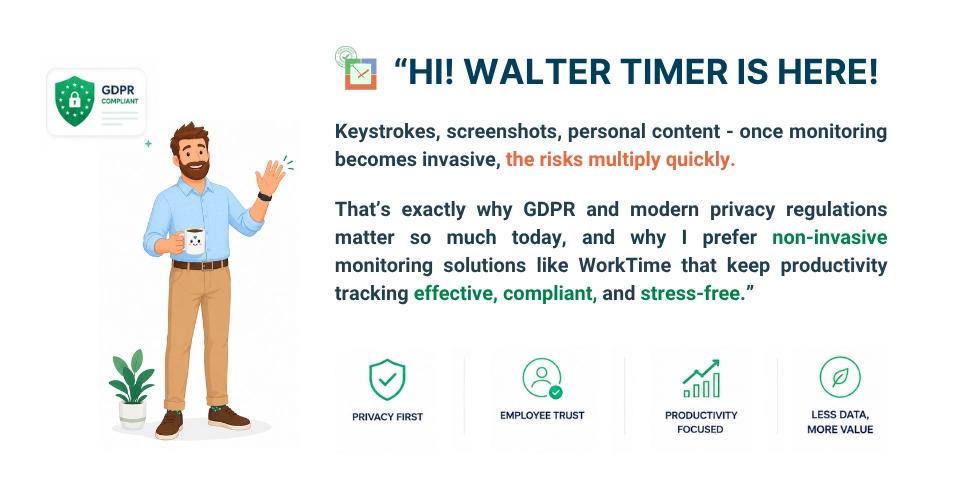
GDPR and employee monitoring: what the law requires
GDPR applies to any organization that processes personal data of individuals in the EU, including employee data. Since employee monitoring involves processing employee data (websites visited, time spent online, app usage), GDPR sets strict rules on how such monitoring can be conducted. Any company monitoring employees must respect employees' data protection rights throughout the process.Establishing a legal basis for monitoring
Under GDPR, every form of data processing needs a lawful basis. For workplace monitoring, the most commonly used legal basis options are:Legitimate interest (Article 6(1)(f))
This is the most common lawful basis for employee monitoring. However, relying on legitimate interest requires a documented legitimate interest assessment that weighs the employer's legitimate interests (productivity, security, compliance) against the employee's privacy rights. Organizations must justify monitoring by showing that monitoring employees is necessary for a legitimate business purpose, that the monitoring practices are proportionate, and that there's no less intrusive way to achieve the same goal.Legal obligations (Article 6(1)(c))
In some regulated industries (healthcare, finance), monitoring internet usage is required by law to ensure compliance with regulations such as HIPAA and GLBA. When legal obligations drive the monitoring, this provides a separate lawful basis.Employee consent (Article 6(1)(a))
Consent is generally considered a weak legal basis for employee monitoring because of the power imbalance between employer and employee. Data protection regulations recognize that employee consent may not be freely given when the alternative is losing your job. Most data protection authorities recommend relying on legitimate interest rather than consent.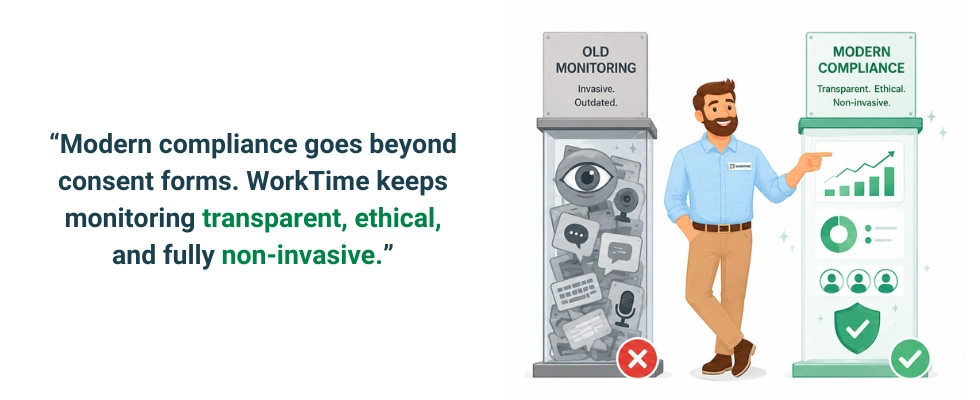
What the General Data Protection Regulation requires for monitoring practices
Even with a valid legal basis, the data protection regulation GDPR imposes requirements on how monitoring is carried out:Transparency
Organizations must inform employees about what data collection takes place, why, how long the data is retained (data retention), and who has access. Your monitoring policies should be documented and communicated before any monitoring begins. A Dtex Systems/Harris Poll survey found that 77% of employees would be less concerned about monitoring if their employers were transparent about it.
Data minimization
Only the data necessary for the stated purpose should be collected. If you're monitoring web activity for productivity, you don't need to capture screenshots, record voice recording, or collect biometric data. The less personal data you collect, the lower your compliance burden.Purpose limitation
Monitoring records collected for productivity purposes cannot later be repurposed for unrelated uses without a new lawful basis. If you collect online activity data to improve team performance, you cannot use that same data to build a case for dismissal without additional legal justification.Data subject rights
Employees have the right to submit a data subject access request to see what employee data you hold. They also have privacy rights to request correction or deletion of inaccurate data. Your monitoring tools and data processing systems need to support these requests.Data protection impact assessment
GDPR requires a data protection impact assessment (DPIA) when monitoring practices are likely to result in a high risk to employee rights. Broad-based monitoring of web activity, especially when combined with location data, biometric data collection, or automated decision-making, typically triggers this requirement. The DPIA should document the necessity and proportionality of the monitoring, the risks to employees, and the security measures in place to protect the data collected.How invasive monitoring creates data protection problems
Not all employee monitoring tools are equal when it comes to data protection compliance. Invasive monitoring practices that capture more personal data than necessary create compounding legal risks. The fundamental principles of the GDPR (data minimization, purpose limitation, and transparency) apply to every organization that monitors its employees.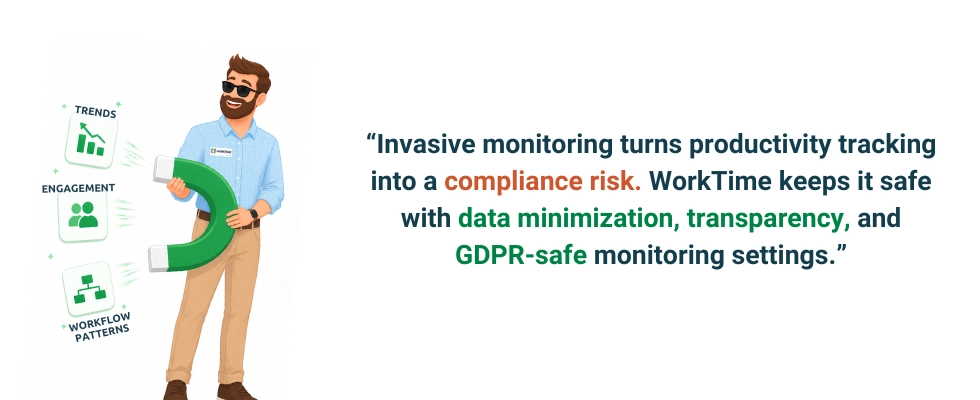
Covert monitoring risks
Covert monitoring, where employees are monitored without their knowledge, is heavily restricted under GDPR. Data protection law generally requires that employees be informed about monitoring before it begins. Covert monitoring is only permitted in very limited circumstances (for example, investigating suspected criminal activity) and requires strong legal justification, a DPIA, and strict limits on scope and duration. Organizations that deploy covert monitoring for general workplace monitoring risk serious regulatory compliance violations.Excessive data collection
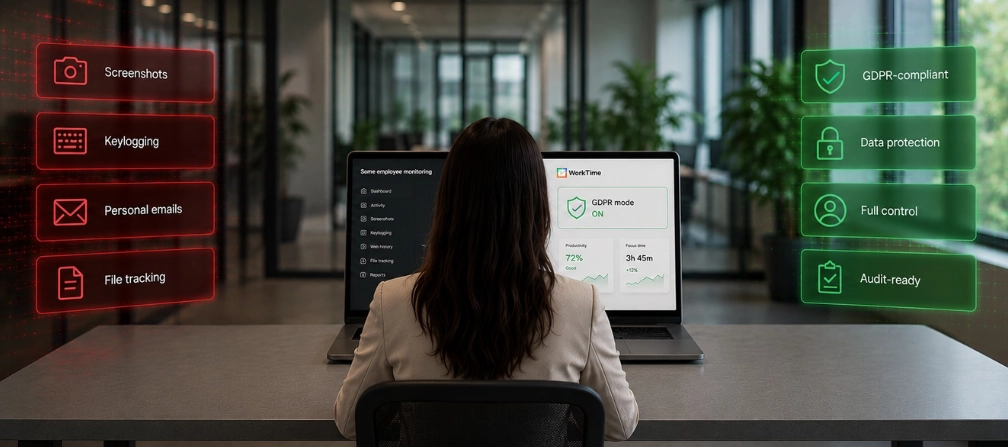
Employee monitoring tools that capture screenshots, log every keystroke, run video surveillance on screens, or track employees' personal data far exceed what's needed for web activity monitoring. This level of data collection conflicts with GDPR's data minimization principle. Every additional piece of sensitive data or personal data you collect increases your exposure to breaches, complicates access requests, and makes it harder to show regulatory compliance during an audit.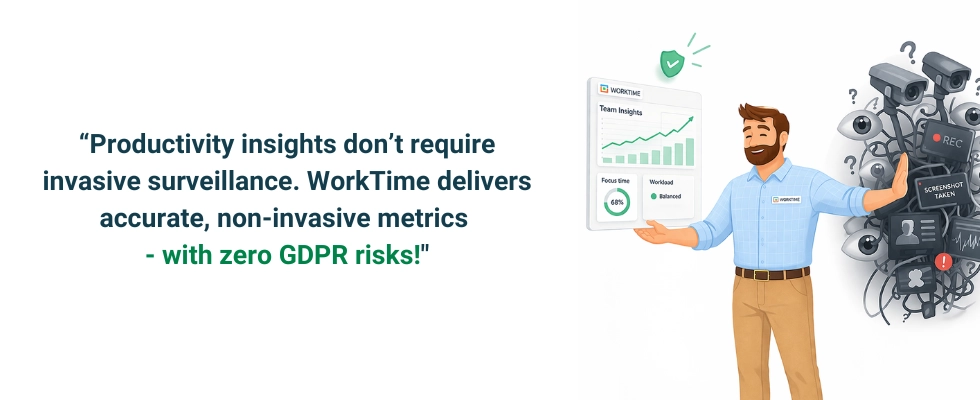
Automated decision making
GDPR gives employees specific rights around automated decision-making, particularly when such systems produce legal or similarly significant effects. If your monitoring software generates productivity scores or flags employees automatically without human intervention, this may qualify as automated decision-making under Article 22. Employees have the right to request a manual review, to express their point of view, and to contest automated outcomes that affect their employment. Your monitoring policies should account for how automated processes are used and ensure that no employment decisions are made solely on the basis of automated decision-making without human review.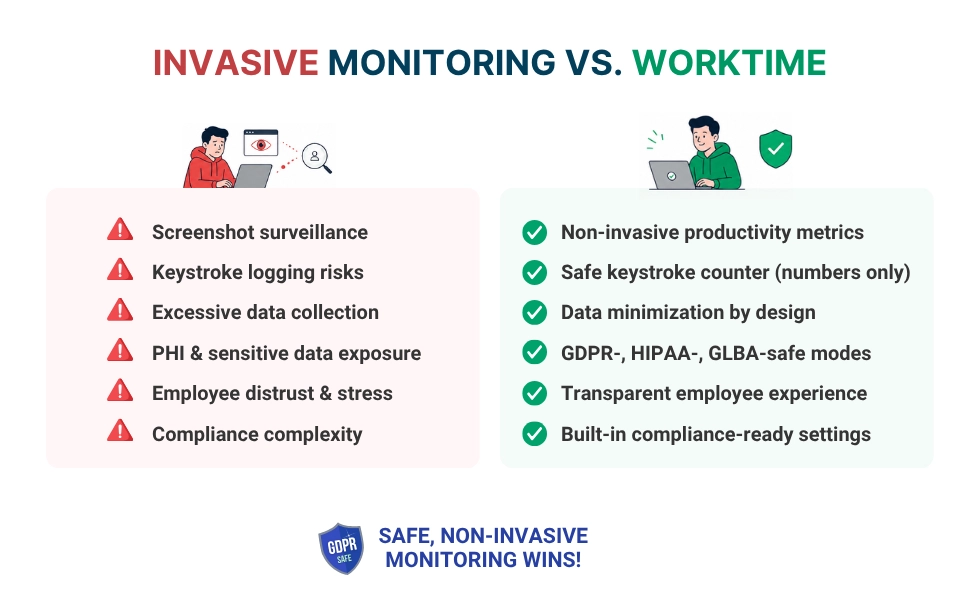
WorkTime: Compliant employee monitoring by design
WorkTime takes a fundamentally different approach to monitoring web activity. Instead of capturing private information through screenshots, keylogging, or screen recording, WorkTime tracks only productivity-related metrics. This means the data collected through WorkTime is limited to what's necessary for a legitimate business purpose, making privacy compliance significantly easier.What WorkTime monitors
- Internet use per employee and department: which websites are visited, for how long, and whether they're productive or unproductive
- App and software usage with productivity classification
- Active and idle time without false flags during meetings or calls
- Online meeting time to identify excessive or unproductive meetings
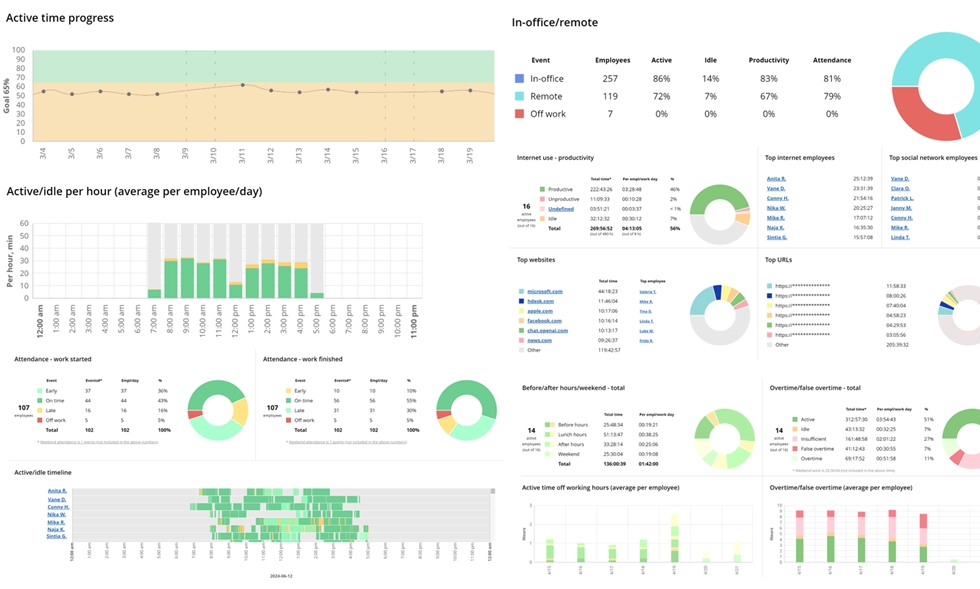
- Remote vs. in-office productivity comparison using IP-based location (not GPS or location data tracking)
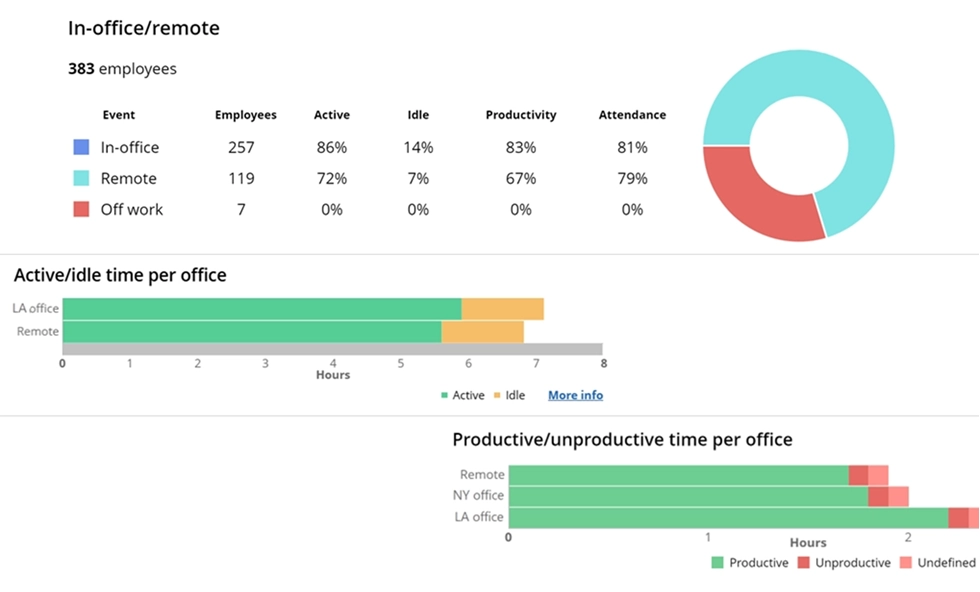

Monitor how employees work across office, home, and remote setups. Understand where employees work most effectively and identify their most-used applications.
Start free trial- Job search and video watching detection for early turnover signals
- Department-level comparisons for identifying areas that need support.
What WorkTime does NOT collect
- Screenshots or video surveillance
- Keystroke monitoring or keystroke logging content
- Email, chat, or message content
- Biometric data collection
- Phone calls or voice recording
- Employees' personal data beyond productivity metrics.
Built-in compliance modes
WorkTime offers HIPAA-safe, GDPR-safe, and GLBA-safe modes that configure the monitoring software to meet specific regulatory requirements. GDPR compliance mode ensures that data collection aligns with legal requirements, including data minimization, purpose limitation, and appropriate data retention periods.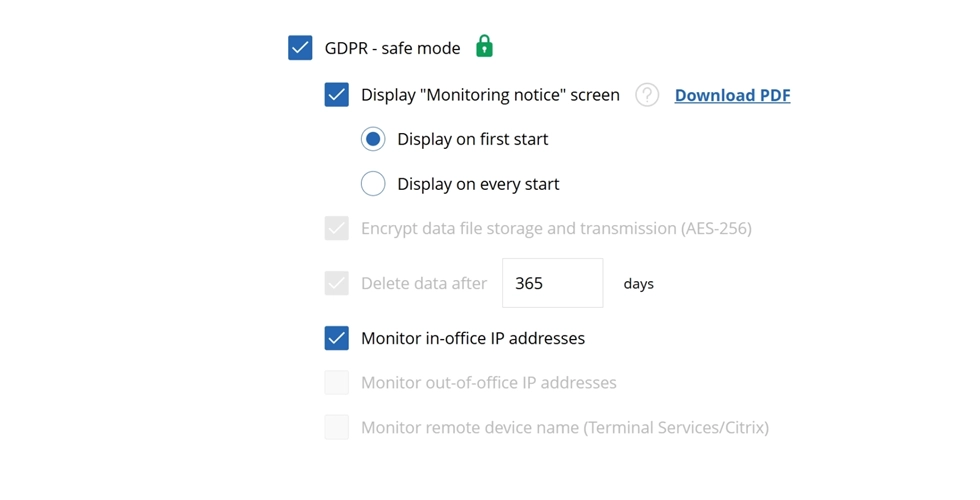

Enable GDPR-safe mode to support transparent and privacy-focused employee monitoring.
Start free trialBest practices for GDPR-compliant internet monitoring
Following these practices helps protect employee privacy while meeting legal requirements. Maintaining employee trust starts here and reduces regulatory risk. Whether you choose WorkTime or another employee monitoring tool, these practices help ensure compliance with data protection regulations. Legal compliance is not optional when it comes to employee monitoring:1. Document your lawful basis
Before monitoring employees, complete a legitimate interest assessment. Record why monitoring is necessary, what data you'll collect, and why less intrusive alternatives won't work. Keep this documentation up to date, as you may need to demonstrate compliance with regulators.2. Conduct a DPIA
For any systematic monitoring of employee web activity, complete a data protection impact assessment. This is a legal requirement under the GDPR when monitoring practices pose a high risk to employees' rights.3. Write clear monitoring policies
Your monitoring policies should explain what is monitored, why, who has access to the data, how long it's retained, and how employees can exercise their rights. Make sure to inform employees before monitoring begins and get written acknowledgment. To make policy creation easier, WorkTime offers monitoring policy samples aligned with transparent workplace practices.Announce employee monitoring seamlessly!


4. Respect employee privacy by default
Choose employee monitoring tools that collect just the data needed for your stated purpose. Non-invasive tools that track productivity metrics without capturing personal data reduce your compliance burden and help maintain compliance with minimal effort.5. Implement strong security measures
All employee data must be protected with appropriate security measures: encryption, access controls, regular security assessments, and secure storage. Data breaches involving monitoring records carry both financial penalties and severe reputational damage.6. Limit data collection to work hours
Monitor only during working hours and only on company devices. Remote monitoring should follow the same principles. Extending such monitoring into personal time or devices creates legal and trust problems.7. Support access and correction rights
Build processes to handle data subject access requests. Employees have the right to see what data you hold on them, request corrections, and, in some cases, request deletion. Your systems should make it easy to retrieve and export the data collected for any individual employee.
8. Ensure human intervention in decisions
Don't rely solely on automated decision-making from monitoring software to make employment decisions. Ensure compliance with GDPR Article 22 by maintaining a manual review step in any process that could significantly affect an employee.Monitor web activity the right way
Monitoring online activity is a legitimate business need. It helps organizations identify productivity patterns, reduce wasted time, and protect against security threats like shadow AI. But in 2026, how you monitor matters as much as whether you monitor. Every data protection regulation, including the GDPR, is getting stricter. Organizations that rely on invasive employee monitoring practices face growing legal exposure and risk violating employee rights. The path forward is clear: use employee monitoring practices that respect employee privacy, limit data collection to what's actually needed, ensure compliance through transparency, and maintain compliance through documentation. WorkTime makes this straightforward. By monitoring web activity without capturing personal data, it removes the most common privacy compliance challenges while still delivering the productivity insights businesses need. Try WorkTime's non-invasive approach with a free 14-day trial.Try WorkTime now!