




In this article
A bit of history
Before COVID
Did remote work not exist before the pandemic? Even before the global spread of COVID-19, forecasts indicated that the steadfast belief in the 5-day office workweek was wavering. Before the virus outbreak, numerous studies and surveys suggested a growing trend toward remote work, particularly within certain industries and among specific demographics.A 2019 FlexJobs and Global Workplace Analytics survey found that telecommuting has increased 159% since 2005, with 4.7 million US employees working remotely at least half the time. Until now, remote work has been more common in specific industries, such as technology, finance, and professional services, where it has often been seen as a way to attract and retain top talent.A 2016 Gallup study found that 43% of employed Americans spent at least some time working remotely.
Despite the benefits of remote work, there have been challenges and barriers to widespread adoption, including issues with productivity, communication, and corporate culture. Employers were often concerned about managing remote teams and keeping remote workers accountable. The development of non-invasive monitoring technologies partially covers these pains of employers. Today, there are many ways you can investigate the effectiveness of remote workers by tracking indicators such as work time and productivity in convenient metrics.According to a 2019 Owl Labs survey, industries with the highest rates of remote work included technology (41%), finance (37%) and healthcare (31%).
WorkTime is a non-invasive employee monitoring technology that has been serving companies since before the COVID-19 pandemic.


During COVID
Due to the COVID-19 pandemic, the number of companies transferring employees to remote work has increased significantly.Additionally, a separate survey by Buffer found that an overwhelming 98% of remote workers expressed a desire to continue working remotely in the future. Since the start of the COVID-19 pandemic, remote work has increased dramatically worldwide. A McKinsey & Company report found that 83% of office workers want to work from home at least one day a week even after the pandemic subsides. According to Global Workplace Analytics 2021 research, by 2022, 25-30% of the US workforce is projected to switch to a remote format several days a week. Global Workplace Analytics' 2022 "Remote/Blended Work/In-Office Trends and Forecast" study echoes this sentiment.According to a Gartner survey, 88% of companies worldwide have given their employees the green light to work from home since the start of the pandemic.
Employee monitoring WorkTime has become a necessity during the COVID times.
After COVID
Since 2020, the discourse around hybrid, flexible, remote, and office work has remained constant. The current talks between employers and workers will continue, but a return to the Office will likely be on the agenda for many worldwide in 2024.Other statistics show that in the US, 90% of companies intend to implement their plans to return to the Office by the end of 2024. Brent Cassell, vice president of consulting in Gartner's HR consulting practice in Virginia, USA, notes that senior executives are becoming increasingly impatient.The KPMG CEO Outlook survey found that 64% of leaders worldwide predict a total return to office work by 2026.
However, they soon discovered that simply inviting employees and offering perks like "free bagels on Tuesdays" wasn't effective in getting them to come back to the Office - Forbes. While some companies have chosen to maintain hybrid arrangements, others, such as Goldman Sachs and Disney, have embraced their new power by requiring their employees to return to the Office four or five days a week. Meanwhile, companies like Amazon warn workers who flout these mandates, halting career development or firing workers altogether.In the spring of 2022, many companies implemented hybrid schedules; the initial strategies were soft reopenings.
There are a lot of employers out there who had suspicions about remote work from the start, and you can see that by the timing of when people went to being remote during the beginning of the pandemic. Even when there are a lot of monitoring tools that help companies optimize work from whatever it is: office, home, beach. Since we've all been forced into being remote for nine months now, we've realized that if somebody in a particular location is willing to work the hours to collaborate, you can do it very effectively.Many companies still need to reopen their offices fully and intend to do so during 2024.
Even Zoom, the video conferencing company that helped make the remote work boom happen in the 1st place, is also taking a hard line on return to Office. When it comes to determining what's best for a company—remote, hybrid, or in-office work—it's unnecessary to guess. Simply implement time-tracking software and monitor. Time-tracking will reveal where employees demonstrate higher productivity, attendance, and active engagement, guiding decisions effectively.The latest data from the Census Bureau found that only 26% of US households still have someone working from home. That's down from 37% in early 2021.
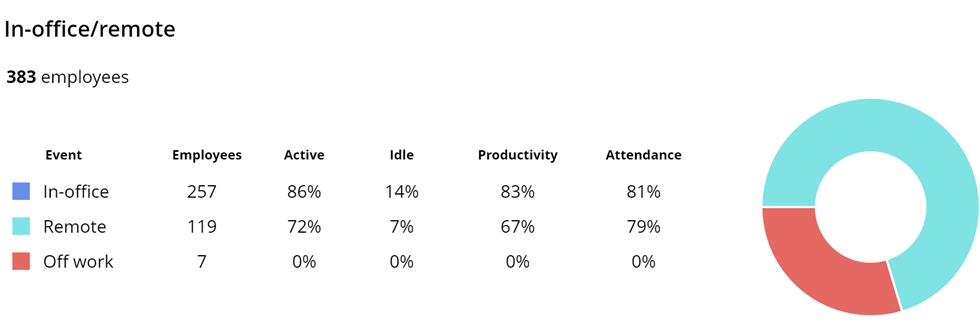
Which work models are sustainable long-term
In 2026, the question is no longer which work model is popular but which one is sustainable for a given role, team, and industry.- Hybrid as the standard. Most teams now combine in-office and remote work, balancing flexibility with accountability.
- Back to the office for strategic purposes. Some companies encourage more in-office presence for collaboration-heavy teams, onboarding, and culture-building activities.
- Employee-centric flexibility. Work models consider engagement, preferences, and work-life balance to retain top talent.
- Data-driven optimization. Productivity, collaboration, and engagement metrics continuously inform adjustments to work policies.
1. Who stays remote
At present, 12.7% of full-time employees engage in remote work, indicating the swift acceptance of remote work setups. Meanwhile, a notable 28.2% of employees have embraced a hybrid work approach, blending remote and in-office work to provide flexibility while ensuring a physical presence in the workplace.Other industries are also embracing remote work. Fields like marketing, accounting and finance, and project management are leveraging digital tools and platforms to ensure seamless work operations. Try WorkTime special metrics for different industries now. For example, with WorkTime IT team monitoring has never been easier. You can monitor employee internet usage, and much more. WorkTime also provides efficient monitoring tools for much more industries such as healthcare, law offices, banking, insurance, finance, government, defense, police, educationThe computer and IT sector stands out as the leading industry for remote work in 2023-2024 - Forbes.
Remote work stays strong in work-models worldwide. But it also presents a range of advantages and obstacles that affect both employees and employers differently. And good quality monitoring became crucial here.57% of workers would look for a new job if their current company didn’t allow remote work - Forbes.
2. Back to the office trend
In 2024, many companies in the USA and Europe will strive to bring their employees back to the offices. At the start of the year, a handful of prominent companies, such as Boeing and UPS, mandate a return to the office for employees on a five-day-per-week basis - CNBC. Also Jotform, an online form-building platform employing approximately 660 team members, has recently mandated that employees must be present in the office for the entirety of the workweek, spanning five days. Several companies, including Amazon, that have implemented more stringent office attendance policies have encountered internal tensions. In May 2023, Amazon initiated a requirement for its employees to work from physical offices for a minimum of three days per week, prompting protests by a group of employees at its Seattle headquarters. The transition from a remote format to the office can seem abrupt and cause employees to resist. With some offices beginning to open in early 2021, workers have largely had the freedom to decide whether to return to or continue working remotely despite previous strong support from management. As employment opportunities become increasingly scarce, it becomes much more difficult for workers to ignore the call to the office. Also, even among the emerging job opportunities, only a tiny fraction offer fully remote work.To make it easier to return to offices, employers are leaving a window of opportunity to retain staff - this is flexible hours.
The widespread adoption of hybrid settings ensures that employees still enjoy the freedom of choice and are unlikely to lose it completely. According to data from Kastle Systems, which tracks the use of employee access cards at many companies, office attendance in 2023 has remained well below pre-pandemic levels. If we speak of industries that tend to return from the remote, it is more likely that banks return to office, also federal workers back to the office, and federal workers back to the office too.Also the WorkTime helps increase productivity in the office with non-invasive monitoring tools. Employee monitoring software is a great tool to improve team’s productivity in offices.
According to research provided to Facilities Dive by JLL, over 400,000 federal employees will need to be present in the office for two to three days per week from the start of 2024. Even with the transition from telework to hybrid work arrangements, JLL noted that federal and state governments remain cautious about adjusting their spatial requirements.A major US bank has issued "letters of education" to its remote employees, warning them of potential disciplinary measures if they do not comply with minimum requirements for in-office attendance.
3. Hybrid setting
Flexible work holds significance for numerous individuals, yet recent findings from the Human Workplace Index survey indicate that work arrangements rank lower on the priority list for job seekers than expected. Job seekers prioritize elements such as work-life balance, recognition and rewards, and company culture over the physical location of work.Despite the increasing popularity of remote work, the majority of the workforce (59.1%) continues to operate from traditional office settings. This data highlights that while remote work is gaining momentum, conventional in-office work remains prevalent and relevant.According to Forbes, as of 2023, 12.7% of full-time employees engage in remote work, with 28.2% adopting a hybrid work model.
WorkTime has valuable propositions that can be applied to businesses of all sizes and work environments, both onsite and remotely. In addition to implementing employee monitoring, here is what can be done to maintain employee productivity in a hybrid setting:WorkTime helps maintain productivity in a hybrid setting format.
1. Make a plan
Anticipating and preparing in advance can significantly boost business growth and productivity. Planning fosters team organization and concentration while equipping you to address potential challenges proactively.A well-organized plan keeps employees focused during work hours.
2. Establish clear objectives
This is an opportune moment to introduce incentives to enhance morale and motivate your team towards achieving shared objectives. Define clear, achievable goals (short and long term) and align your team with them.Define clear and achievable short- and long-term goals and ensure your team fully comprehends them and their expectations.
3. Ensure fair distribution of tasks
To maintain team productivity and prevent burnout, it's crucial to avoid overwhelming workloads. When employees feel overburdened, they often need more time to improve, leading to decreased efficiency. Aim for a balanced workload and realistic deadlines for tasks. Prioritize and categorize tasks to streamline workflow and enhance focus and productivity.4. Set achievable goals
The success of your business relies on the feasibility of your expectations. Unrealistic expectations hinder productivity and advancement and foster stress, anxiety, and reduced motivation.Establish realistic expectations to motivate employees towards their achievement.
5. Frequent communication
Productivity thrives on structured communication. Regular team interactions, preferably face-to-face, enhance productivity. This can include daily check-ins for quick updates, occasional one-on-one sessions to address individual progress and challenges, and monthly meetings to review completed projects and plan.Good communication enhances productivity.
6. Utilize cutting-edge technology
Invest in advanced technology to streamline employee performance monitoring and automate tedious manual tasks.7. Maximize time accountability
Implement effective time-tracking software to ensure everyone is responsible for their time allocation. Employees can log hours worked, task durations, and check-in/out to promote productivity. Real-time access to reports facilitates monitoring regardless of location.8. Promote healthy competition
Harness the power of friendly competition to maintain motivation and productivity within a goal-oriented environment. Utilize employee monitoring reports to identify top performers and recognize their achievements. Incentivize excellence with prizes to spur engagement and continuous improvement. This fosters a culture of competitiveness, learning, and heightened productivity for all involved.9. Acknowledge excellence
Recognizing and praising good work is essential for maintaining high employee motivation and productivity.Positive feedback can significantly boost their performance and enthusiasm.
10. Foster transparency and trust
Creating a transparent and trusting work environment where employees feel empowered to excel without fear of micromanagement is crucial for both individual productivity and the overall well-being of the business.Work model trends per country
USA embraces hybrid model
Rather than full office returns, most U.S. companies now operate with structured hybrid models (e.g., 3 days office, 2 remote, or defined core hours). Firms increasingly link office attendance to team collaboration days, not blanket mandates. Remote work remains strong in tech, finance, and creative sectors, while hybrid models dominate corporate America.According to Stephan Meier, a business professor at Columbia University, the shift towards a permanent five-day office policy is unlikely. Instead, he predicts that more companies will focus on effectively managing hybrid work arrangements in the coming year.USA's companies embrace the hybrid model.
Bloom described remote-work figures in 2023 as remaining stagnant. While notable companies such as Meta and Zoom gained attention for their return-to-office directives, Bloom noted that an equal number of other companies were discreetly reducing office presence to streamline expenses.Thirty-eight percent of companies require full-time in-office work, down from 39% one quarter ago and 49% at the start of the year, according to software firm Scoop Technologies.
UK - four-day workweeks & flexible schedules
The UK continues to lead with flexible work approaches, including widespread experimentation with four-day workweeks and compressed schedules. Many organizations report gains in morale and productivity, making flexible time arrangements a stable feature of the post-pandemic workplace. Employees reported lower levels of burnout and stress, and companies observed higher levels of employee satisfaction and productivity. While more companies are considering implementing the four-day workweek, not all have found it feasible or suitable for their operations. Overall, evolving workplace scheduling trends and remote work will continue influencing work dynamics in 2024.Australia - back-to-office
"In the next five years, the trend is to reintegrate people into office spaces. That's our direction," stated Professor Christina Boedker from the University of Newcastle's business school.There are indications that a transition towards increased office presence is already occurring. Zoom, the platform facilitating remote work for many, mandated employees residing within an 80km radius of its offices to return two days each week in 2023. The Community and Public Sector Union successfully negotiated the removal of any restrictions on working from home for its 120,000 members. According to CPSU national secretary Melissa Donnelly, flexible work and remote work are priorities for their members. However, there is debate over whether unlimited remote work arrangements suit everyone. Productivity concerns frequently drive calls for minimum office attendance requirements. Furthermore, the role of the Office has evolved. It is no longer solely a space for completing tasks. Still, it has transformed into a place for fostering psychological safety, nurturing an innovation culture, and cultivating relationships to enhance employee retention.A recent KPMG report released last week revealed that two-thirds of the 1,300 CEOs surveyed anticipate employees returning to full-time office work within three years.
Southern Africa backing to office soon
According to KPMG's Southern African 2023 CEO Outlook, a gradual shift is underway, with 72% of Southern African CEOs indicating their support for returning to in-person work within the next three years. The rest of the respondents preferred a hybrid or remote work model. This mirrors the global trend, as 64% of CEOs worldwide anticipate a complete return to office-based work.This reflects a recognition of the younger workforce's appreciation for the independence and flexibility associated with remote work. In the Sandton CBD and other northern areas of Johannesburg, there is a growing trend of office visits lasting more than two hours, although they have yet to return to pre-Covid levels. In August 2023, approximately 55% of visits lasted longer than two hours, higher than the 50% reported in 2022 but still lower than the 60% observed in 2019.In Southern Africa, 87% of CEOs expressed their readiness to offer incentives such as desirable assignments, salary increases, and promotions to employees who choose to work from the Office.
India - "flexible work"
Recent research conducted by happiness.me in partnership with The Happiness Research Academy unveils unexpected insights into employee preferences across India's five major cities. The study's results uncover an intriguing paradox. While most Indian employees prefer a five-day office workweek, they desire the autonomy to decide when and how they work within this structure.For organizations, the implications are substantial. Adopting flexible work arrangements is now an optional perk and a crucial strategy for attracting and retaining top-tier talent.This desire for "flexible work" goes beyond the mere convenience of remote work; it reflects a more profound yearning for trust and empowerment in the workplace.
So, what becomes the long-term work trend?
The dominant pattern is not a return to the past, nor a fully remote future. Instead, most organizations have settled into structured hybrid models, typically combining defined in-office collaboration days with flexible remote work. This approach balances operational control with employee autonomy. Utilizing productivity monitoring software is essential for maintaining high productivity levels in remote or work-from-home setups. It effectively recreates an office environment remotely. As seasoned providers of productivity monitoring software with over two decades of expertise, we emphasize the importance of implementing this process thoughtfully. We advocate for non-intrusive, goal-oriented software solutions.