


TL;DR
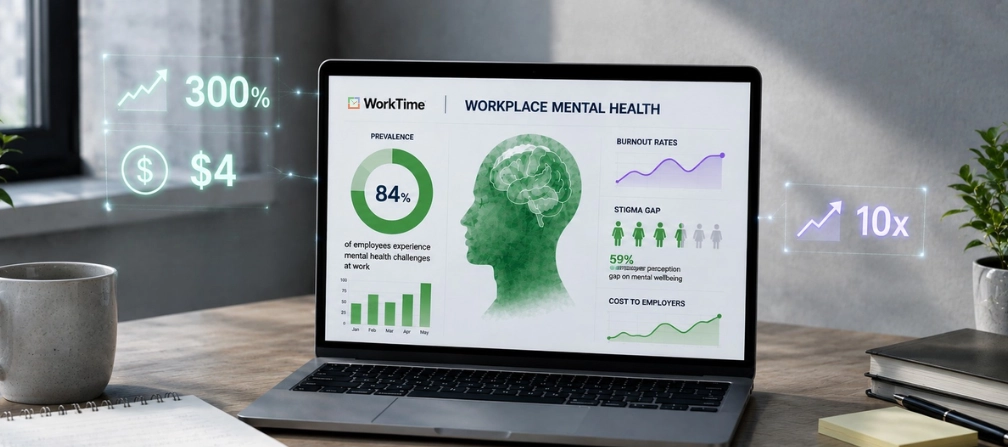
- 84% of respondents said their workplace conditions contributed to at least one mental health challenge (Mind Share Partners).
- 59% of workers agree their employer thinks the workplace is mentally healthier than it actually is, a perception gap that drives underinvestment.
- Presenteeism costs employers 10 times more than absenteeism, yet most organizations track sick days and ignore the hidden output loss from people working while unwell.
- Mental health-related leaves of absence rose 300% from 2017 to 2023, and 61% of HR leaders say leaves increased again in the past year.
- Employees at companies that actively support employee mental health are twice as likely to report no burnout or depression.
- For every $1 invested in evidence-based mental health support, employers see approximately $4 in return.
In this article
The article is prepared by WorkTime, helping organizations improve employee performance through an ethical monitoring approach and transparency.
Top 50+ mental health in the workplace statistics & trends
How common are mental health challenges at work?
Workplace mental health challenges affect a larger share of the workforce than most employers realize. Mental health conditions are no longer rare events. They are a standard part of working life for a large majority of the workforce. Here is what the prevalence data shows. 1. According to the Mind Share Partners 2021 Mental Health at Work Report, 84% of respondents said their workplace conditions contributed to at least one mental health challenge. That figure, cited in the U.S. Surgeon General’s framework, remains the most widely referenced benchmark of how far the problem extends into the workplace.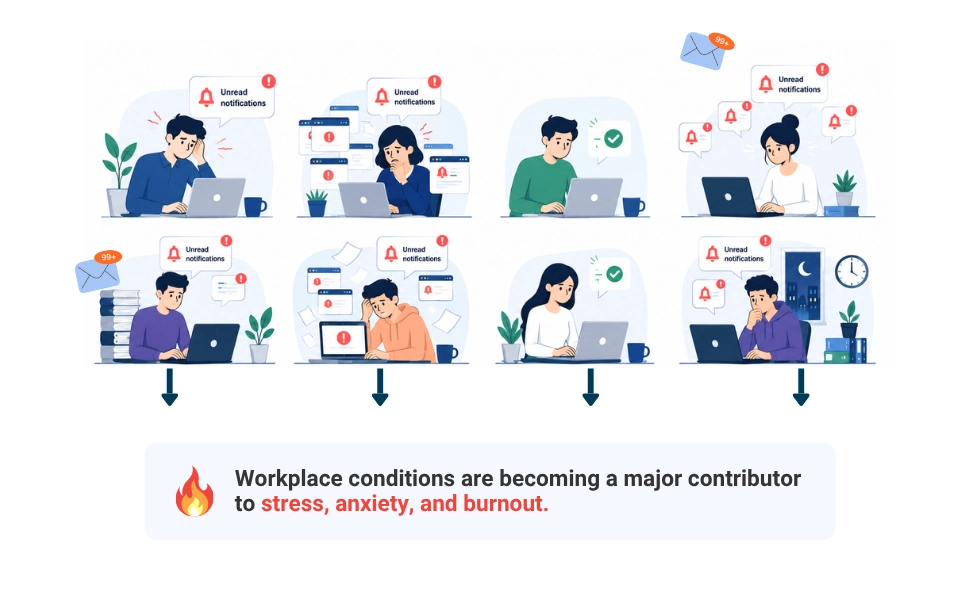
The cost of poor mental health at work
The financial impact of poor mental health at work is substantial, and most of it is invisible until it shows up in turnover reports. 7. Depression and anxiety cost the global economy an estimated $1 trillion per year in lost output. The World Health Organization attributes this primarily to presenteeism, which is harder to address than absenteeism because it does not show up on a timesheet. 8. Poor workplace mental health costs UK employers approximately £56 billion per year, according to Deloitte. The breakdown matters: presenteeism accounts for £28 billion, staff turnover for £22 billion, and absenteeism for £6 billion. Presenteeism is the highest single cost and the one organizations spend the least time tracking. 9. Untreated mental health issues cost U.S. employers between $31 billion and $51 billion annually in absenteeism and presenteeism. These figures from Sapien Labs exclude the downstream costs of turnover, errors, and disengagement. The true cost of poor mental health at work is significantly higher.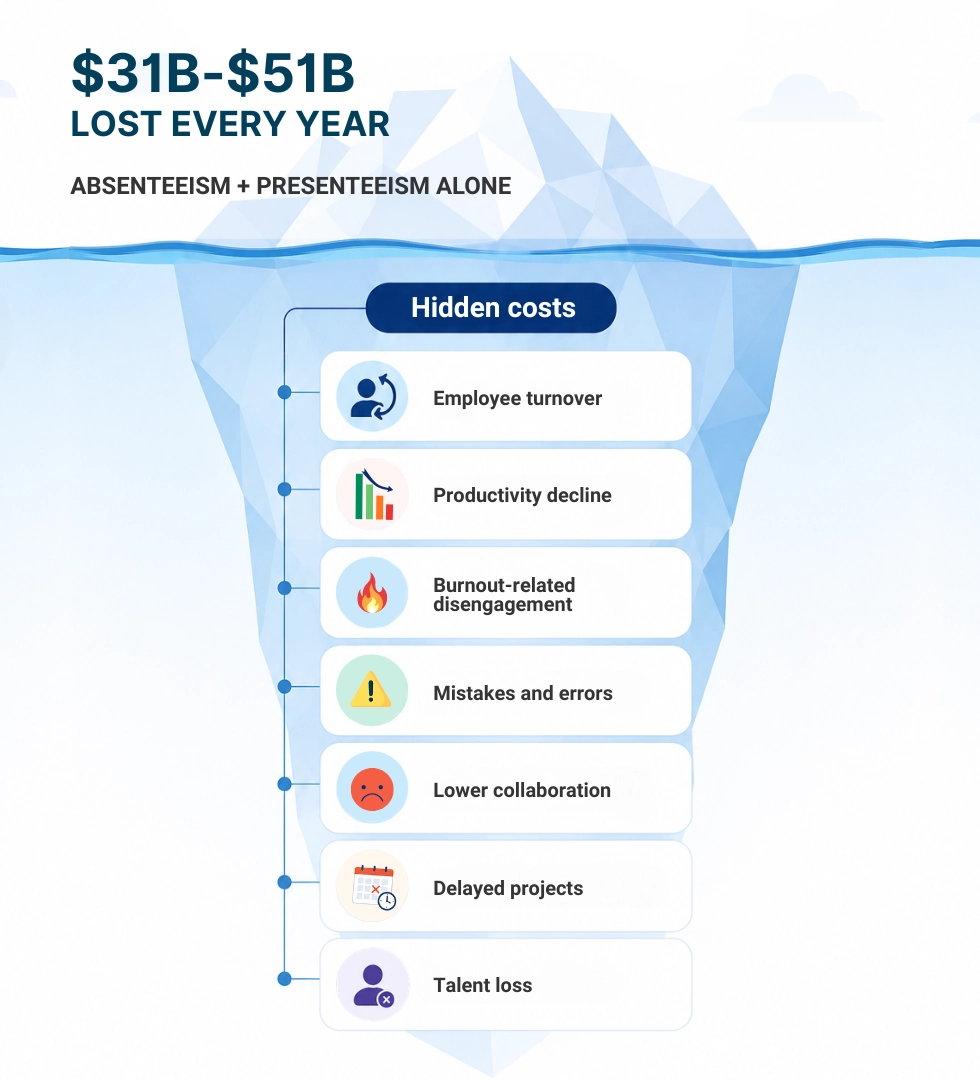
Burnout and workplace stress
urnout is the most widely tracked acute outcome of poor workplace mental health and a leading indicator that workplace mental health conditions are worsening. Research shows it is getting worse, not better. 13. According to Moodle's 2025 workplace research, 66% of U.S. employees report feeling burned out in some form in the past year. That is two-thirds of the workforce carrying chronic exhaustion into every workday. Burnout at this scale affects team output, retention, and healthcare costs.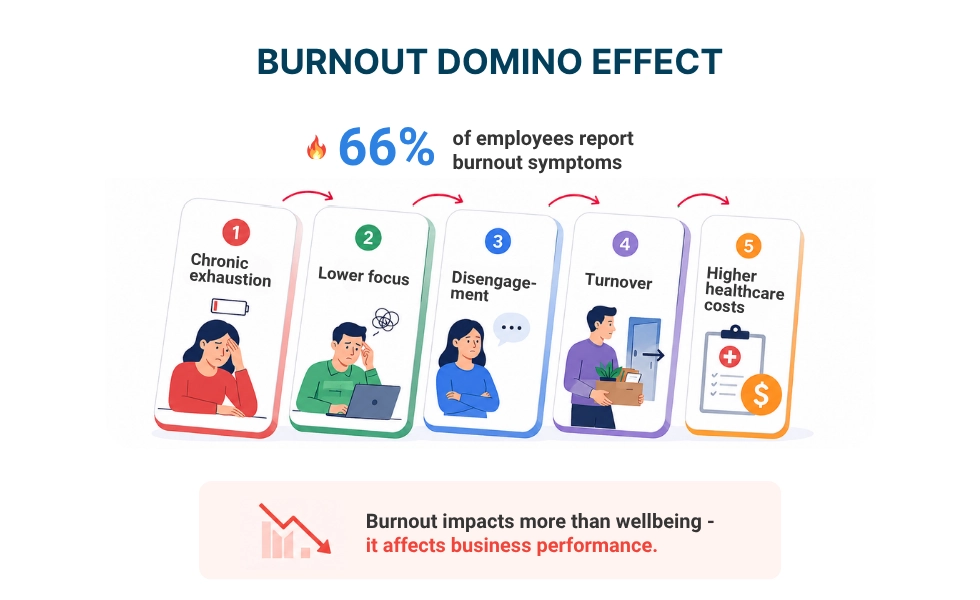
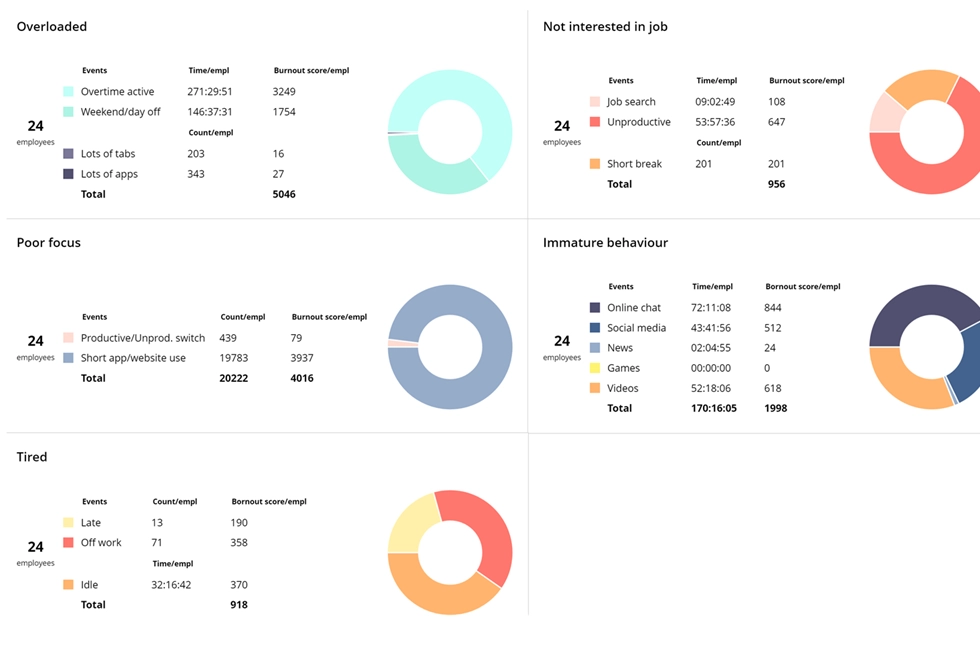
Use this report as a starting point for deeper analysis to address productivity concerns effectively.
Book demo
WorkTime highlights potential signs of employee burnout, offering insights into individuals or teams.
Start free trialThe stigma gap
High prevalence does not translate to help-seeking. Stigma and structural barriers keep many employees from using the support that exists. 18. Data shows that 46% of employees worry about losing their job if they disclosed a mental health at work concern. This figure comes from the Mind Share Partners 2025 Mental Health at Work Report. 19. Two in five workers worry they would be judged if they shared a mental health concern at work. The 2025 NAMI/Ipsos Workplace Mental Health Poll surveyed 2,376 full-time workers at companies with 100+ employees. 20. Notably, 80% of employees with mental health conditions do not seek help at work. Shame and fear of professional consequences are the most cited barriers, making other workers reluctant to disclose. Shame and fear of professional consequences are the most cited barriers to disclosing a mental health condition at work.WorkTime - for healthier, more productive teams!


The employer perception gap
One of the most consistent findings in workplace mental health research is that employers systematically overestimate how healthy their work environment actually is. 24. According to APA's 2024 Work in America survey, 59% of workers agree their employer thinks the workplace is a lot mentally healthier than it actually is. That figure climbs to 75% among employees who report low psychological safety. 25. Only 28% of organizations are effective at helping employees manage stress, according to HR.com 2025. Stress is present in 8 out of 10 organizations. The intervention rate in the workplace mental health context is less than a third of the problem rate. 26. According toccording to Spring Health's commissioned Forrester study, 36% of employees cannot access their mental health benefits at all. Only 53% of employees know how to access mental health care through their employer plan. Benefits exist on paper but are not reaching employees. 27. About 30% of employers report low engagement with their mental health programs, one of the clearest operational failures in this space, fixable through better communication and increasing access to care. WorkTime's distraction score and active time data give managers objective signals about when teams are struggling, helping close the gap between employer perception and employee reality.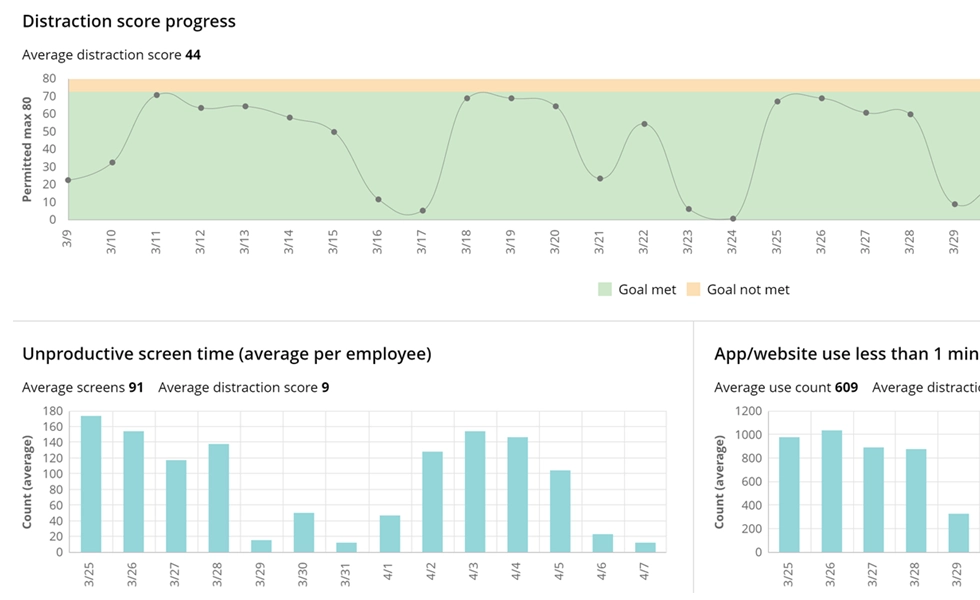

Gain deeper insight into employee focus and productivity by analyzing distraction trends across departments and individual team members.
Start free trialThe Surgeon General's framework: a blueprint for employers
The most authoritative framework for improving mental health at work comes from the U.S. government. In 2022, the U.S. Surgeon General released a “Framework for Workplace Mental Health and Well-Being,” centered on five essentials grounded in human needs shared across industry and role. 28. The five essentials in the Surgeon General's framework are: Protection from Harm, Connection and Community, Work Life Harmony, Mattering at Work, and Opportunity for Growth. Each maps to human needs employees carry into every job: psychological safety and rest (Protection from Harm), social support and positive relationships with co-workers (Connection and Community), work-life harmony and home-life balance (Work-Life Harmony), sense of purpose (Mattering at Work), and growth opportunities (Opportunity for Growth). 29. Overly 80% of workers say they will look for workplaces that actively address mental health at work in the future, according to APA. That preference is pushing employers to create benefit structures that are visible, accessible, and easy to use, and to create cultures where stigma does not prevent employees from using them. 30. Employees whose organizations adopt the five essentials experience greater productivity, lower absenteeism, and stronger alignment with organizational goals, according to HHS. The framework is not aspirational; it maps directly to measurable business outcomes. Employers who apply this framework create work environments where employees feel seen, supported, and able to ask for help without fear.What actually works: managers, training, and structure
The most effective organizations foster a culture where mental health is discussed openly and foster habits at the manager level that prevent problems before they escalate. The research on what drives mental health outcomes at work converges on a few high-impact levers. 31. Importantly, 69% of employees say their manager has the biggest impact on their mental health and well-being, more than salary, company policy, or HR team. Manager behavior is the single most controllable lever for improving employee well-being at scale.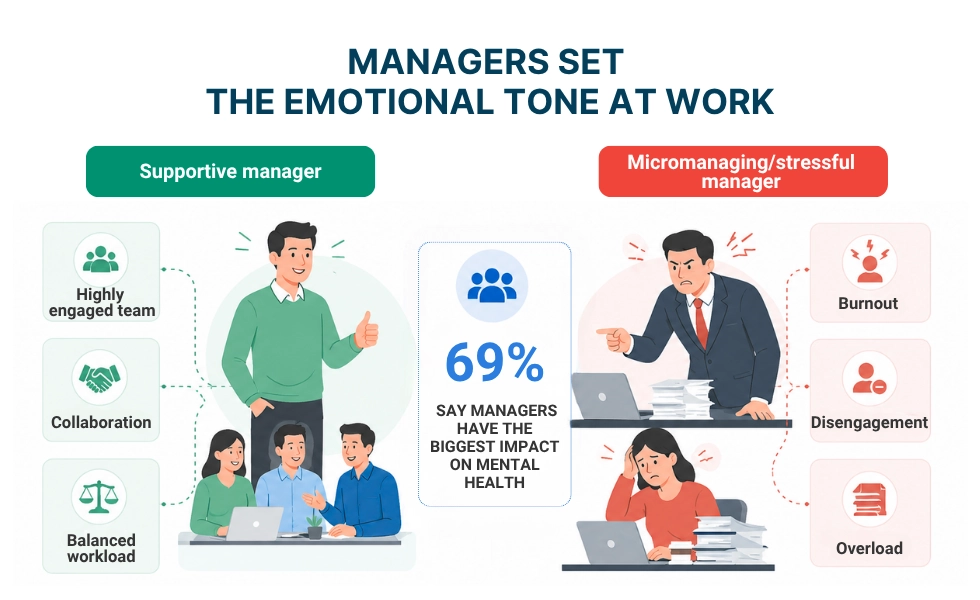
The ROI of mental health investment
37. For example, improving mental health at work through evidence-based programs returns approximately $3.70 in net economic benefit for every $1 invested, according to multiple analyses. The WHO cites a $4 return per $1 invested. Either way, the ROI is clear. 38. About 70% of employees say mental health benefits are very or extremely important to their job decisions. This finding from Spring Health's 2026 Annual Report reflects how central well-being support has become to the employment offer. Mental health benefits have shifted from differentiator to baseline expectation in talent acquisition. 39. Team-level social support drives greater reductions in absenteeism than clinical benefits alone. For example, peer programs, mental health first aiders, and regular manager check-ins all help support workers more effectively. These informal networks have a positive impact that formal programs alone cannot replicate.Mental health by generation and identity
40. Notably, 91% of Gen Z workers report experiencing mental health issues at work at least sometimes, compared to 75% of all workers, according to LIMRA 2024. Gen Z now makes up nearly 20% of the U.S. labor force. Among other things, Gen Z entered the workforce during pandemic disruption, economic uncertainty, and accelerating AI adoption, all of which compound mental health risk. 41. Workers with disabilities face disproportionately high rates of workplace mental health strain. Employees with disabilities consistently report lower psychological safety, fewer growth opportunities, and greater difficulty accessing mental health care through their employers. Promoting inclusion across disabilities, sexual orientation, and other dimensions of identity is not separate from mental health strategy; it is part of it. Promoting psychological safety, promoting access to care, and promoting open conversations about mental health all contribute to employee well-being and are the three behaviors most strongly linked to positive outcomes. 42. Research indicates that 77% of workers report that poor mental health negatively affected their physical health in the past year. These effects do not stay contained to mood and motivation. They convert into physical symptoms that add to healthcare costs and absence rates.Absence, attendance, and early detection
43. In the UK, employees take an average of 18 days off per year for anxiety, burnout, or other mental health conditions, more than injuries (10 days) or physical illness (17 days). Mental health-related absence is already the largest driver of sick leave. 44. For example, paid sick leave policies that explicitly cover mental health conditions increase help-seeking rates among workers and reduce the likelihood that employees push through illness until a crisis forces extended leave. Organizations that include mental health in their paid sick leave framework send a signal that mental health conditions are treated the same as physical ones. 45. Organizations that track attendance patterns identify burnout earlier than those relying on self-reporting. Micro-absences, Friday spikes, and rolling lateness appear in data before workers formally report problems, giving managers a window to reduce risk before it escalates. That risk window is narrow, which is why early detection matters. For example, WorkTime's attendance monitoring and absenteeism tracking surface these patterns automatically across in-office, hybrid, and remote teams. No screenshots. No invasive data capture. Just the attendance and workload signals that flag risk early.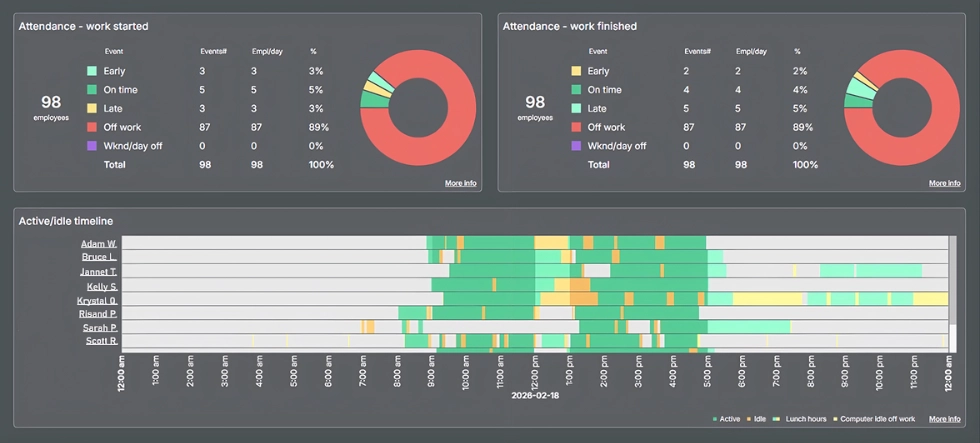

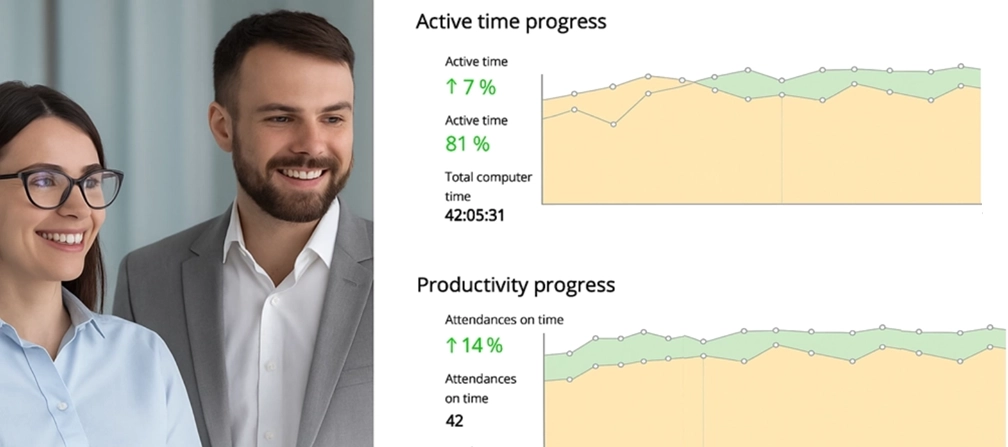
WorkTime report provides a clear overview of employee attendance, punctuality, absences, and active work time.
Start free trialWhat employees want from employers
48. As the data suggests, 92% of workers say it is important to work for an organization that values their emotional and psychological well-being. This finding from APA's 2023 Work in America survey reflects a near-universal expectation. That well-being expectation now shapes hiring decisions. Organizations that foster a culture of mental health support see stronger candidate attraction and lower turnover.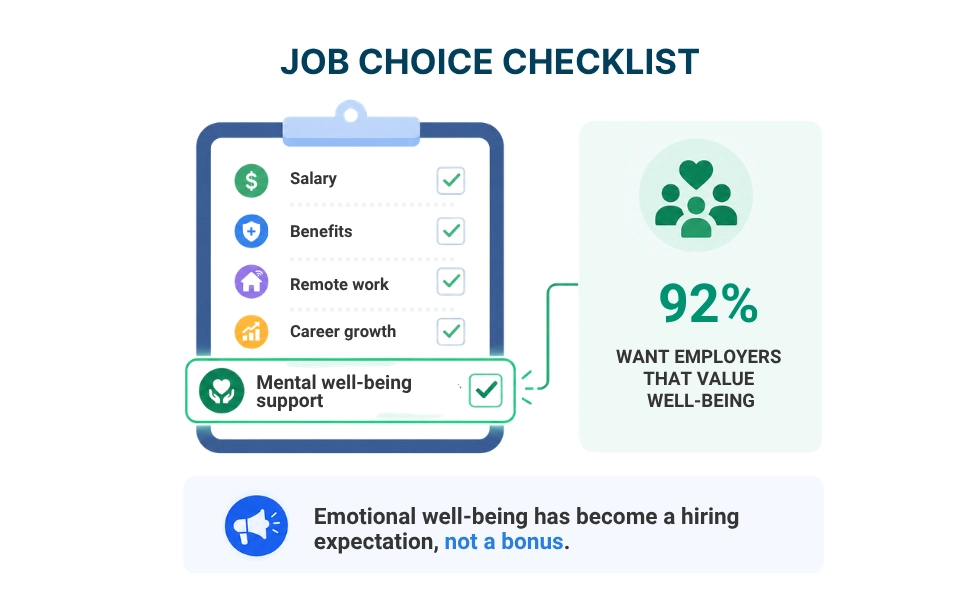
Final thoughts
The workplace mental health statistics in this article point to one consistent pattern. Most organizations know workplace mental health is a problem. Fewer measure it. Fewer still allocate the resources needed to maintain progress and address it at the root, or measure whether those resources are reaching employees. Far fewer have systems in place to detect it early, promote access to the right support, or measure whether their interventions are working. The goal is to support workers before they reach a breaking point. WorkTime helps close the operational layer of that gap. Organizations that want to support workers early, not reactively, need tools that surface behavioral signals before employees self-report. WorkTime tracks attendance patterns, workload signals, distraction scores, and early burnout indicators without screenshots or invasive data capture, giving managers the information they need to intervene. When employers create the conditions to detect and address mental health strain early, they protect both their people and their bottom line.Try WorkTime now!
Frequently asked questions
How widespread is poor mental health in the workplace?
Very widespread. 84% of respondents said their workplace conditions contributed to at least one mental health challenge. Around 1 in 6 workers is managing one at any given time. 75% of U.S. workers experience anxiety, depression, or similar challenges at least sometimes, according to LIMRA.What does poor mental health cost employers?
Depression and anxiety cost the global economy $1 trillion per year. U.S. employers lose $31 to $51 billion annually. The ROI of addressing it proactively is approximately $4 returned for every $1 invested.What is the Surgeon General's framework for workplace mental health?
The Surgeon General's Framework, released in 2022, identifies five essentials grounded in human needs:- Protection from harm;
- Connection and community;
- Work-life harmony;
- Mattering at work;
- Opportunity for growth.