



TL;DR
- A BLS analysis of 61 industries found a positive link between remote work and total factor productivity growth, showing that remote and hybrid work arrangements do not drag down economic output.
- Quiet quitting looks like the same hours and the same role, but with less initiative, fewer ideas, and minimal collaboration.
- Most workplace productivity losses from quiet quitting are invisible but cumulative, because there’s no resignation moment to trigger action.
- Employee monitoring data is only useful when it’s trend-based and transparent; it can increase employee disengagement.
- Non-invasive employee monitoring and productivity analytics help leaders spot performance trends early and start better conversations without micromanaging.
In this article
This article is prepared by WorkTime, a non-invasive productivity monitoring tool that helps managers spot early signs of disengagement and support their team effectively.
What does “quiet quitting” mean?
Quiet quitting is when a worker completes their assigned tasks and meets deadlines, but the level of effort and personal investment in completing those tasks drops off. As an example, an employee will complete all tasks on time but will rarely offer suggestions for improvement, check in with others regarding how they are doing, and/or take responsibility for anything that is never assigned to them. While the employee remains at work and indeed performs their duties, there is no desire to do anything else. Many times, quiet quitting is a symptom of something going rotten in the workplace, rather than a personality issue. Some common causes include some classics like unclear priorities, unbalanced workload, lack of recognition, and limited opportunity for advancement. Quiet quitting is also different from burnout. As with burnout, a worker is exhausted with work, whereas with quiet quitting, they are trying to do the bare minimum and nothing else.
Why quiet quitting hurts workplace productivity
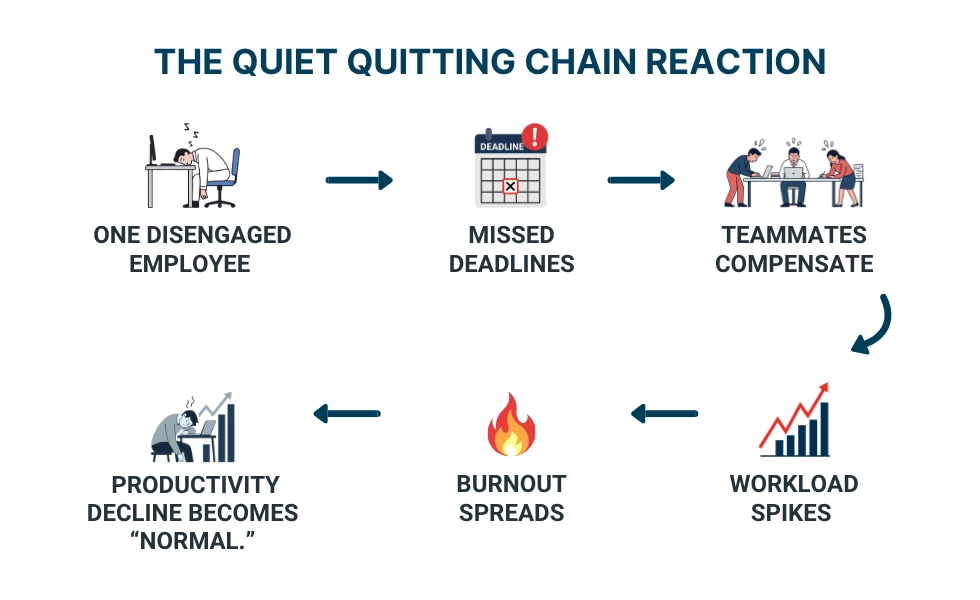
Quiet quitting harms workplace productivity because the losses aren't a single failure you can point to. It's a slow, blood-sucking drag on the entire organization. The operational cost is real, even if output still “looks fine” week to week: 1. Slower execution - momentum drops without obvious alarms.- Projects lose acceleration as discretionary effort disappears.
- Dependencies and risks surface later, and deadlines compress.
- Innovation requires caring enough to fix friction.
- Quiet quitting reduces the small upgrades that drive meaningful gains.
- Teams notice who carries the load.
- High performers compensate, and burnout spreads.
- Leaders spend more time clarifying and chasing status.
- The time tax becomes permanent and weakens planning.
Early signs of quiet quitting, managers often miss
Managers often try to read personality. A better approach is to track patterns. Quiet quitting at work usually looks like a stable presence paired with shrinking outcomes, initiative, and collaboration. Common signs of quiet quitting at work include:- Stable hours, declining output quality;
- Fewer proactive actions;
- Reduced meeting participation;
- Tasks completed at the minimum acceptable level;
- Less collaboration, more isolation;
- More “busy work,” less high-impact work.
Top reasons employees quietly quit at work
Most reasons for quiet quitting fit into a few buckets.Chronic micromanagement
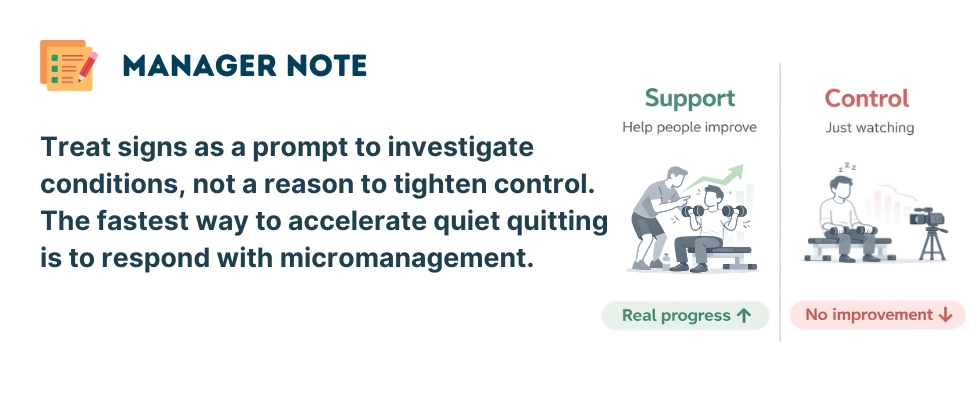
As soon as an employee is managed by a manager who focuses on how things get done rather than what gets done, employees start to lose the ability to think independently. As soon as an employee's initiative is corrected by a manager instead of recognized as an example of good initiative, employees will eventually limit their risk-taking and follow a script.Lack of recognition or growth
Quiet quitting typically starts when employees find out that their hard work does not receive either feedback, visibility, or career advancement opportunities. At that point, employees adjust their level of effort to fit the system they're working in, and their discretionary energy fades away since there is no defined path linking performance to career advancement or recognition.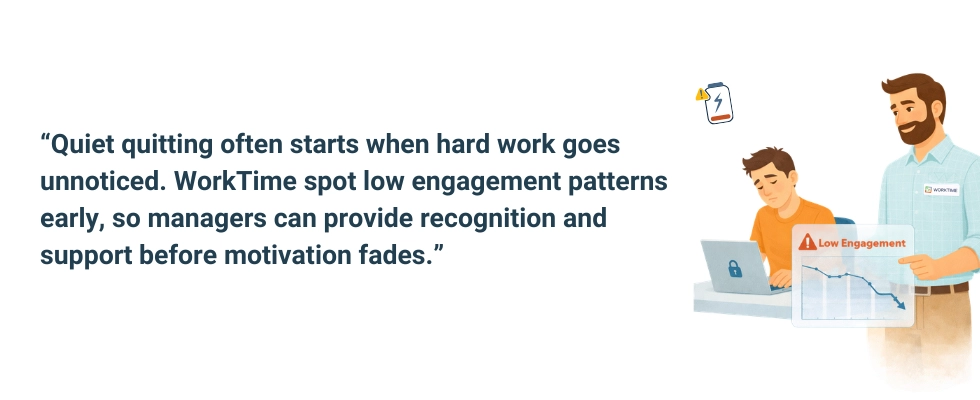
Unclear expectations and shifting priorities
When employees are required to continuously adapt to changing priorities on a weekly basis, and the success metrics remain vague, employees will start to disown their work as a means of protecting themselves. It is safer for employees to deliver exactly what their manager has asked them to do rather than take the initiative to try something new that might later be labeled "not aligned."Always-on culture and meeting overload
The always-on culture and excessive number of meetings slowly take away employees' focused time and mental bandwidth. Since employees have no uninterrupted time to engage in meaningful work, their output will suffer, and so will their frustration levels. Ultimately, the consistent distraction of employees' attention will lead to a decrease in engagement and ultimately lead to a type of quiet quitting where employees no longer openly complain but instead just go through the motions of their job.


Invasive monitoring and lack of trust
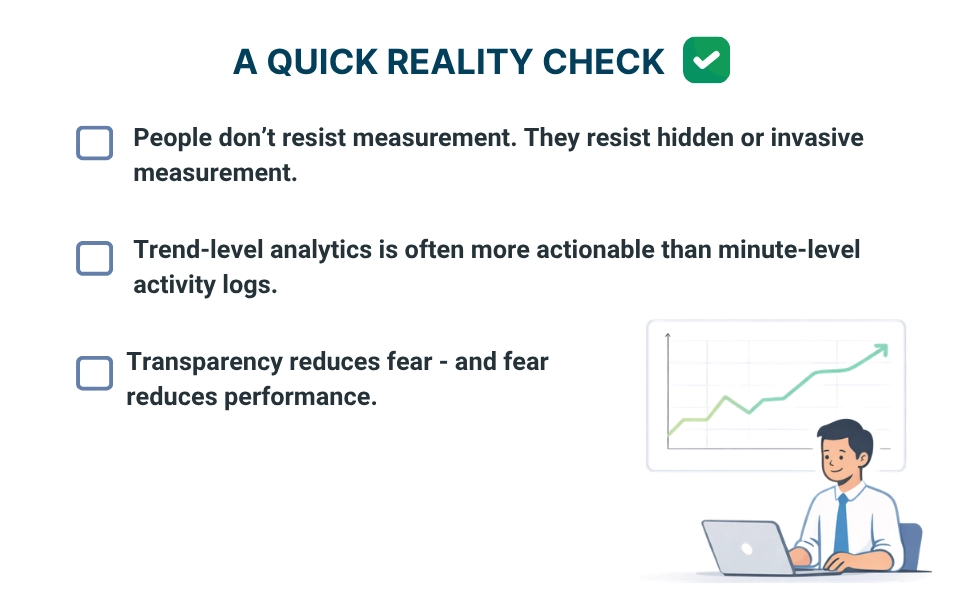
Monitoring employees that appears to be intrusive or invisible can cause employees to focus on being productive rather than producing valuable work. This will distort performance behaviors. However, ethical and transparent monitoring that measures productivity based on results rather than individual activities can help eliminate this distortion.No feedback loop
When effort disappears into a void, people stop offering it. Quiet quitting is sometimes the outcome of a missing system: no recognition, no coaching, no clarity on what “great” looks like.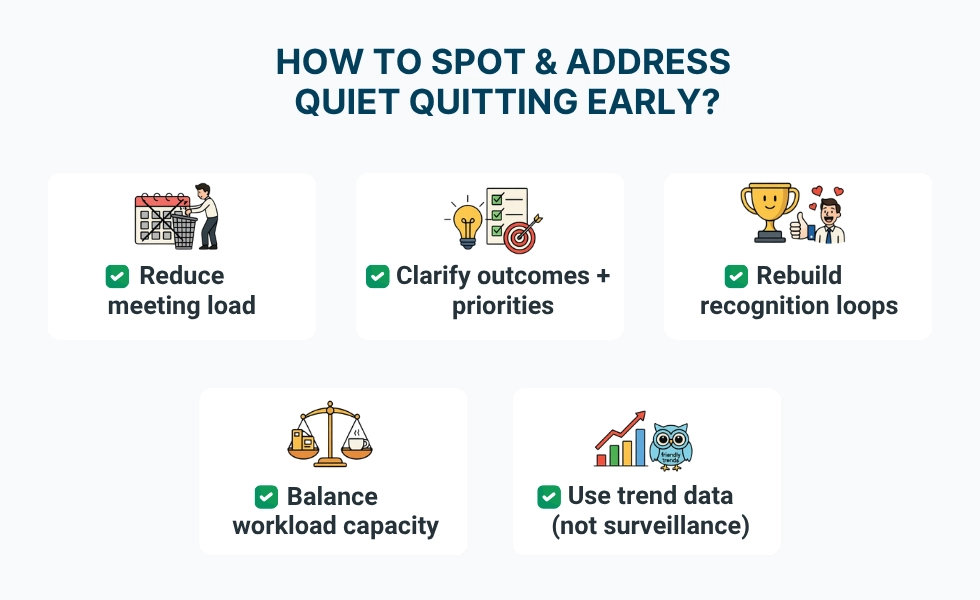
How employee monitoring data reveals quiet quitting patterns
If you think you might have quiet quitters in your business but are not quite certain, then the best course of action is to start monitoring their productivity to see if they are indeed quiet quitting.The evolution from surveillance to ethical trend-based monitoring
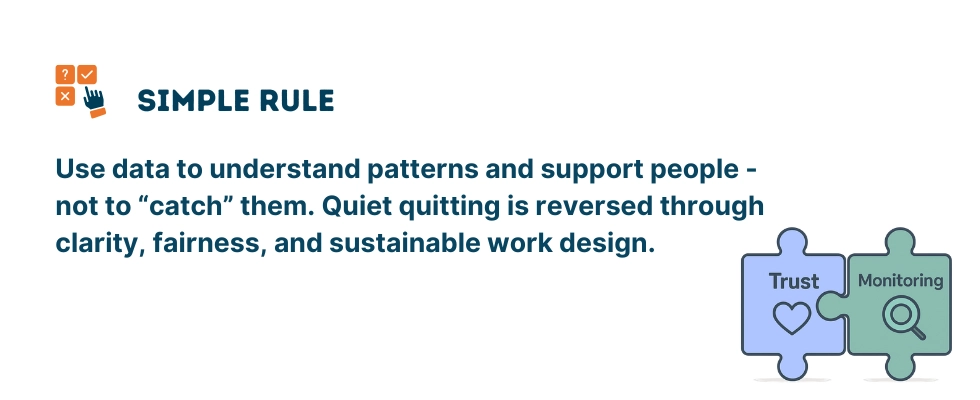
1. Uncertainty about what’s happening. Leaders lack visibility into workload and outcomes. 2. Control-focused monitoring. Goal: reduce uncertainty by tracking granular activity. 3. Surveillance-style monitoring. Signal: moment-by-moment activity and content capture. Employee experience: stress, “looking busy,” trust erosion. 4. Trust and performance decline. Risk rises. Employees disengage. Productivity becomes performative. 5. Shift to ethical, trend-based monitoring.- Goal: Support outcomes, planning, and workload balance - not control behavior.
- Signal: Trends, ratios, and consistency patterns over time instead of moment-by-moment activity.
- Employee experience: Fairness, transparency, and lower defensiveness because people understand what’s being measured and why.
Quiet quitting patterns that data can surface
If you know what to look for, the data can highlight early signs of quiet quitting. This table breaks down the patterns and the best response.| Pattern in monitoring data | What it may indicate | How to respond (without micromanaging) |
|---|---|---|
|
Consistent time logged, declining output consistency |
Early quiet quitting or process friction |
Clarify priorities; remove blockers; reset expectations |
|
High active time, low completion signals |
Fragmented focus; context switching; meeting overload |
Reduce meetings; protect deep work; align on outcomes |
|
Meeting time rising, focus time shrinking |
Loss of control → disengagement patterns |
Audit meetings; shift updates async; rebuild focus blocks |
|
Presence is increasing while results trend down |
Performative work (visibility over outcomes) |
Re-anchor to deliverables; reward outcomes, not activity |
|
Long days + worsening performance trends |
Burnout risk |
Rebalance workload; adjust deadlines; restore recovery |
Preventing quiet quitting with WorkTime
WorkTime helps prevent or address quiet quitting by analyzing real work patterns, not just screenshots or emails. Unlike traditional monitoring tools, it provides a complete view of productivity, helping managers see who is delivering results and who may be disengaged. By focusing on outcomes with transparent, non-invasive monitoring, WorkTime gives teams actionable insights without eroding trust.WorkTime principles: outcomes over surveillance
WorkTime provides trend-based, privacy-friendly performance insights:- Productivity trends over time;
- Workload balance signals;
- Focus vs. meeting time visibility.
- Planning and coaching context.
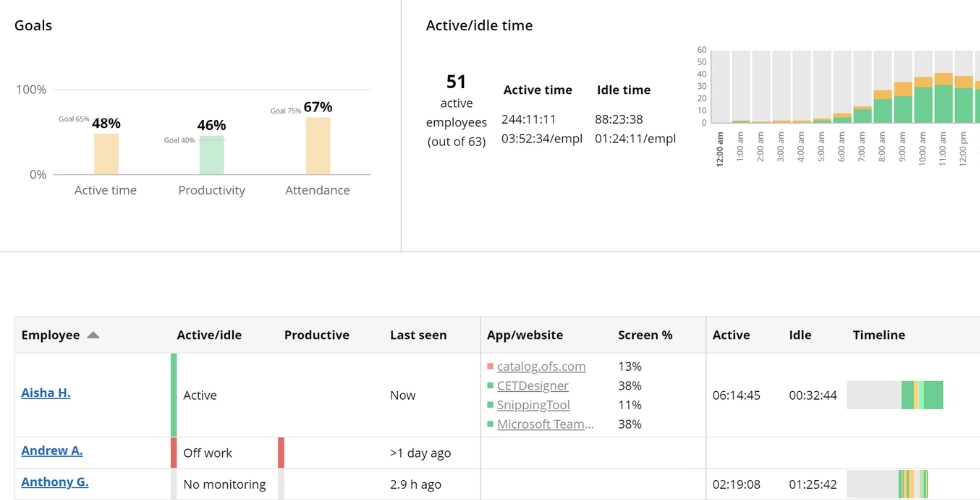

Curious about your team’s real performance? This report shows each employee’s key performance metrics - without capturing any personal content.
Start free trial- Screenshots;
- Keystrokes;
- Private message content;
- On-screen details.
The signals that matter most
- To prevent quiet quitting, managers need decision-ready visibility, not noise. WorkTime helps surface:
- Employee performance trends over weeks (not single-day spikes);
- Workload imbalance (who’s overloaded and who’s underutilized);
- Meeting overload vs. focus time (a key driver of disengagement); Remote vs. in-office performance patterns (useful for hybrid teams).
How to rectify quiet quitting with WorkTime
A common quiet quitting scenario looks like this: a high-performing employee’s meeting load increases for several weeks, their focus time shrinks, and delivery quality becomes “good enough.” Managers may read this as an attitude, but it’s often overload plus low control over attention. Using WorkTime's trend-based productivity analytics, you can identify these trends quickly:- 1. Increased meetings;
- 2. Decreased focused time;
- 3. Decline in overall performance.
Bottom line: Quiet quitting can be addressed early - with WorkTime
Quiet quitting isn’t about employees doing something “wrong.” Often, it’s a signal that support, clarity, or engagement could be improved. You want your team to feel connected and motivated, not just present. WorkTime helps spot early patterns of disengagement by showing real work trends and outcomes, not just screenshots or random activity. And because it works non-invasively and ethically, you get clear insights without undermining trust or privacy. The result? You can retain valuable employees, guide them back on track, and keep your team productive and engaged before quiet quitting ever becomes visible.