


TL;DR
- Call monitoring and employee monitoring are different tools. Call recording tracks customer interactions. Employee monitoring tracks productivity, attendance, and active time. You need both for full visibility into call center operations.
- Turnover costs call centers over $1 million annually for a 100-agent team. Monitoring tools that detect signs of burnout and attendance issues early can significantly reduce this.
- 69% of contact centers now maintain work-from-home programs. Without center monitoring tools, remote agents operate in a visibility gap that hurts service quality and accountability.
- Non-invasive monitoring outperforms invasive surveillance. Research shows employees are twice as likely to fake productivity when tracked using invasive call-center monitoring software. Lighter, productivity-focused monitoring builds trust and delivers better results.
In this article
This article is brought to you by WorkTime - experts in non-invasive employee monitoring designed to support productive and trusted workplaces.
What is call center monitoring?
Call center monitoring is the process of tracking, measuring, and improving how your call center teams handle customer service interactions and manage their time. It covers everything from evaluating phone calls and customer interactions to measuring agent productivity, attendance, and computer activity during work hours. Most center managers think of call monitoring as either listening to recordings or running quality-assurance scorecards. That is one piece of the puzzle. But effective call monitoring goes beyond the conversation itself. It also includes tracking what agents do between calls, how much time they spend active versus idle, and whether attendance patterns signal deeper agent performance issues. There are two layers to a complete call center monitoring strategy: 1. Call quality monitoring focuses on the customer interaction itself. This includes call recording, speech analytics, quality assurance scorecards, and evaluating customer interactions to ensure agents meet quality standards. Call monitoring at this level drives service quality and compliance across contact centers. 2. Employee productivity monitoring focuses on agent performance patterns and work habits. This includes active and idle time tracking, application and website usage, attendance monitoring, and productivity scoring. The goal is operational efficiency and agent well-being.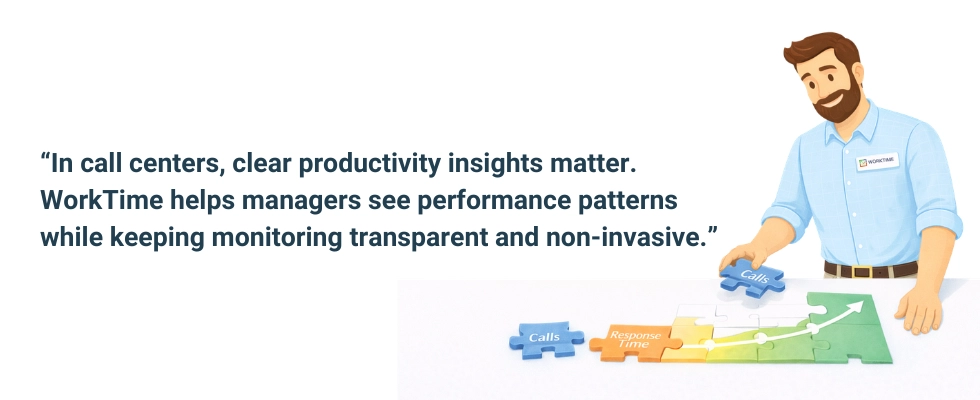
Why call center quality monitoring matters
The call center industry is under pressure from every direction. Customer expectations are higher than ever. Agent performance varies widely, especially across distributed teams. And the shift to remote work has made it harder to maintain consistent service quality across contact centers of all sizes. Here's what the data says:- Annual agent turnover runs 30% to 45% across the industry, with some sectors hitting 60%. That makes this one of the highest-turnover work environments in any industry. Every agent who leaves takes training, product knowledge, and customer relationships with them.
- The average agent stays just over 13 months. That means most managers are constantly recruiting, onboarding, and training replacements rather than developing experienced teams.
- 87% of agents report high workplace stress, and 77% say it affects their personal life. Burnout is the leading driver of this turnover cycle.
- A good customer satisfaction score falls between 75% and 85%. But maintaining that range is nearly impossible when teams are in constant flux. First call resolution rates, the percentage of customer issues solved on the first contact, typically land between 70% and 79%. Every unresolved issue costs additional time and erodes customer loyalty.


How to monitor call center agent performance
Effective call monitoring starts with knowing what to measure. Here are the key performance indicators that matter most for quality assurance in any contact center.Call quality metrics
These metrics evaluate how call center agents handle customer service interactions directly:| Metric | Benchmark | Why it matters |
|---|---|---|
|
First call resolution (FCR) |
70%+ |
Measures whether customer issues are solved on the first contact. Higher first call resolution rates mean fewer callbacks and better customer experience |
|
Average handle time (AHT) |
~6 minutes |
Tracks the average length of a customer service call, including wrap-up. Too high signals inefficiency; too low may mean rushing customers |
|
Customer satisfaction score (CSAT) |
75-85% |
Direct feedback from post-call surveys measuring customer sentiment after interactions |
|
Average speed of answer (ASA) |
Under 28 seconds |
How long customers wait before reaching an agent. Long wait times increase negative customer sentiment and drive abandonment |
|
Call abandonment rate |
Under 5% |
Percentage of callers who hang up before reaching an agent |
Agent productivity metrics
These metrics track what happens outside of (and around) phone calls:| Metric | What it tracks | Why it matters |
|---|---|---|
|
Active vs. idle time |
Time agents spend actively working vs. sitting idle |
Identifies disengaged agents or those who may need more support |
|
Attendance patterns |
Late arrivals, early departures, break duration |
Daily absenteeism in call centers runs 5-7%. Tracking patterns helps reduce it |
|
Occupancy rate |
Percentage of time agents spend on call-related work |
Should stay between 85-90%. Above 90% leads to burnout |
|
Application usage |
Which apps and websites agents use during work hours |
Reveals productivity gaps and distraction patterns |
|
Overtime patterns |
Frequency and duration of overtime work |
Flags potential burnout signs and overtime fraud |
Call center monitoring software: what to look for
Not all center monitoring software is built the same. When evaluating call center monitoring software for your operation, focus on these capabilities:Real-time dashboards
You need to see what's happening right now: who's active, who's idle, who arrived late, and which teams are hitting their targets. Real-time visibility lets center managers make adjustments before small issues become big problems. WorkTime real-time dashboards give you this visibility transparently and non-invasively - no screenshots or private content are captured.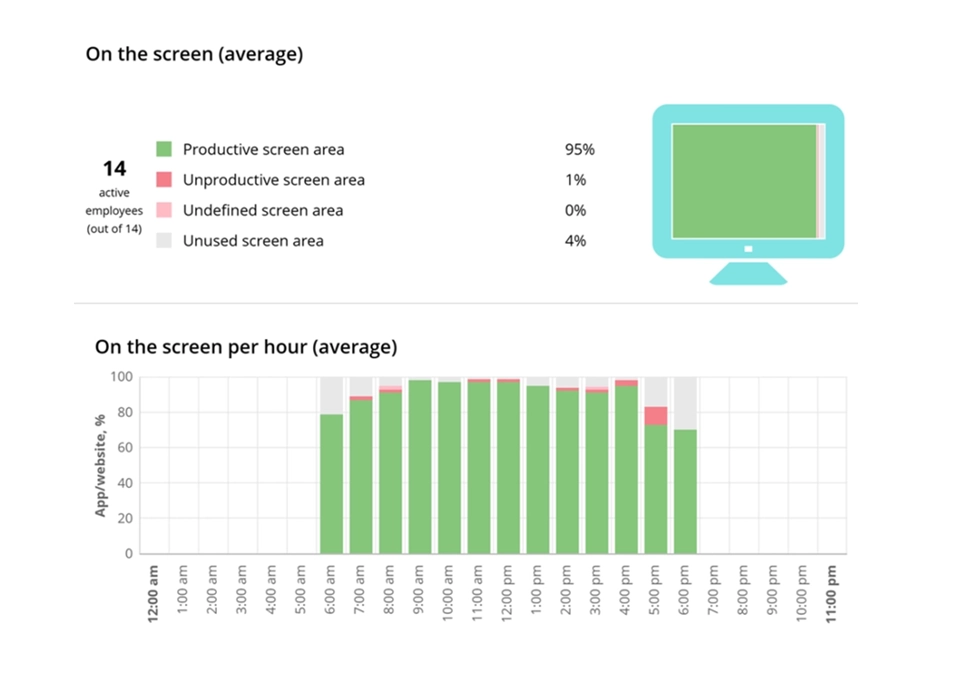

WorkTime measures employee productivity transparently and non-invasively. Use this report to monitor team performance and identify trends at a glance.
Start free trialAttendance tracking
With daily absenteeism rates of 5-7% in call centers, attendance monitoring is mandatory. Look for monitoring software that tracks login and logout times, break duration, and attendance trends over time.Active and idle time monitoring
Knowing how much of the workday agents spend actively engaged versus idle is one of the most valuable insights center quality monitoring software can provide. This data reveals whether staffing levels match demand and which center agents may be struggling.Remote and hybrid support
With 69% of contact centers maintaining work-from-home programs (Deloitte Digital, 2024), your center monitoring software ensures the same level of visibility for remote agents as on-site teams. Tools that compare remote and in-office productivity help you make data-driven decisions about your workforce model.Non-invasive data collection
This matters more than most call center managers realize. Research from Arizona State University found that excessive monitoring actually reduces productivity. A Gartner study found that employees under invasive tracking systems are twice as likely to engage in "productivity theater," spending time looking busy rather than being productive. Call center monitoring software that tracks productivity metrics without capturing screenshots, keystrokes, or personal content gets better results because agents trust it. Non-invasive monitoring collects actionable insights without crossing privacy lines.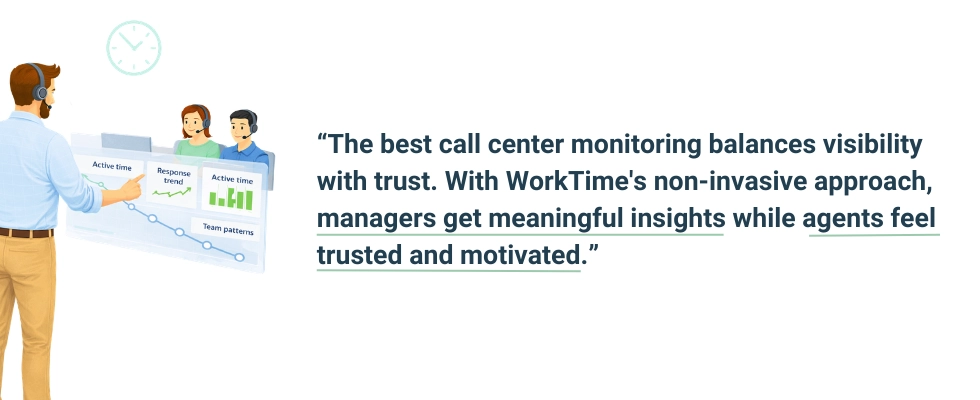
Compliance readiness
Contact centers in healthcare, finance, and insurance operate under legal and industry regulations. Your call monitoring tools should support HIPAA, GDPR, and GLBA compliance modes to protect both customer data and employee privacy. Call monitoring software that lacks compliance features is a liability for regulated contact centers.How call center monitoring reduces turnover and burnout
Most articles about call center quality monitoring focus on catching problems. The bigger opportunity is preventing them.1. Burnout detection
When occupancy rates push above 90%, agents burn out. Monitoring active time and overtime patterns over weeks reveals which agents are overworked before they submit a resignation. Burnout signs tracking turns monitoring data into an early warning system that protects both center agents and the call center's performance.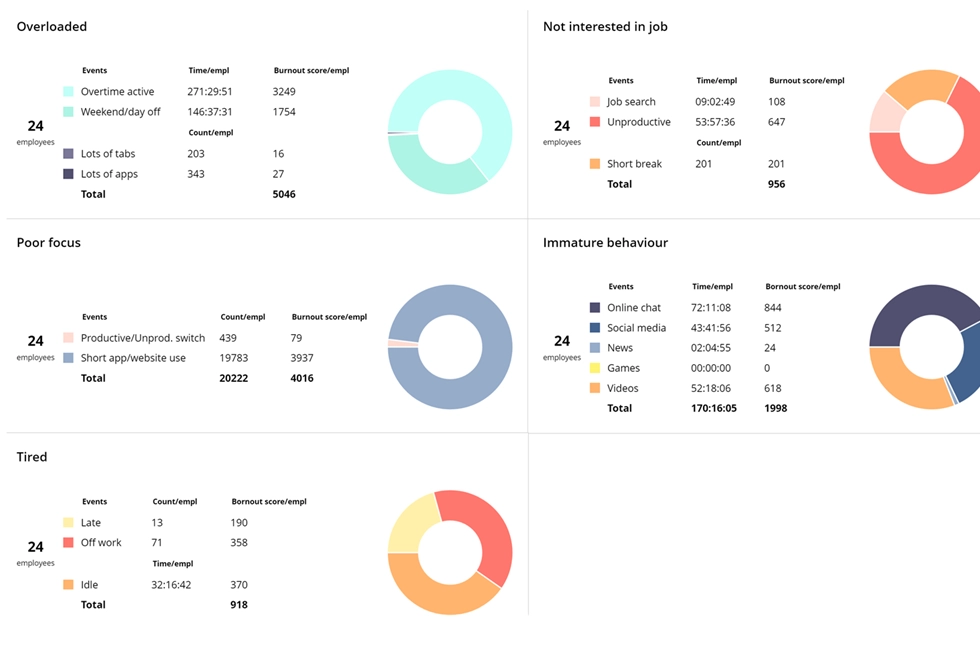

WorkTime burnout report helps you detect early warning signs of employee fatigue. Get actionable insights to address risks before productivity declines.
Start free trial2. Fair workload distribution
Real-time center-monitoring tools show managers which agents and teams carry heavier workloads. Rebalancing work before it becomes overwhelming improves both agent well-being and customer experience.3. Data-driven coaching
Instead of subjective evaluations, quality-monitoring process data provides managers with specific, measurable insights to guide coaching conversations. Call monitoring data, paired with agent performance metrics, provides the full picture. Agents respond better to concrete data than vague feedback, and the coaching itself becomes a retention tool. You can pair call recording insights with active time and application usage data for a complete view of agent performance.4. Engagement through transparency
Allowing agents to access their own productivity data shifts the dynamic from surveillance to self-improvement. Research shows that engaged and satisfied call center agents are 8.5 times more likely to stay within a year. Tools like leaderboards and self-service reports make monitoring a two-way conversation that supports high-quality service.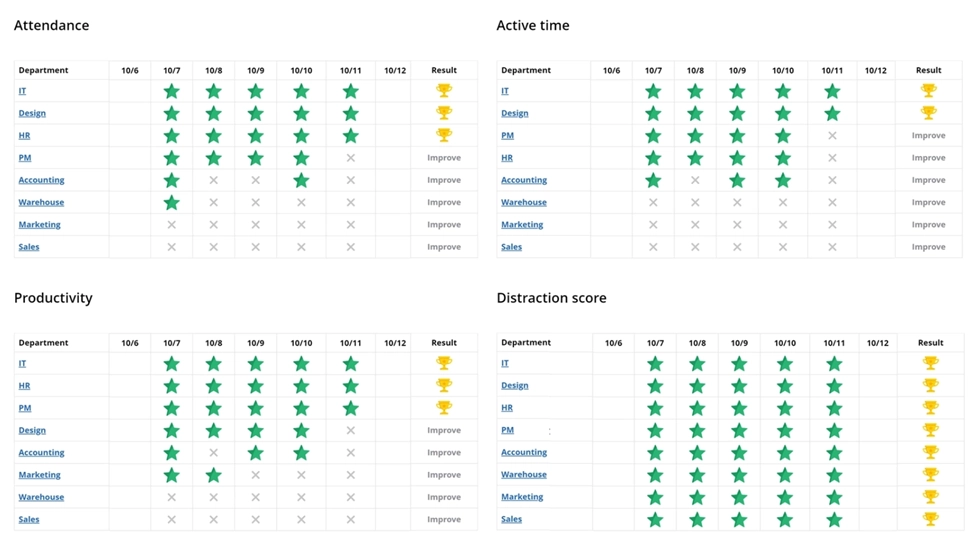

Motivate your team with WorkTime leaderboards. Share them in your newsletter or display the report in the office to showcase progress, celebrate wins, and clarify performance goals.
Start free trialMonitoring remote and hybrid call center teams
Managing remote call center agents is one of the biggest challenges center managers face in 2026. Without physical oversight, it's harder to spot disengagement, enforce schedule adherence, and maintain consistent center quality across locations. Effective center monitoring practices for remote teams require the following:- Equal visibility regardless of location. Remote employee monitoring should provide the same metrics for work-from-home agents as for in-office teams: attendance, active time, productivity scores, and application usage.
- Location-based performance comparison. Are remote agents more or less productive than their in-office counterparts? Without call-monitoring data and productivity metrics, managers have to guess. With remote vs. in-office comparison tools, they know. This data also helps justify (or adjust) remote work policies to improve overall call center efficiency.
- Consistent quality standards. Quality assurance standards don't change because an agent works from home. Center monitoring software ensures that the same key performance indicators apply across the board, and that customer service interactions meet the same quality standards regardless of agent location. This consistency is what separates contact centers that deliver excellent customer service from those that struggle to do so.
What is the best call center quality monitoring process?
1. Set clear benchmarks
Define what "good" looks like for your operation. Targets for first-call resolution, customer satisfaction scores, active time percentages, and attendance provide agents with clear goals and managers with clear evaluation criteria. Use data from call recording reviews and productivity reports to set realistic baselines.2. Monitor consistently
Quality monitoring is not a quarterly audit. Use call center monitoring tools to continuously track both call quality and agent performance. The best call center monitoring software generates trends over time, not just snapshots. Consistent quality management produces patterns you can act on.3. Analyze for patterns
Look beyond individual agent performance. Are certain shifts consistently underperforming? Does absenteeism spike on specific days? Are remote agents showing different productivity patterns than in-office teams? Patterns reveal systemic issues that individual coaching can't fix. Speech analytics and productivity data from your call monitoring tools together provide valuable insights neither tool provides on its own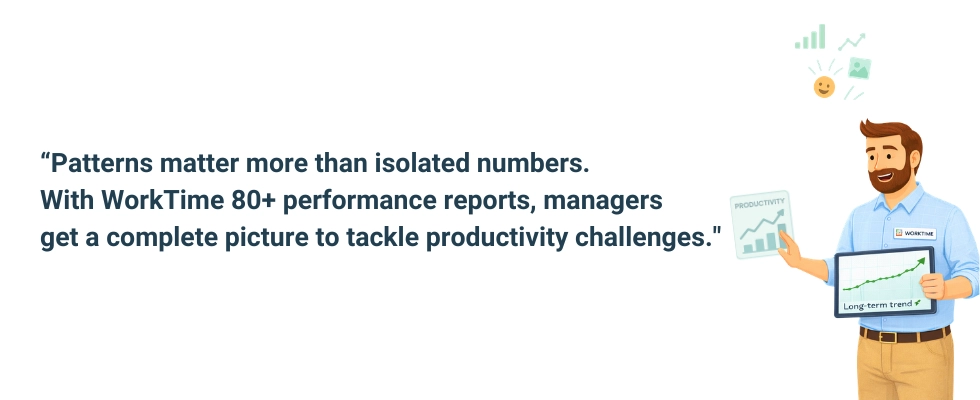
4. Coach with data
Share monitoring insights with agents regularly. Use specific examples from quality monitoring data, not generalizations. When agents see their own data and understand how it connects to customer satisfaction and call center operations, they're more likely to improve. This kind of coaching helps predict customer behavior patterns and prepare agents to handle them.5. Adjust and repeat
Use monitoring data to refine processes, update training, and reallocate resources. The quality management cycle never stops, and neither should your call center monitoring strategy.How can call center monitoring improve customer satisfaction?
Every improvement in center operations ultimately benefits the customer. When call monitoring reveals that agents are more productive, customers wait less. When attendance is consistent, staffing levels match demand. When burnout is prevented, agents have the energy to deliver exceptional customer service and handle customer issues with care.
Conclusion
Call center monitoring works best when it serves two goals at once: better customer satisfaction and better agent experience. The data shows that high turnover, burnout, and absenteeism are the biggest threats to center quality, and all three are preventable with the right monitoring approach. WorkTime is built for exactly this. As the only non-invasive employee monitoring software on the market, WorkTime provides managers with real-time visibility into attendance, productivity, active time, and signs of burnout without capturing screenshots, keystrokes, or personal content. It works for in-office, remote, and hybrid teams and supports HIPAA and GDPR compliance out of the box. Start a free 14-day trial to see how WorkTime can improve agent performance and customer service quality across your operation.