


TL;DR
- Teramind is the pick for native data loss prevention and live visual monitoring. It offers heavy DLP, screen recording with session playback, and granular endpoint controls, but it carries the steepest setup and the strongest "invasive" reputation.
- Veriato is the pick for AI behavioral risk analytics and insider-threat investigations. Its risk scoring reads more than 130 behavioral data points, and its lower entry price makes it easier to start.
- Both tools capture content, which is a compliance liability in regulated settings. Screenshots, keystroke content, and email capture create exposure under HIPAA, GDPR, and GLBA.
- Pricing is uneven. Veriato publishes its price ($18 per user per month for its monitoring product). Teramind no longer publishes prices and routes buyers to sales, with third-party reviews reporting roughly $21 per seat to start.
- A non-invasive path exists. Productivity analytics without screenshots or keystroke content gives you remote-workforce visibility while sidestepping the backlash and legal risk that content capture creates.
In this article
The article is presented by WorkTime, combining 25+ years of workforce monitoring expertise with non-invasive analytics that help organizations improve performance while maintaining employee trust.
Teramind vs. Veriato at a glance
Here is how the two tools compare on the factors buyers weigh most, as of July 2026.| Factor | Teramind | Veriato |
|---|---|---|
|
Best for |
Native DLP and live endpoint control |
AI behavioral risk scoring and investigations |
|
Core strength |
Continuous visual monitoring plus data loss prevention |
Predictive insider-risk analytics and forensics |
|
Data loss prevention |
Heavy, native (block transfers, restrict USB, print controls) |
Lighter, investigation-focused, with PII/PHI redaction |
|
Behavioral analytics |
Machine-learning behavior rules |
Generative-AI risk scoring across 130+ data points |
|
Screen capture |
Live desktop viewing and DVR-style session playback |
Alert-based, continuous, and smart-camera screenshots |
|
Keystroke logging |
Yes, including copy and paste |
Yes, including concealed characters |
|
Email monitoring |
Yes |
Yes, with NLP sentiment analysis (IRM) |
|
Deployment |
Cloud and self-hosted |
Cloud and on-premise |
|
Starting price |
Contact sales (third parties report ~$21/seat) |
$18/user/month (annual, min 5 users) |
|
Minimum seats |
Reported 5-seat minimum |
5 users (monitoring); 20 users (insider risk) |
|
Rating context |
Gartner Peer Insights 4.2 (small sample) |
Gartner Peer Insights 2.8 (small sample) |
|
Content capture |
Extensive |
Extensive |
What is Teramind?
Teramind is a user-activity monitoring and data loss prevention platform aimed at security teams and organizations that want tight control over endpoint behavior. It combines workforce analytics, insider-threat detection, and one of the deepest DLP feature sets in the category. On monitoring, Teramind captures nearly everything. It offers live desktop viewing and DVR-style session playback, continuous and interval screenshots, full keystroke logging that captures copy and paste, and optical character recognition that reads on-screen text and images. It tracks websites, applications, individual pages, printing, and file transfers, including the content of printed documents. Its higher tier adds typing-pattern and mouse-dynamics checks to validate that the person at the keyboard is who they claim to be.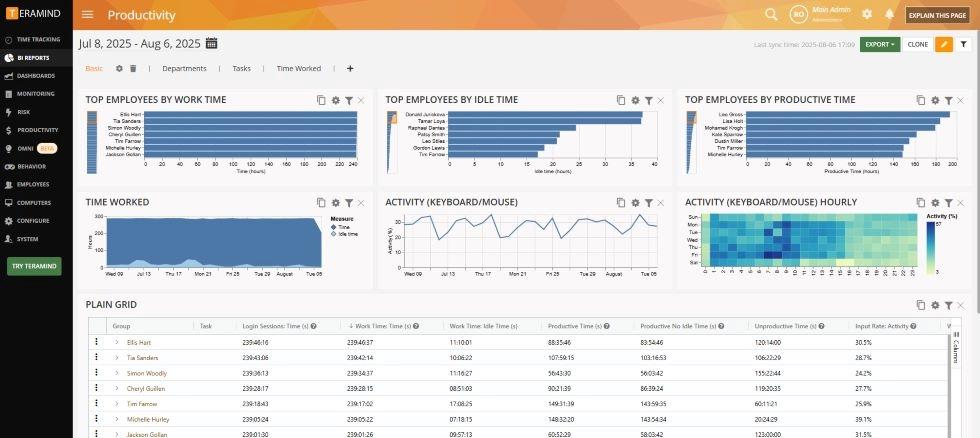
What is Veriato?
Veriato is a workforce monitoring and insider-risk platform that has operated for more than two decades and serves customers in over 70 countries. It splits into two products: Veriato UAM for real-time activity visibility and Veriato IRM (formerly Cerebral) for advanced behavioral analytics. Veriato's differentiator is its AI. Veriato IRM applies generative AI risk scoring across more than 130 behavioral data points to flag genuine risk signals instead of noise. It adds predictive risk scoring at the user and group level, NLP sentiment analysis across employee communications, automatic identification and redaction of PII and PHI, and detection of stolen-credential access. Veriato UAM continuously collects endpoint data across more than 60 activity types, including email, chat, web history, file transfers, keystrokes, and screenshots.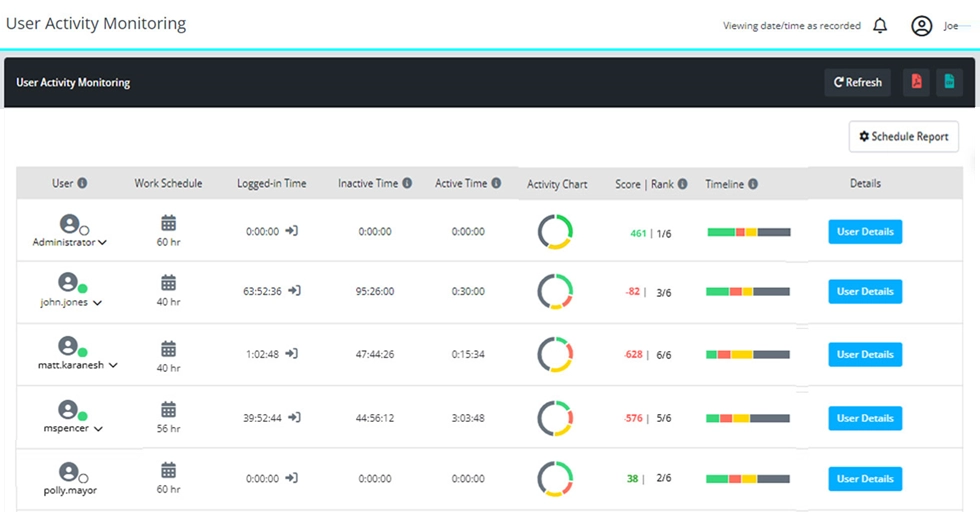
Teramind vs. Veriato: Feature by feature
Both tools cover the core monitoring checklist. The differences show up in depth and focus.Data loss prevention
Teramind leads on data loss prevention. It blocks specific file transfers, restricts USB usage, controls printing, and fires real-time triggers when someone moves or prints sensitive data. This is native, policy-driven DLP built for stopping data exfiltration as it happens. Veriato's DLP is lighter and leans toward visibility and investigation. It tracks file activity and adds automatic PII and PHI identification with redaction, which helps in regulated environments. If preventing data loss in real time is your primary goal, Teramind has the stronger toolkit.Behavioral analytics and risk scoring
Veriato leads on behavioral analytics. Veriato IRM uses generative-AI risk scoring across more than 130 behavioral data points and builds AI-driven baselines to predict which users or groups are becoming a risk. Its NLP sentiment analysis reads communications to flag disengagement and alerts managers early. Teramind also analyzes behavior, but through machine learning rules rather than a generative AI scoring engine. Its behavior tooling is strong for policy enforcement. Veriato's is more specialized for ongoing behavioral risk prediction. Buyers whose main concern is early insider-threat detection tend to favor Veriato here.Monitoring vs. forensics
The clearest philosophical split is live monitoring versus investigation. Teramind is built for continuous, real-time visibility: watch a live desktop, replay a session, and enforce a rule the moment it breaks. Veriato captures similar data but centers its reporting on post-incident forensics and investigation management, giving investigators a case file to reconstruct what happened. This distinction matters for how your team will actually use the tool. Teramind fits security operations that want to intervene in the moment. Veriato fits teams that investigate after an alert or an incident.Screen and keystroke capture
Both tools capture screens and keystrokes in depth, and this is where the compliance conversation starts. Teramind records live screens with session playback and logs keystrokes, including copy and paste. Veriato captures alert-based, continuous, and smart-camera screenshots and logs keystrokes down to concealed characters. The capability is nearly matched. The point for buyers is that both products store the actual content employees type and view. In a hospital, a bank, or a law office, that content can include patient records, account data, or privileged material, which is exactly what a compliance team does not want sitting in a monitoring archive.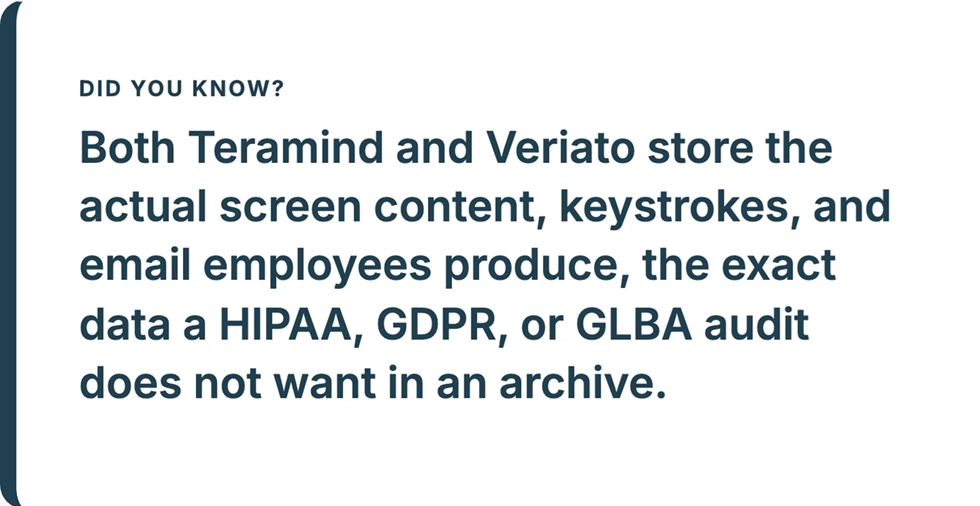
Email, web, and app monitoring
Both tools monitor email, websites, and applications. Teramind tracks web and app activity down to individual pages and monitors email traffic. Veriato monitors the same surfaces and adds NLP sentiment analysis on email in its IRM product, scoring the tone of communications for risk signals. For most buyers, this category is a tie on coverage. The difference is intent: Teramind is watching for policy violations; Veriato is scoring communications for behavioral risk.Deployment and resource footprint
Both tools deploy in the cloud or on-premise, so infrastructure choice is not a deciding factor. Resource footprint can be. Veriato reviewers repeatedly cite a heavy client, antivirus conflicts during agent updates, and difficulty pushing the agent to remote machines. Teramind's weight is less commonly flagged, but its setup complexity is. For IT teams rolling monitoring across hundreds or thousands of endpoints, agent weight and deployment friction are real costs. A lightweight agent installs faster, breaks less, and generates fewer support tickets.Ratings and reputation
Third-party ratings favor Teramind, though sample sizes are small. On Gartner Peer Insights, Teramind holds 4.2 stars and Veriato 2.8 stars, each based on only a handful of reviews. On G2, reviewers found Teramind easier to use, set up, and administer. Veriato's larger review pools skew lower and echo the deployment complaints above. Treat all of these as directional signals, not scores to bank on, given how few reviews drive them.Pricing: Teramind vs. Veriato
Pricing is where the two vendors diverge in transparency. Here is the verified picture as of July 2026.Veriato publishes its pricing
Veriato's pricing page lists its UAM monitoring product at $18 per user per month billed annually, with a minimum of 5 users. Its insider-risk product, Veriato IRM, carries a 20-user minimum and custom pricing. Veriato prices per user regardless of the number of devices.Teramind no longer publishes prices
As of July 2026, Teramind's pricing page shows no dollar figures and routes every plan to "Contact Sales" across its four tiers (Starter, UAM, DLP, and Enterprise). Independent review sites such as business.com peg the Starter tier at roughly $21 per seat per month billed annually with a 5-seat minimum and $30 to $35 per seat for the UAM and DLP tiers. Because these come from reviewers rather than Teramind directly, treat them as estimates and confirm with a quote. Both vendors use seat minimums and reward annual billing, so total cost climbs with headcount and tier. A 50-person team on a mid-tier is looking at a meaningful annual commitment with either tool, which is worth modeling before you shortlist.Which one should you choose?
The right pick depends on your primary job to be done. Choose Teramind if your priority is native, heavy-duty data loss prevention paired with live visual monitoring and granular endpoint control, and you have the staff to configure and manage a complex deployment. It is the stronger tool for security operations that want to intervene in real time. Choose Veriato if your priority is AI-driven behavioral risk scoring and structured insider-threat investigations, and you want a lower, published entry price. Its IRM product is purpose-built for predicting and reconstructing insider incidents. Reconsider both if content capture is a problem for your industry or your culture. If screenshots and keystroke content would put regulated data at risk, or if your workforce would revolt against continuous recording, the better move is a monitoring model that never captures that content in the first place.The non-invasive alternative: visibility without content capture
The entire Teramind vs. Veriato debate assumes you have to capture content to get visibility. You do not. This is the option the head-to-head comparisons leave out, and for many buyers it is the one that actually fits. WorkTime is non-invasive employee monitoring software that gives HR and IT leaders productivity analytics and full remote-workforce visibility without screenshots, keystroke-content logging, screen recording, or email and chat capture. It tracks productivity scores, active and idle time, attendance, application and website usage, distraction levels, and burnout signals.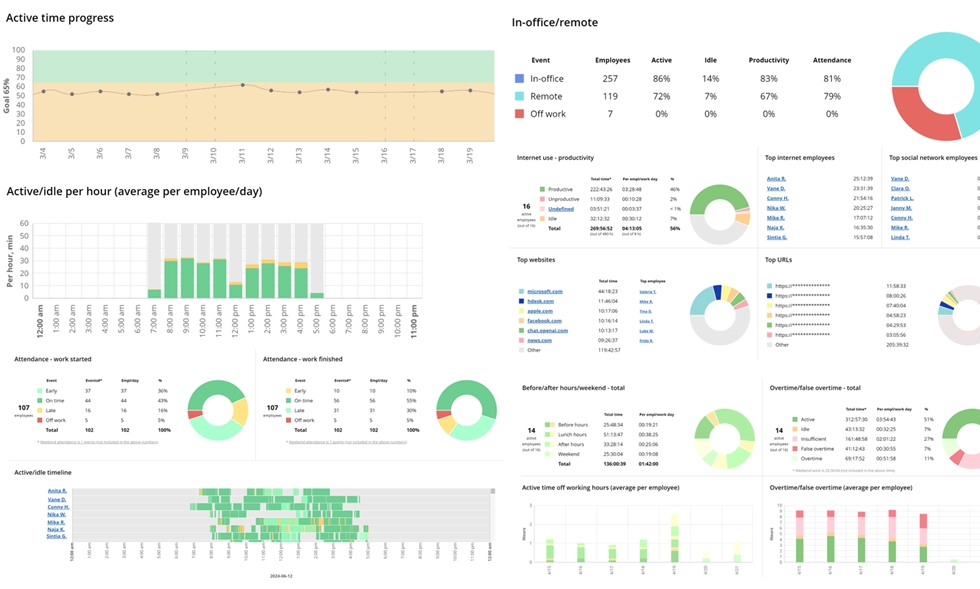


Gain deeper workforce insights with 80+ comprehensive reports covering productivity, attendance, engagement, and more.
Start free trialCompliance
Because WorkTime does not capture screen content, keystrokes, or messages, there is no sensitive data to leak or subpoena, which is the opposite of the content archives Teramind and Veriato accumulate. For regulated buyers, our HIPAA-safe mode plus GDPR-safe and GLBA-safe modes ship with the Enterprise plan, covering the service. A healthcare, finance, or government team gets the monitoring signal without a vault of protected data to defend.


Employee trust
Continuous surveillance carries a measurable human cost. Among U.S. workers, those who are monitored are more likely to say their work environment harms their mental health, at 45% versus 29% for those who are not monitored, according to the American Psychological Association's Work in America survey. Non-invasive monitoring gives you the accountability without triggering the backlash and turnover that content capture invites.Resource footprint
WorkTime runs on the lightest agent among the competitors we benchmarked. Independently, a heavy client is one of the most common complaints reviewers raise about Veriato, which is the kind of deployment cost a lighter agent avoids. The contrast with screenshot-based tools is stark: WorkTime generates a productivity report in about 5 minutes versus 5 days and needs 0 GB of local storage versus 9.5 GB for screenshot archives. Our performance comparison shows the full benchmark, and the same non-invasive approach powers our remote-workforce visibility across hybrid teams.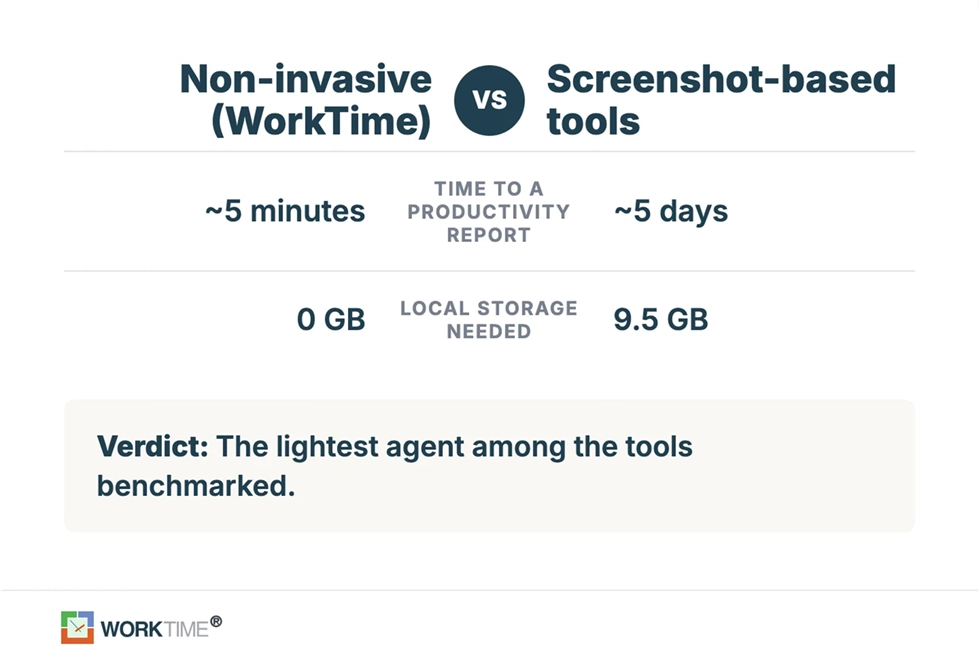
How to choose an employee monitoring tool
Employee monitoring is now near-universal: about 81% of U.S. companies run some form of employee tracking software, according to Owl Labs' State of Hybrid Work report. That makes the choice of tool more consequential, not less. Before you commit to any platform, work through five questions in order. They surface the real fit faster than a feature checklist.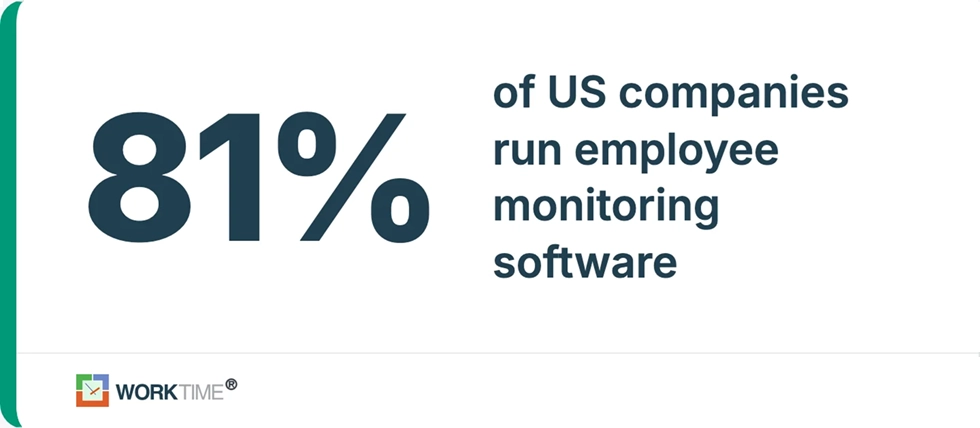
1. What is the actual goal?
Be specific. Real-time data loss prevention, insider-threat investigation, and everyday productivity or attendance visibility are three different jobs.2. What can your compliance team live with?
Decide up front whether capturing screen content, keystrokes, and messages is acceptable in your industry. In regulated environments, metadata-only monitoring is often the only model that clears review.3. How large is your remote footprint?
Count the endpoints and factor in agent weight and deployment friction. A heavy client that fights antivirus tools becomes an ongoing IT cost across hundreds of machines.4. Will employees accept it?
Monitoring that feels like surveillance drives disengagement and turnover and pushes people to work around the tool, which corrupts your data. Trust is a feature.The bottom line
Teramind and Veriato are both capable platforms that answer different questions. Teramind wins on native data loss prevention and live, granular monitoring for security teams that want real-time control. Veriato wins on AI behavioral risk scoring and insider-threat investigations at a lower, published entry price. The catch is the one both tools share: they capture screen content, keystrokes, and email, which is a real liability in regulated industries and a real risk to employee trust. That is why the choice is wider than these two names. If your goal is productivity and remote-workforce visibility rather than deep surveillance, WorkTime delivers non-invasive employee monitoring that regulated teams can adopt without storing sensitive content, backed by more than 26 years of doing monitoring the ethical way.