
TL;DR
- Judge purpose, scope, and use. A monitoring method can be excessive even when it captures activity rather than content.
- Content capture adds exposure. Screens, messages, typed text, and recordings can include sensitive information about workers, customers, and third parties.
- Check legal obligations before collection. The US Wiretap Act has specific exceptions, while state notice and privacy rules add separate requirements.
- Use the least intrusive useful signal. Limit who can see the data, how detailed it is, how long you keep it, and which decisions it supports.
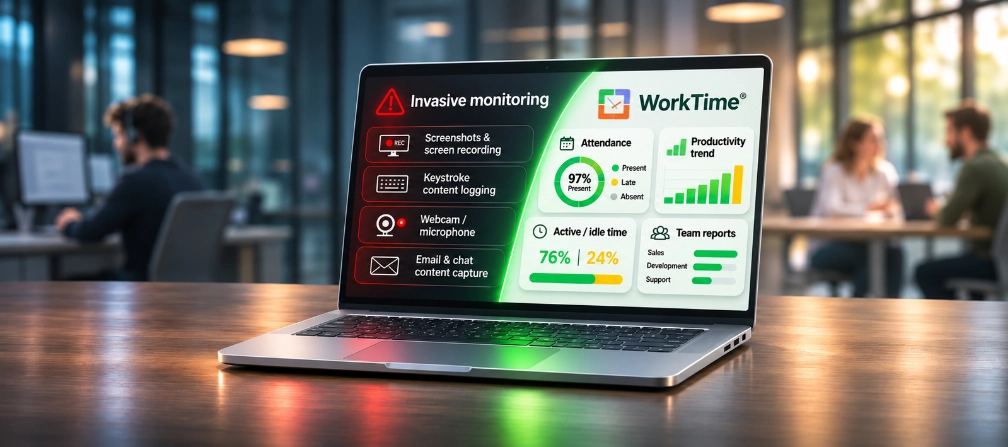
- WorkTime provides a non-invasive collection method. Its productivity analytics do not capture screenshots, keystroke content, screen recordings, or email/chat bodies.
In this article
Presented by WorkTime
WorkTime helps organizations build trust and improve performance through transparent, non-invasive employee monitoring and in-depth analytics.
What counts as invasive employee monitoring?
Employee monitoring becomes invasive when its collection or use is disproportionate to the work question it is meant to answer. Content capture deserves particular care because it can collect private communications and sensitive third-party data. The same necessity test also applies to activity logs, attendance, and other identifiable worker data.
- Screen recording and screenshots: continuous or interval capture of everything visible on an employee's screen, including documents and third-party data they did not choose to share.
- Keystroke-content logging: recording the actual text a person types, which can include passwords, private messages, and sensitive information. This is different from counting keystrokes as an activity signal.
- Webcam and microphone recording: always-on camera or audio capture, the most intrusive form and the one that draws the sharpest backlash when it reaches into a home office.
- Email and chat content capture: reading the bodies of messages, which also pulls in the data of customers and outside parties who never agreed to be monitored.
- Covert or hidden tracking: any of the above installed without the employee's knowledge.list
| Data collected | Example | Privacy risk profile |
|---|---|---|
|
Screen recording/screenshots |
Continuous capture of everything on screen |
High. Captures regulated data, passwords, and third-party information |
|
Keystroke-content logging |
Every character typed, including messages and credentials |
High. Captures private content and login details |
|
Webcam/microphone recording |
Always-on camera or audio |
Highest. Deep personal intrusion, strong home-office backlash |
|
Email/chat content capture |
Reading message bodies |
High. Captures personal and third-party content |
|
Activity metrics |
Active/idle time, app and website categories, attendance |
Avoids content capture, but identifiable activity still creates privacy, retention, and use obligations |
The risks of invasive monitoring
The risks of invasive monitoring fall into three buckets: legal and regulatory exposure, data-security liability, and damage to trust and retention. Each one can cost more than the monitoring was meant to save. What can go wrong when monitoring crosses the line? One company faced multiple lawsuits and over $100,000 in legal fees and settlements after employee screenshots displayed on a public office TV exposed private messages and sensitive information. Alongside the lawsuits, the company lost valuable team members. Explore more monitoring misuse cases here.Legal and regulatory exposure
Activity data can create privacy problems even without capturing message or screen content. France's regulator originally fined Amazon France Logistique €32 million over warehouse-worker monitoring. In December 2025, the Conseil d'État reduced the fine to €15 million, reversing some findings about the legality of activity indicators while upholding data-minimization findings concerning the detailed data retained for 31 days. The case shows why purpose, granularity, and retention belong in the decision alongside the type of data collected.Data security liability
Screens, keystrokes, and messages routinely contain protected health information, financial records, passwords, and customer data. Capturing and storing all of that turns a monitoring tool into a high-value breach target and a compliance problem. The more sensitive content a system holds, the larger the liability if it leaks, which is why data handling, access controls, and retention limits belong in any monitoring decision.Trust and reporting burden
In Zety's 2025 survey of 1,000 US workers, about one in nine respondents said they had quit a job because of extreme accountability or monitoring. The study covered practices such as reporting requirements and check-ins, not just tools that capture content. A Visier survey of 1,000 US full-time employees in February 2023 found 43% reported more than 10 hours a week of performative work. These findings are reasons to ask how workers experience oversight; they do not establish that one collection method caused the reported outcomes.Is invasive employee monitoring legal?
Monitoring obligations depend on the data, method, worker location, and intended use. Company ownership of a device does not settle every requirement. The examples below are general information, not legal advice; have the proposed program reviewed for the places where your workers are based.United States (federal)
The Wiretap Act, 18 USC 2511, restricts interception of wire, oral, and electronic communications. It includes specific exceptions, such as qualifying prior consent and limited activities necessary for a service provider to provide its service or protect its rights or property. A general business reason is not blanket permission to intercept communications. The method, communication, facts, and applicable state rules need to be assessed before monitoring begins.
New York notice requirements
Civil Rights Law §52-c requires covered private employers to give written or electronic notice on hiring to employees subject to the listed electronic monitoring, obtain written or electronic acknowledgment, and post notice conspicuously. The Attorney General can enforce penalties of up to $500 for the first offense, $1,000 for the second, and $3,000 for subsequent offenses. The statute defines its scope and includes an exception for certain system-maintenance and protection processes.California employee data
The CCPA's employee-data exemption expired January 1, 2023. Qualifying California employees have CCPA rights when their information is handled by a covered business, subject to the law's conditions and exceptions. Activity information can still be personal information when it identifies or relates to a worker. Other state and national rules may add notice, consent, data protection, or employee rights requirements. Have the proposed collection and use reviewed for each place where workers are based. For more guidance, explore WorkTime's articles on employee monitoring laws in different countries and our practical guides to creating employee monitoring policies.The benefits side: when monitoring is legitimate
Monitoring can serve a legitimate operational purpose, but usefulness alone does not settle whether a particular collection method is appropriate. Start with the decision you need to make, then ask whether a less intrusive signal can answer it. Attendance, workload, and software-use questions often do not require access to messages or screen contents.
- Security and compliance: provide relevant evidence for a defined control or investigation, using monitoring tools suited to that purpose.
- Workload and capacity: seeing where teams are overloaded or underused so work can be rebalanced before burnout sets in.
- Attendance and remote visibility: confirming coverage and comparing remote and in-office patterns without watching individuals.
- Resource and cost control: identifying unused software licenses and recurring waste.
Productivity increased from 40% to 95%!
Industry
Telecommu- nications
Country
South Africa
Employees
20+
WorkTime helped this telecommunications company improve employee engagement, align team KPIs, and achieve a major productivity boost.
Read more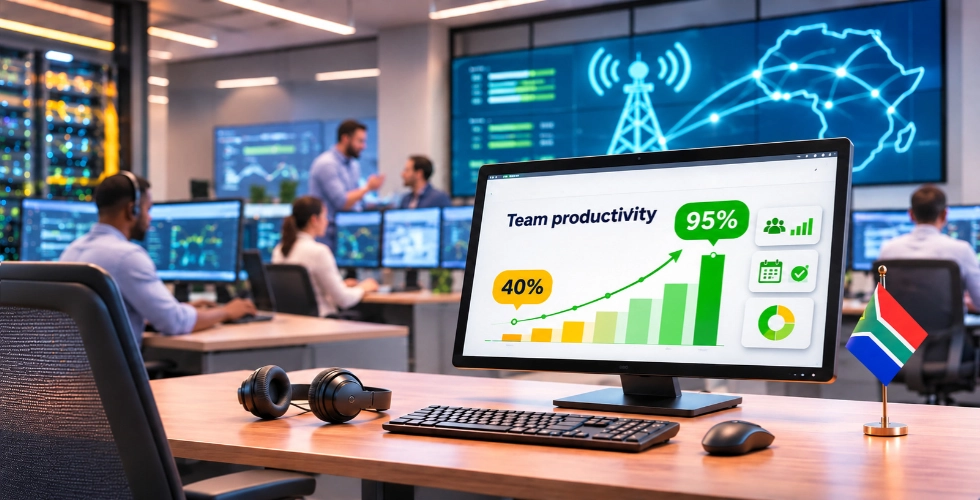
Where's the line? How to monitor without being invasive
For every monitoring proposal, check transparency, the applicable legal basis and notice or consent requirements, proportionality, and whether a less intrusive method will answer the question. Review retention, access, and the use of results as part of that assessment. Completing a checklist does not replace the legal and employee review your organization needs.- Transparency: tell employees what is monitored, how, and why. Covert monitoring is what triggers grievances, bad press, and legal risk. Our guide to implementing monitoring without losing employee trust covers how to introduce it well.
- Legal basis and notice: identify the applicable legal requirements before collection. Meet the relevant notice and acknowledgment rules, and assess whether consent or another legal basis applies; notice and consent are not interchangeable.
- Proportionality: match the data you collect to a specific, stated business need. If you cannot name the need, you do not have a basis to collect the data.
- Least intrusive method: when two methods answer the same question, choose the one that collects less. An activity metric that shows a workload problem is better than a screen recording that also exposes everything else on the screen.
- What specific question does this data answer?
- Is there a less intrusive signal that answers the same question?
- Does it identify a worker or reveal personal, sensitive, customer, or third-party information?
- How long will it be kept, who can see it, and when is it deleted?
- Would you be comfortable explaining this collection to the people it affects?
Monitoring productivity without capturing content
At WorkTime, we have built non-invasive employee monitoring software since 1998, used by more than 9,500 organizations to measure productivity without capturing personal content. WorkTime is a working example of the activity-based path described above: we monitor productivity scores, active and idle time, attendance, app and website usage, and burnout signals, while, by design, WorkTime does not take screenshots, log keystroke content, record screens, or capture email and chat.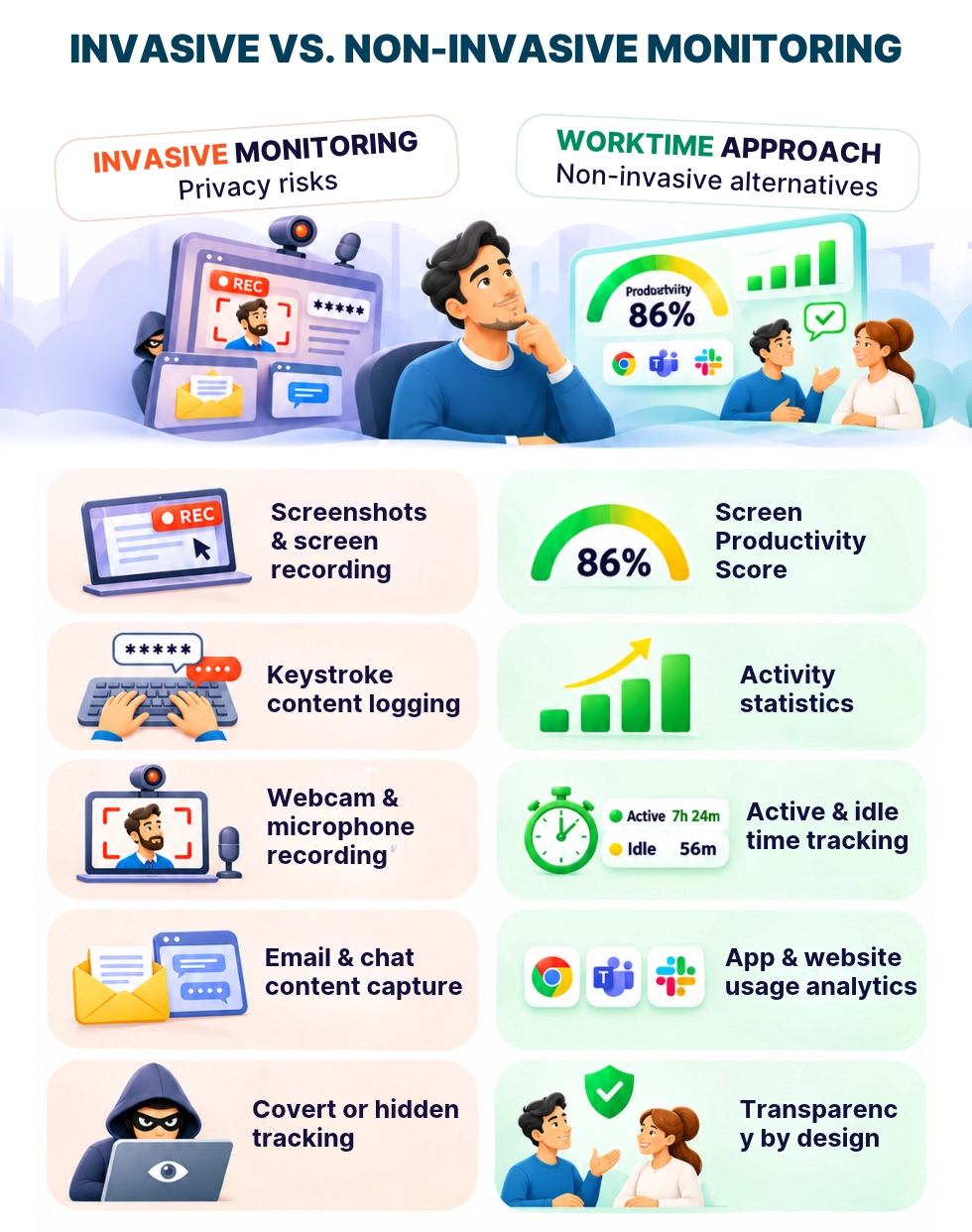
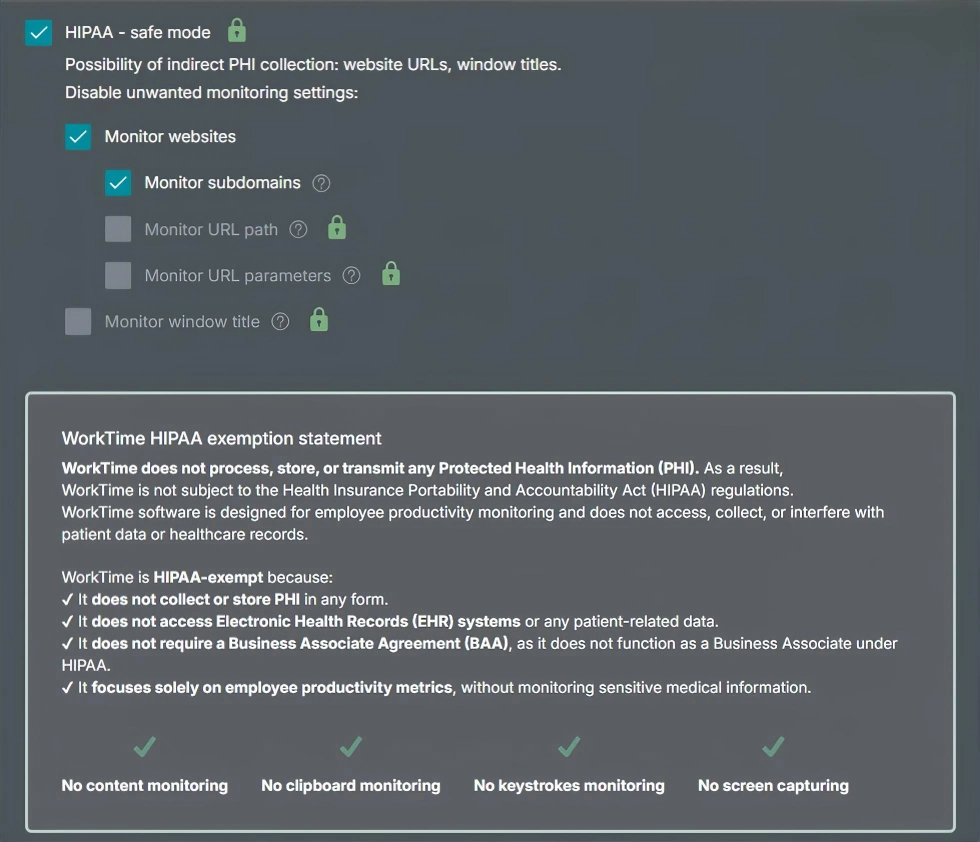

HIPAA-safe mode reinforces WorkTime’s privacy-first approach by eliminating even an indirect collection of potentially sensitive healthcare data.
Start free trialConclusion
The boundary is whether collection and use fit a defined business purpose. Content capture adds exposure, and activity metrics still require care over detail, retention, access, and interpretation. Start with the decision you need to make and collect only the evidence needed to support it. WorkTime combines non-invasive productivity analytics, attendance, and remote-team visibility without screenshots, keystroke content, screen recordings, or email/chat capture. Its collection limits help buyers assess one part of the monitoring decision alongside their policies and legal obligations. Try WorkTime free for 14 days or book a demo to see what the reports measure.